New Blackmagic Camera July 16th?

John - did you notice a need for an IR Cut in front of the sensor or was it good enough for you? I know you are rocking Rawlite filters in front of your G2s.

IR filtering is still being tweaked. My comments wouldn’t mean much because I had a prototype camera that had a different IR filter than what will ship so that’s a bit difficult to draw conclusions from.

I used all internal ND’s on my shoot. There was also a calibration difference with my camera that wasn’t picked up till recently. Most of the RAW files are shot at the default WB of 5600K +10, which is the “standard” BMD daylight default.

BUT

When you start to go into he RAW tab you’ll find it’s really about -500K to -1000K (Less warm) and -5 to -10 tint (less magenta)

I didn’t change these on my initial clips, but I have on these ones...

https://vimeo.com/440479199

Which also by the way show the 8K and 4K modes :-)

JB
 
Since BMCUser became pretty much unusable and dead, and on most other boards became a kindergarden s*%tshow after the release of the 12K,
this is one of the last places where on can have a mature discussion.

So yeah, glad I'm back home :-)

Seems like it's been forever Frank. Welcome back, good to see some people from the past here. For the most part, we still have good discussions here.
 
I've been trying to figure out what it is about the footage from this camera that seems special. We've all seen higher resolution video downsized, extremely sharp lenses, etc., so I was trying to figure out what it is specifically about the sensor that is contributing to the uniqueness of the image. I believe I have it figured out.

This is the first time we have a pure black and white capture being used as the luma in a color image.

This sensor is not only 12K, it's also an 8.5K purely monochrome sensor.

We know from their patent that Blackmagic is using a checkerboard pattern for the clear sensor elements. So, those clear photosites are now in the same pattern that Green photosites would otherwise be on a Bayer pattern sensor.

So, the math to figure out the basic minimum luma resolution is the same as Bayer. This is an 79.6 megapixel sensor, so there are 39.8 megapixels worth of clear photosites, which is just about 8.5K. (8.5K 17:9 would be 8704x4608 which is 40.1 MP. 8K 17:9 is only 35.4 MP.)

This is huge. This sensor gives the benefits of both color and monochrome sensors.

All image subsampling that we use is based on the idea that the human brain responds to luma resolution more than chroma resolution. This is the first color sensor in a cinema camera that also gives us unfiltered luma - more of what we respond to.

Virtually all the digital color images, moving or not, that we have seen since the dawning of the technology have had their luminance filtered, mainly by green.

We are seeing a pure unfiltered luminance combined with a high chrominance for the first time and it looks special.

It's as if a giant green filter was removed from our field of view.

And 8.5K is the bare minimum of luma resolution. Since this is in a Bayer type pattern for luma, the same benefits should apply. Most people (including Graeme Nattress of Red: https://www.premiumbeat.com/blog/exclusive-interview-reds-sensors-resolution/) estimate the true luma resolution of Bayer to be 80% of the total resolution. If that held true for this, then we would be closer to a 9.6K monochrome sensor.

And, on top of all of this, the clear photosites are most likely capturing more chrominance resolution than a Bayer pattern would, because, as I posted earlier, you can use subtraction from the nearby photosites to work out the color that the clear photosite is capturing. If that is the case, chrominance resolution is increased because the clear photosite is contributing double or triple the color information than a filtered photosite would. And, in general, the filtered Red and Blue photosites are in a ratio to green that is 33% more than they would be on a Bayer pattern. The bottom line is that there should also be more chrominance resolution than there would be in an equivalent 12K Bayer.

This sensor is truly something special.
 
Maybe it's because it is somewhat similar to the cones and rods in our eyes.

Rods are responsible for vision at low light levels (scotopic vision). They do not mediate color vision, and have a low spatial acuity.
Cones are active at higher light levels (photopic vision), are capable of color vision and are responsible for high spatial acuity.

After seeing Johns footage (and picking up my jaw from the floor) I was convinced, that this new sensor approach has an enormous potential.
Most folks got into this "who needs 12K" rant, without even realizing what it means, and how it all works together with BRAW.

Also, when you control the whole chain - from acquisition (even on sensor level), to codec and a complete post production solution at the end,
you also have 100% control of your images, since everything works perfectly hand in hand.
 
This new sensor tech is pretty cool, but I keep reading how 12K is the natural result of the new sensor pattern. Does this mean that we will never see a cheaper 8K or 6K S35 camera using this tech? I would love to see this new sensor tech make its way into an UMPG3 without a major price increase.
 
They were making this for the new camera. Im sure it will trickle down. Who knows where it or how it will wind up. Maybe and 8k thank can do 6k, and a 6 k that can do 4k. Or cameras just 8,6,&4k cameras. This stuff is owned by bmd so they can do anything they was.

Starman55
 
Possibly wouldn't be enough color information with so many pixels dedicated to luminance only.

Possibly. But I wager at the least it would provide enough color info for an HD deliverable. Is there an absolute minimum pixels needed for this implementation? Aren't we just dealing with ratios of capture pixels to deliverable pixels?
 
You need 12K to get full raster 4K RGB color information - without any interpolating - out of it.
Actually it's a bit more complicated (when you look at the patents) and the luminance photosites are also playing into it, but you get the idea.

So yeah, it would be possible to make a sensor with less resolution to get full raster HD, but HD is pretty much dead in acquisition.
 
Possibly wouldn't be enough color information with so many pixels dedicated to luminance only.

If you looked solely at the Red and Blue photosites, ignoring the clear photosites and ignoring the size of the photosites on this sensor, this sensor would have 1/3 less chrominance than an equivalent Bayer pattern. That is because this sensor is only capturing 1/6 Red and Blue, whereas a Bayer patter sensor is able to capture 1/4 Red and Blue.

However, this sensor actually has the ability to wring more chrominance resolution out of it than an equivalent Bayer pattern sensor. It has to do with the size of the photosites and it has to do with the clear photosites capturing more photons (and more data) than a filtered sensor.

Looking at the size of the photosites, the closest competitor to this sensor is probably the Red Helium, which does 8K in a slightly larger version of Super 35mm (33.8mm on the Helium vs 30.56mm on the Blackmagic - which also means more lenses will cover the Blackmagic).

At 8K on the Helium, at the bare minimum (ignoring high quality debayering) 1/4 of the photosites are going to Red and 1/4 are going to Blue. So for an 8K 17:9 sensor, that would be 8192 x 4320 = 35.4 MP total. Dividing that by 4 = 8.8 MP. That is 4K worth of Red and Blue.

if you look at this sensor, at the bare minimum (ignoring the clear photosites and high quality demosaicing) 1/6 are going to Red and 1/6 are going to Blue. So for 12K 17:9, that would be 12288 x 6480 = 79.6 MP total. Dividing that by 6 = 13.3 MP. That is actually just a hair under 5K worth of Red and Blue.

So, ignoring the clear photosites, this 12K sensor has about 50% more chrominance resolution per channel than an 8K bayer sensor does (13.3MP/8.8MP = 1.51).

By cramming in more pixels per area, we get better total resolution, including chrominance resolution.

And this would absolutely carry over to a smaller crop of the sensor. Where is an 8K sensor that would be covered by MFT lenses? No where except here.
 
On top of the size of the photosites, the clear photosites have the ability to play a huge role in increasing the amount of chrominance data.

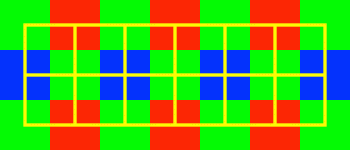
Very basically, pixels from Bayer look like this:

6x2Bayer.gif


If you look inside the yellow lines, you can see that each pixel is capturing 1/4 of each of the surrounding photosites to make a total pixel. (And, incidentally also see why you need extra photosites outside of the pixel area.)

So, to determine exactly how much of each color we are capturing in total in this 6 pixel by 2 pixel area, we can simply add all the 1/4 portions up.

Green = 24 quarters or 6 total photosites (24/4)
Red = 12 quarters or 3 total photosites (12/4)
Blue = 12 quarters or 3 total photosites (12/4)

And this makes sense - we have 12 total pixels in this tiny area and we know that half the photosites would be Green (6 total) and one quarter would be red and blue (3 total for each).

Makes sense?

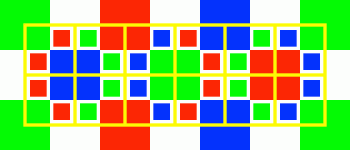
So, now let's look at the same size area on the Blackmagic sensor.

6x2Blackmagic.gif


As I mentioned before, you can use the surrounding colors to subtract from white to determine the color information that the clear pixels are capturing. (You can, once again, read more info here: http://image-sensors-world.blogspot.com/2013/07/aptina-explains-clarity-technology.html)

Looking at the above image, you can see that the white photosites border two other colors, and you could subtract the two colors from white to get the third color.

So, for instance, in the first pixel, the corners of the white photosites that meet the corners of the green and blue photosites could become 1/4 red photosites by subtracting green and blue from it. (And I kept a white border around those 1/4 portions of calculated color to help distinguish them.)

In this case, if we added up the 1/4 portions we get this:

Green = 16 quarters or 4 total photosites (16/4)
Red = 16 quarters or 4 total photosites (16/4)
Blue = 16 quarters or 4 total photosites (16/4)

So that means that Red and Blue are each getting an extra photosite than they would with Bayer, or 33% more information each.

Extrapolating that to the full sensor would mean that we would actually be getting 33% more chrominance than we would with a 12K Bayer sensor

So, 79.6MP / 4 = 19.9MP x 1.333 = 26.5MP of total chrominance resolution.

26.5MP is just about 7K worth of chrominance resolution.

On top of that, this demosaicing we are doing here is rudimentary. The actual math would be looking several photosites away in every direction.

Modern demosaicing gets about 10-15% better resolution than you would otherwise expect, so it's not a big leap to say we could be getting approximately 8K worth of chrominance with this subtractive approach.

I can't say for certain if Blackmagic is using this approach, but if you look at section 99-100 of the patent, they describe how they determine the chrominance of white pixels by using a given kernel (a type of matrix) that includes subtraction of nearby photosites. I need to double check the math to know for sure, but that is where you can find it.
 
Last edited:
What I'm hearing is that a 6K BM sensor of this arrangement could resolve "4K worth of crominance" and make me happy.

Do it S35 with bigger pixels + dual ISO and you've for yourself a monster low-light Pocket 6K for 4K deliverable
 
Back
Top