New Blackmagic Camera July 16th?

No link above but I think this was the "Why I Bought six UMP12k," basically 10 minutes of unboxing drivel with 30 seconds of useless video, finally getting around to answering the question of why he bought six UMP12k, which I didn't stick around for the answer. Thank heaven for the skip button, and I'm not posting the link either.
Yeah, was just surprised by the jump from the camera they were using, then to the BM12K. had some funkiness. I think these uncontrolled situations tend to give one side to the equation though. Like I can make a Red look good, but its default look is not my favourite.

in any case, I am certain they can make it look good, as others have done. It seems like we are all ok with saying Sony, Panasonic, and Red have bad default looks. Not every camera is perfect all the time. Still requires quite a bit of skill from the operator to make a good looking image for any camera.
 
I’ve actually blocked that poster so I didn’t see the comment.

I offer this though as an example of “ungraded” straight from camera.

Shot using Zeiss CP’s (2/3) and not even edited. It’s in the order that I shot it.

There’s NO GRADE here, other than the “extended video” look applied in camera / Resolve. So “straight from camera”

12K Q1 extended video.

https://vimeo.com/459834673

JB

The image I posted was a worst case scenario. I was just surprised in the jump from the camera they were shooting the unboxing with, and then the jump to the BM12K footage had some funkiness going on in the blacks. It is also visible in several other BM12K videos. That does not mean that the camera cannot provide beautiful images to a skilled operator. Also, there isn't another 12K cinema camera out there for $10K. I think BM has a pretty good thing on their hands.
 
Thought I'd post this here too.
Here are some stills from the Ursa Mini Pro 12K. Shots with people in them coming at a later time.
I'm extremely impressed with the details and colors that you can get from this camera.
I think the team at BMD has achieved something really special.

Both shot with the Sigma 18-35mm.
Check out the links for better quality versions.

Ursa Mini Pro 12K by Note S., on Flickr

Ursa Mini Pro 12K by Note S., on Flickr

^^^^^ These are still some of my favourite images ever posted on all of Dvxuser, from any camera.

Swaneon did an amazing job capturing this moment in time, with having a keen eye for some gorgeous colours and composition. (Swaneon, I want a print of this!)

The camera was able to record the visual data that was necessary, but for the most part, cameras are passive instruments in many ways. Like a spoon works for what it is made for, but without a person involved, it is just a piece of metal. Also, cameras have limits and quirks. We as users find them and either decide the tool is not for us, or we learn to work with them.

For example, the Gemini sensor skews a little rosy sometimes, and if you dig deep enough into the shadows, it even gets a little magenta. Annoying defect? Yeah. But also an opportunity to exploit, as that rosiness can work really well with skintones. On the other hand, with some skill, one can completely avoid the colour shift with some experience.

does an Alexa look weak sauce at iso2500? yeah, it looks horrible. Can it be worked around? Is it the end of the world limitation?

So, the BM12K has some small issues, they might fix it, but in the meantime, it is not preventing people from making good images.
 
Last edited:

A fun watch, and less a camera review. So, only watch if you have 15min to throw away. haha.
 
Last edited:
No link above but I think this was the "Why I Bought six UMP12k," basically 10 minutes of unboxing drivel with 30 seconds of useless video, finally getting around to answering the question of why he bought six UMP12k, which I didn't stick around for the answer. Thank heaven for the skip button, and I'm not posting the link either.

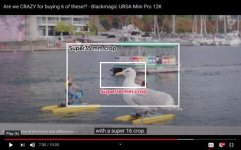
you missed them arbitrarily adding crop marks to the ursa...

Screen Shot 2020-10-18 at 5.59.55 PM.jpg
 
I can’t be the only one who thinks these Canon cameras have video-ish motion, can I? To me the Canons’ 24p looks like 30p or 60 fields-per-second on other cameras. They have a very smooth motion look to them. Even my layman girlfriend thinks they look soap opera-ish when compared to other mid to high end cameras. The colors are great, the screen grabs look wonderful, but that motion just sticks out like a sore thumb for me personally.
 
Last edited:
I can’t be the only one who thinks these Canon cameras have video-ish motion, can I? To me the Canons’ 24p looks like 30p or 60 fields-per-second on other cameras. They have a very smooth motion look to them. Even my layman girlfriend thinks they look soap opera-ish when compared to other mid to high end cameras. The colors are great, the screen grabs look wonderful, but that motion just sticks out like a sore thumb for me personally.

I agree. But I am uncertain whether it is the motion, or if it is the default colours and contrast. It looks nice, but yeah, more video straight out the gate.

Would be interesting to do a motion cadence analysis. I'm trying to think why one CMOS camera might capture motion differently enough to make that big a difference?
 
Would be interesting to do a motion cadence analysis. I'm trying to think why one CMOS camera might capture motion differently enough to make that big a difference?

I wish I knew the answer to that. I do know 24p does not looks the same across the board, every camera's 24p has its own unique look.

I work primarily as an editor for sports, and we often throw a 24p look onto 59.94 video to make it look more cinematic. Some people can't see the difference but the boss-man can, and if something airs without the '24p look' he'll let us know. We achieve this using Avid's motion effect editor. If anyone tweaks those settings slightly then the 24p look disappears entirely. Perhaps the mojo behind the CMOS sensor does something similar to create the look of the motion, and one little tweak can throw the motion off. I don't know though.
 
Point being, any camera can moire, even with an OLPF.

I am almost certain that that is not entirely true. If we were dealing with Foveon pixels, combined with a properly designed OLPF, there should be no moire at all, as the OLPF would blur every frequency above what the sensor could capture into non-aliasing mush. We are not dealing with Foveon pixels here, though.


--------


I just did a deep dive into the math and, unfortunately, all chroma subsampled sensors (Bayer, Blackmagic 12K) will produce moire, even with an OLPF, since the OLPF is going to be working at a luminance (per pixel) level, not a chroma level. So there is going to be color moire, which you can see explained here: https://www.imatest.com/docs/log_f/


But keep reading, because there is a solution.


The physics of light means that smaller pixel sizes will make higher resolutions harder to obtain, because you are going to be diffraction limited at smaller f stops. (Also, and this is wild to me, an Airy disk produces the same diffraction pattern as the double-slit experiment does in quantum physics.) So, that means that the other side of moire is diffraction. You can decrease the amount of overall resolution by stopping down further than what the pixels can capture.


The math for diffraction encompasses one of the most elegant equations I have run across regarding optics. And that is the equation for the diameter of the central brightness of the Airy Disk (which is the focused point of light). The math is simply 2.44, multiplied by the f stop, multiplied by the nanometer of the wavelength of light. 2.44 and the f stop is a ratio, so you are left with a unit of measurement - nanometers, which means all of this adds up to an actual measurement in fractional meters.


For instance, green light is often used as an average for light falling on a sensor, since it falls between the ultraviolet and infrared spectrum limits that the camera stops capturing at. Assuming a camera that begins to image at 400nm and ends at 700nm (not always the case), this puts the middle at 550nm. So that equation means that for 550nm at, say, f2.8, you have 2.44*2.8*550nm, which puts the point of light at 3.76um in diameter. How beautiful and simple is that.


On this sensor, since the photosite size is 2.2um, at what f stop will the central portion of the Airy Disk fill it? At what f stop is the maximum resolution reached? The math would be 2.2 = 2.44*X*550nm, where X = f stop. Solving for that means that f1.64 is the limit - after that, the points of light start overlapping themselves, spilling into multiple photosites.


But, we can still make out those points of light until they completely overlap. So, where would that exactly be? Different calculators online have different ratios. One uses between 2 and 3 pixel (photosite) widths. Another sets it exactly at 2.5. Now, this might have been true at some point using older optics and sensors, but currently these numbers aren't entirely accurate.


--------


One way to refine how the Airy Disk is captured is by looking at the total amount of photons in the Airy Disk in a given circle, which is known as Encircled Energy: https://en.wikipedia.org/wiki/Encircled_energy. Since we are dealing with square pixels, though, we need to look at the total amount of photons in a given square, which is known as Ensquared Energy (which sounds like the name of a protein bar.)


Ensquared Energy is very close to Encircled Energy:https://imagebank.osa.org/getImage.xqy?img=LmxhcmdlLGFvLTU0LTI1LTc1MjUtZzAwNQ . I did a very rough calculation to figure out at what factor does Ensquared equal Encircled for the central portion of the Airy Disk and ended up at (2*3.35)/pi = 2.13, which is a little narrower than 2.44.


For the 12K sensor, that makes the math 2.2 = 2.13*X*550nm - which puts f1.88 as the limit before the main points of light start overlapping. But that's where they potentially start overlapping (it could happen sooner - there is about 16% more light outside of the central portion of the Airy Disk). So where does it actually start limiting resolution?


I realized that lens testing would see this. Photozone.de (AKA OpticalLimits.com) is a fantastic lens testing website that I like, mainly because they test bokeh, including longitudinal chromatic aberration. They have a number of tests on the A7RII, which is 42MP, has no OLPF, and has a photosite size that is 4.5um, which is very close to twice the size of the 12Ks 2.2um.


What do we see on that sensor? On almost every lens, diffraction starts to happen between f4 and f5.6:https://www.opticallimits.com/sonyalphaff/980-sonyfe50f18?start=1 . Put another way, peak performance on almost every lens is at f4. Check them all out here:https://www.opticallimits.com/Reviews/sonyalphaff


The math checks out as well: 2.13*550nm*4 = 4.67um, which is just bigger than the 4.5um of the photosite size. At f5.6, when we know for sure diffraction is kicking in, we would be at 2.13*550*5.6 = 6.56um. And using the 2.44 ratio (which all of the calculators I ran across use) at f5.6 gets = 7.52um, which is even bigger, but still much less than 2x the width of the photosite.


If we went by some of the online calculators, they would say that diffraction starts much later. This one, for instance, says that diffraction starts to be seen on the A7RII at f6.8 (2x photosite width) and then limits the maximum extinction resolution at f8.5:https://www.cambridgeincolour.com/tutorials/diffraction-photography-2.htm (plug in 42.4 mp for full frame on the calculator.) I think they may have neglected encircled energy - looking at the Airy Disk more in 3D, rather than 2D, as things start mushing together much sooner than 2x of the photosite width. At f5.6 on the A7RII, 7.52um is about 1.67 photosites wide. Using my ensquared energy number of 2.13 puts it at about a 1.5 photosite width.


--------


Going back to the 12K sensor, the ratio scales between it and the A7RII (4.5/2.2) giving a 2.05 stop difference between the two, which means that the sharpest you are going to get on the 12K sensor is going to be somewhere around f1.8-f2. This explains the difference in moire that people are seeing. If you stop down beyond about f2, you will actually limit the resolution that the camera can capture, which will start to act like an OLPF and blur the image enough to suppress moire.


Unfortunately, as I mentioned earlier, on a chroma subsampled sensor, color moire happens even when the system is diffraction limited. But even that can still be suppressed. I ran across a test that was done on the Fuji GFX100, which has 3.76um photosites. The author wanted to see if diffraction would work as an OLPF:https://blog.kasson.com/gfx-100/a-visual-look-at-gfx-100-diffraction-blur/ . It does! At f5.6 on the GFX100, color moire begins to be suppressed, it is very suppressed at f8, and it is almost entirely gone at f11.


If the 12K had a Bayer Pattern Sensor, we could then scale those GFX100 results to the 12K. The math would be 3.76/2.2 or a 1.7 stop difference. So, that would mean, on the 12K, that at about f3.3, color moire would begin to be suppressed, then be very suppressed at about f4.7 and be almost entirely gone at about f6.4. However, since the 12K does not have a Bayer Pattern Sensor, and we don't know exactly what the pattern is, someone just needs to test it out with a Siemens Star or something similar, and actually see where color moire is suppressed.


The good news is that since this sensor has such small pixels, we should be able to suppress moire on it by simply stopping down until it goes away. It is quite a counter-intuitive method, but everything says it should work. It just needs to be tested.
 
Last edited:
Interesting analysis, Joshua. Perhaps the implication is that JB might typically use a fatter stop than the moire sufferers?

Relying on diffraction to suppress moire would seem to defeat the purpose of having such a high-resolution sensor. Though perhaps an OLPF does as well.

At any rate, the matter is probably best settled as most lens/camera issues are - by testing and seeing if you're happy with the outcome and the gestalt.
 
Cadmium, i think i lost hair reading that, but sheesh, that was exhilerating!


It is also interesting that the Armondo’s and Epic Light test, was that they were using a F1.4 and F2.8 range on their tests.


Do you think that since the 12K sensor can have a lower chroma subsample, that may actually moire more than a similarly spec’d bayer (pronounced ‘buyer’) colour array? Not saying that it isn’t easily mitigated though, and the extra pixel density will always have some unique properties. But adding enough dithering to prevent moire, would lower the light sensitivity and resolution to the point that there is little advantage over an 8K bayer sensor?

Was the pixel density an important part of the 12K design, or could it be an advantage to have gone LF with the sensor?

I would say until i see footage on an 8K screen, or perhaps work with VFX, most of the 12K s35 benefits i can only perceive in theory. For example, i am very interested in the grain pattern after chroma denoise. The non sharpened real detail look from the 12K is pretty awesome. Huge improvement over many of the malign HD and 4K Resolutions trying to prove to consumers that they were “look out the window” clear.

I don’t mind if an OLPF reduces resolution, as the extra chroma and luma sampling will still take place, making for some lovely tones and gradations. However if an olpf dithers enough light, does that effect the senstitivity? Or is that a non-issue.
 
Last edited:
Josh, it’s very accepted as far as I understand, that when calculating for an Airy disk you should use 2.5 times as the multiplier each time you make a conclusion which you often sort of skipped over a bit in your informative email.

It’s easily seen if you look at Geoff Boyle’s tests on CML, where he used a Cooke lens and found that resolution dramatically fell off at deeper stops. This happens for many reasons. Diffraction yes, but also lens designs are generally optomised for 1-2 stops from wide open

However. I feel like a broken record here. Resolution is but one metric of evaluating an image. Maybe not the best single one to focus on. I would posit GAMUT and BIT DEPTH are more important single biggest influences and yet resolution is what we all seem to chase.

So, as I said...

Any camera (well, the ones that we use commonly in cinema) can moire. With or without an OLPF.

OLPF’s dramatically reduce the chances of it happening. But don’t guarantee.

There’s also huge issues that using OLPF’s also bring into the equation but no one here wants to hear that either.....But it’s no magic bullet like it always seems to be talked about. Short version is...if they really did what was promised, then they would totally eliminate moire. They DO NOT. And they screw your image (potentially) in other ways that no one talks about.

The trend in photography for several years has been to not use OLPFs, especially on higher end cameras with higher resolution sensors. Leica back to the M8 did it. Camera companies used to be ashamed and sometimes not even list if the camera did or did not have an OLPF. Nowadays, it’s practically listed as a feature (no OLPF).

There are better techniques for post fixes of moire in imaging for stills that are much harder to do in moving images for sure. But the accepted wisdom is that OLPF’s aren’t the best way to deal with this problem, especially in higher end imaging.

Higher sensor resolution raises the threshold for when it’s likely to happen. (Moire)

And so.

Back to my conundrum. I haven’t been bitten by moire on the 12K. I’ve probably shot it more than anyone. In theory it SHOULD trigger far less easily than a G2. And yet there’s examples of it seeming to happen easily. So...it’s a mystery to me.

JB
 
Josh, it’s very accepted as far as I understand, that when calculating for an Airy disk you should use 2.5 times as the multiplier each time you make a conclusion which you often sort of skipped over a bit in your informative email.

So, I tried not to skip over it, by linking to an online calculator. But let's look at the math at 2.5 pixels (or photosites).

For the A7RII (which I am using because we have repeatable data on it) that would means that diffraction would start when the Airy Disk was this wide: 4.5um * 2.5 = 11.25um. So the accepted math for what f stop (X) equals a 11.25um Airy Disk would be: 11.25um = 550nm * X * 2.44 = f8.38. But, it's clear to see that diffraction started limiting resolution on lenses tested on the A7RII at f5.6 and most likely at a faster stop than that. At f8, you are really seeing the effects of diffraction, but where does it begin? I was trying to figure out where exactly diffraction does start, because while some say 2.5, others say more or less.

When the Airy Disks that a lens produces has a lot of aberrations in it, stopping down is going to improve resolution even when there is a little bit of diffraction.

But how about a diffraction limited lens? The Zeiss Batis 85mm f1.8 is a super sharp lens, similar to the Otus and appears to be diffraction limited on the A7RII sensor. Because of that, we should see diffraction start to limit resolution at where the Airy Disks start to overlap - a single pixel (photosite) width. The math puts it at f3.4 (550nm * 3.4 * 2.44 = 4.5um). So that means with a perfect lens on an A7RII, we should see the effects of diffraction at f3.4 and then more and more as we stop down. Looking at the resolution charts, that is exactly what was measured - resolution is starting to take a hit at f4: https://www.opticallimits.com/sonyalphaff/1032-zeissbatis85f18?start=1

So, you can use 2.5 or whatever ratio helps, but that number is not correct if you are trying to wring as much resolution out of the system as possible. It's a coarse number that tells us a point at which we are well within the limiting effects of diffraction. It may have been more helpful when we were dealing with lower megapixel sensors or film, and lower resolution lenses. The 2.5 ratio absolutely does not tell us where diffraction starts, though.

Think about it another way - the Airy Disk is what we are capturing. When the central portion of the Airy Disk (the point source of light) is the width of the photosite ("pixel") the photosite is capturing all the photons within that area. As soon as the Airy Disk gets any bigger, it is going to be breaching the walls of the photosite and sending its photons to other photosites. That is blurring - leading to a drop in resolution.

Now, since the Airy Disk looks similar to a Gaussian function, the edges can overlap a bit and not have a huge blurring effect - that's why there is a little wiggle room and the central portion of the Airy Disk can start to take up multiple photosite widths and not have a huge impact on resolution. But that impact is there and it is quantifiable.


It’s easily seen if you look at Geoff Boyle’s tests on CML, where he used a Cooke lens and found that resolution dramatically fell off at deeper stops. This happens for many reasons. Diffraction yes, but also lens designs are generally optomised for 1-2 stops from wide open

No, that is diffraction and proves my point. If the resolution didn't drop off like that, it would mean that the Airy Disk could get bigger and not have as deleterious of an effect on the resolution, but it, in fact, does. You can't escape the physics of it.


However. I feel like a broken record here. Resolution is but one metric of evaluating an image. Maybe not the best single one to focus on. I would posit GAMUT and BIT DEPTH are more important single biggest influences and yet resolution is what we all seem to chase.

Of course! I was merely trying to figure out why some were seeing moire and you weren't - and was trying to find the math for why. In the process, I saw visual evidence that you can simulate an OLPF by stopping down, which may be helpful when using this camera if you see moire. If it is not going away, stopping down may help - at least it does with Bayer Pattern sensors.


There’s also huge issues that using OLPF’s also bring into the equation but no one here wants to hear that either.....But it’s no magic bullet like it always seems to be talked about. Short version is...if they really did what was promised, then they would totally eliminate moire. They DO NOT. And they screw your image (potentially) in other ways that no one talks about.

The trend in photography for several years has been to not use OLPFs, especially on higher end cameras with higher resolution sensors. Leica back to the M8 did it. Camera companies used to be ashamed and sometimes not even list if the camera did or did not have an OLPF. Nowadays, it’s practically listed as a feature (no OLPF).

There are better techniques for post fixes of moire in imaging for stills that are much harder to do in moving images for sure. But the accepted wisdom is that OLPF’s aren’t the best way to deal with this problem, especially in higher end imaging.

I disagree, especially with moving pictures. As you said yourself, resolution is not the end all be all. But the risk from moire can be high. You can have shots rejected by QC because of moire and then need to reshoot. Moire should be avoided whenever possible. And the hit to resolution is low. One of the articles I posted previously was from an engineer that owns the Fuji GFX100, which is a $10,000 medium format camera that has a resolution of 11648 x 8736 and has small pixels. He strongly advocates using an OLFP in the path of the sensor because the hit to real resolution is low, but the hit to false resolution is very high and he has the math to back it up. Here is the article: https://blog.kasson.com/the-last-word/optical-low-pass-filters-and-the-fuji-gfx-50s-and-50r/


Back to my conundrum. I haven’t been bitten by moire on the 12K. I’ve probably shot it more than anyone. In theory it SHOULD trigger far less easily than a G2. And yet there’s examples of it seeming to happen easily. So...it’s a mystery to me.

Besides you perhaps using higher f stops, another thing I was thinking is that since the resolution is high, moire is likely only going to be seen on small repeating patterns, like on some clothing. Wardrobe or anyone involved in selecting clothing might automatically know what doesn't work on camera and simply does not select those types of fabrics that will typically alias. Just a thought, though.
 
Last edited:
Back
Top