Mysterious Rainbow Filter ?? 🌈🌈

eladbari

Member
Hi Guys!
Trying to find out what is this mysterious special-effect filter? It's a diffraction filter that divides the light into organic random colorful spots.
You can see it in action in this video:
https://streamable.com/rdotga

And I managed to find an image of people using it, it seems to be a squared filter with etched diagonal lines (marked via yellow arrow):
https://ibb.co/rxJbGKg

Would you have any direction or clue what's the name of this filter and where to get it? Seems to be an old one. Any help would be so amazing!
Thank you so much!
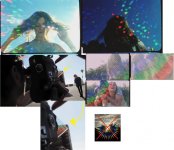
Unknown rainbow filter.jpg
 
These could be crystal ball filters. Particularly some variation of a trigonal prism.
https://www.bhphotovideo.com/c/prod...cb_03_photography_trigonal_prism_crystal.html

Hey buddy!
1. No confusion here, as you can definitely see from the BTS image how this filter looks [and it is far away from the trendy youtuber glass that people use].
It's a square filter with etched diagonal lines, and I guess it's an old one [meaning- it's probably sold on eBay. Not B&H], and I just gotta figure out it's exact name.

2. Also, in my screenshot you can see the sample I crossed with an "X" so people won't be confused with other refraction / diffraction filters that spread the light so symmetrically. Which is not the case here.
As this filter scatters those colorful drops organically & randomly.

I got a feeling that veteran cinematographers might know what this filter is, as it was used with SUPER8 film cameras, and I just didn't see any clue of someone using it nowadays...
 
The information above was direction as requested...need to Google hard for the specific hardware above (or just reach out to the people above).

Although I mentioned crystal ball filters in the opening of the response, it should have said crystal filters, glass.

That's what they are...plates, balls, squares, rectangles, triangles, flat, bumpy - and you can position them differently in front of the camera (even stack them) and the dispersion result will depend on how light hits and travels through the object(s). Simple concept, YouTube or no YouTube.

There are different designs and creative choices versus a flat plate. The one above is actually very simple and can easily be done in post (combining and adjusting multiple digital lens flares that have control over various parameters such as colors, bokeh, location of elements, etc).

___

I'm sure you'll find it eventually but if not: glue some RGB gems (the colorful spots you mention are only red, green and blue) in a similar pattern above on a piece of glass and you'll have some fun.
 
The one above is actually very simple and can easily be done in post (combining and adjusting multiple digital lens flares that have control over various parameters such as colors, bokeh, location of elements, etc).
I'm sure you'll find it eventually but if not: glue some RGB gems (the colorful spots you mention are only red, green and blue) in a similar pattern above on a piece of glass and you'll have some fun.

I appreciate the efforts, man, but:
1. Unless you wanna kill hours & days in the editing room- never ever try to recreate such an effect, with motion tracking everything, and at the end it will still look CG.
2. Very cool idea with sticking colorful gems to glass or something, but, it won't work, as the refraction spots move all around the place. Appear & disappear. Sticking a glass like that will anchor these gems to one place, making it look like dirt on the lens.

Again, my quest here is about finding the name of this filter.
I don't want to recreate or fake it. Question is...who the hell could know anything about it? :(
 
1. Unless you wanna kill hours & days in the editing room- never ever try to recreate such an effect, with motion tracking everything, and at the end it will still look CG.

It's instant these days, man.

I know the most passionate in the industry will always do the manual labor of love/art, but just wanted to point that out.

Will not comment any more about the recreation aspect, but there are hundreds of plugins out there. And with AI doing various calculations and keyframing, it's finger clicks, not hours or days.

If you care to browse through each video sample below, you'll see beautiful results.

Even Hollywood uses this stuff every day.

https://www.motionvfx.com/store,mleaks-4k-prism,p2308.html

https://www.motionvfx.com/store,mbokeh-anamorphic-4k,p2006.html

https://www.motionvfx.com/store,mcaustic,p2166.html

https://www.motionvfx.com/store,mleaks-halo,p2086.html

https://www.motionvfx.com/store,mleaks-4k,p1989.html

Dozens of compositing elements that look very realistic, and some with full, simple, instant control.

It might be difficult to comprehend without the experience, but you could create your desired pattern above in seconds.

MVFX_Sample Effects.jpg
 
Lensbaby has a filter in their variety pack that's kind of close (results from samples) but still not the same...now I'm determined to find it, ha.

OMNI.jpg
 
I know, man. It's a 200-400$ Schneider filter...BUT, this isn't the filter in the images above... :\

I was not suggesting it is.

I’ve reached out to the Director of that ad. If he responds with an answer I will share it.

The ad is from 2010, if that helps narrow it down any. The filter-holder looks like the one from Cokin, who produced all sorts of specialty acrylic filters. In the photo you provided it looks to be acrylic and not glass. I say that because the edges appear to be unsealed.
 
Last edited:
Darn, this one is a tough find. If it's not a custom-job or something super vintage, I'm thinking it's transparent holographic adhesive foil with a random pattern that's on a clear rectangular filter or some acrylic glass plate. (There is so much DIY in this particular area of photography.)

1.jpg

2.jpg
 
I think you're on the right track, NorBro. I was looking as well and couldn't find anything, either. The closest I've seen are filters made by Vantage Film, but nothing like this.
 
This is a fun rabbit-hole.

I learned about Vantage ā€œBethke effectā€ filters. But now I’m wanting to know the origin of ā€œBethkeā€. Someone involved in development?

http://https://www.vantagefilm.com/en/news/null/august-2012-10027


Note how every filter is mounted in a tray, suggesting the filters are permanently mounted in trays.

Vantage released these in 2012, which is the same year the Seven commercial came out. But we may be able to rule them out given that the filter used in the Seven spot had no tray.


OP- where did you find the images of the filter? Maybe the source can provide clues for us.

I learned that the spot was directed by Bruce Thierry Cheung.

rabbit-holing also led me to these:

http://https://prismlensfx.com/products/dream-fx-filter

and also these:

http://https://www.biofilms.cz/en/sada-filtru-4x5-65-biofilms-bethke-efekt-twirl-diamond-bee-nest

But our guy is tray-less. So not him.
 
A thousand years ago... well back the '60s and early '70s the heyday of psychedelia... who remembers those days! All sorts of people wanted trippy sorts of images so innovation was the order of the day. We used to get similar results using clear Skylight or UV filters by placing small dots of various colors of that transparent colored nail varnish in various patterns to create various effects. Mainly just little dots or lines. With the Cokin series, we could actually stack two or three different "psychedelic" creations together and get various effects. We also made some creations by shooting penlights shot through colored gels through holes in black Art card sheets and shooting them with 5 x 4" on neg film. Totally dark room, the shutter on 'T' and just multiple momentary clicks on and off through different colored gels with the penlight did the job. Colors reversed of course when developed. You could then use the developed 5 x 4" Neg sheet as an FX filter. We also used to do the same using Reversal film.

If I had to create something like what you are describing today I would take a totally different approach. I would create the sort of color matrix I wanted in say Photoshop. Then I would print those colored grid matrices onto OHP Copier Transparency Film which are acetate sheets, like film stock that are used for overhead slide presentations. Remember them? Full transparency ones are available in A4 sheet size which would give you really good-sized sheets to clip into a frame for shooting through at various angles, distances, etc. Clean easy achievable and pretty cheap to accomplish as most of us have access to a color laser A4 printer somewhere. Those of us who learned on film were very used to shooting through Wratten filters

Photoshop PSD matrix

Filter rinbow matrix.jpg

Locally I would get it here but there must be a zillion places around the globe you can get it. At least this will give you an idea of what I would use.

https://www.meter.com.au/presentationproducts/transparencyfilm/copiertransparencyfilm/

Another idea I would pursue would be to use some of the clear film acetate and use colored nail varnish or felt-tip pens and you may get similar results. Or a clear 4 x 4" or 4 x 5.6" matte box filter with colored nail varnish or colored felt tip pens.

Chris Young
 
Last edited:
I was not suggesting it is.
I’ve reached out to the Director of that ad. If he responds with an answer I will share it.

1. Holy Moses! How do you remember which ad it is, and whose the director? Wow, very impressive, man!
Yea, many years ago I tried contacting some people I could find online that were part of this jeans ad, yet, my message didn't come through (getting a hold of James franco, yea, quite tough).

2. Your whole Glass vs. Acrylic idea is very interesting. The fact you spotted it from such a tiny BTS image is impressive.
But, what does it really mean that it's acrylic? Any chance this filter was especially made for this (hence, rare)? Maybe it's just an experimental one, or was originally created not for cinematography?
There are many filters out there that are made for studying physics, not photography / cinematography. So, I wonder if that is why it's hard to find it. Since, no Cokin or Lee or Schneider made it.
 
Darn, this one is a tough find. If it's not a custom-job or something super vintage, I'm thinking it's transparent holographic adhesive foil with a random pattern that's on a clear rectangular filter or some acrylic glass plate. (There is so much DIY in this particular area of photography.)

View attachment 142484

1. Very nice finds, man.
Again, as I said- you could see from the BTS shots the ACTUAL filter! So, whenever you spot a square glass with diagonal etched lines (they feel etched, but, there's a chance that it's a translucent film layer stuck to an acrylic/glass so maybe we need to look for that).
You can see it in motion, in the first shots here:

2. Also, your eBay find is interesting, even thought that glass is not it. These are the pieces of glass I was talking about which relate to the optics / physics world. I have no clue what they're used for, really.

3. The interesting thing here is- the pattern of the filter! From such a symmetrical patterned etched lines filter = I would expect it to create a boring symmetrical effect [like the sample with the red "X" on my original 1st post].
But, despite that- it creates the most random, organic RGB spot pattern I'd ever seen (you just gotta hold it in front of the sun, as later in the video- you can see the side-effect it has. The diagonal lines reveal themselves in foggy white pattern). Anyways, the randomness is amazing.
 
Definitely appears holographic-like...the pattern disappears at a certain angle/light.

Might have nothing to do with photography/videography and be one of those optical illusion gift gadgets sold in places like Brookstone, etc.
 
Definitely appears holographic-like...the pattern disappears at a certain angle/light.

Might have nothing to do with photography/videography and be one of those optical illusion gift gadgets sold in places like Brookstone, etc.

Good idea for a keyword, man!
It made me look out for "Holographic" and I got some interesting links.
Seems like a direction for keywords is around:

Adhesive + Holographic + Transparent / Translucent + Overlay + Film + Grating Diffraction

Sticker film:
https://tinyurl.com/16mn9hr5
For Windows:
https://tinyurl.com/1416snww

Thing is...you can't know if those things have a real effect of diffracting light. They could just be stickers with a faint rainbow reflection in light. That's why I believe glass / acrylic, as it's part of the glass itself- has the most chances to refract light and not look like a milky stain on a glass [as a sticker might].
 
Back
Top