My first documentary! Need help with lighting for school classroom.

badabing

Member
I have volunteered to make a documentary for a school band. I am planning on getting rehearsal shots in the band rooms, as well as interviews with teachers in their offices.
Everything is lit with ceiling mounted fluorescent strips. There are no windows to deal with, all the ambient light is from overhead.
Any advice on adding a little more shape so that everything doesn't look flat?
I was thinking maybe some DIY fluorescent strip lighting on stands with matching bulbs for the overheads, so no white balance issues. Or maybe some Home Depot clamp on lights with matching temperature compact fluorescents?
You might have guessed that this is lower than low budget! It's a freebie I'm doing to help with fundraising.
Any thoughts or advice would be appreciated.
Thanks
 
Fluorescent lighting, especially the kind you find in a school, will never be pretty. Shooting outdoors, or an indoor location with lots of windows, isn't an option?
 
Unfortunately, no. I will be shooting during class time. The band rehearsal rooms have no windows. Same with the instructors offices. Just ceiling fluorescents.
 
I may be able to pick up a used lowell light kit locally. 2 omni lights and a tota.
Would these lights, gelled to match, be ok? Just to give some shape to the students.
 
I'd take a very careful look at the available lights before shooting under flourescents in a school. In my experience, it's not uncommon for all the bulbs to have different color temperatures and for some of the ballasts to be broken resulting in flickering. Your most effective lighting might be to ask the school to fix the ballasts and replace the off-temperature bulbs, etc. You won't know until you look at the actual scene and take some test footage.
 
I may be able to pick up a used lowell light kit locally. 2 omni lights and a tota.
Would these lights, gelled to match, be ok? Just to give some shape to the students.

Lowel lights are designed for this style shooting & a much better choice then DIY or Home Depot options.
 
I'd use the available light and only bring in lights if absolutely necessary. Lights are going to drag you down. It will make everyone just that much more conscious they are on film. You want to capture real action, not set up action. For interviews, sure, set up some lights. But if you are documenting the band in the class room or in the rehearsal room or on stage, use the available light.
 
I'd recommend just skirting the fluro's with some black wrap and then bringing in your own lights to key, fill and backlight. Get some pools of light happening by removing a couple of the tubes from the ceiling fluro's and skirt the rest, that should get some nice fall off happening in your wider shots and create a bit of depth. Then just subtly key and fill the faces to get some shape and get a soft backlight happening. Presto, you've brought some depth back into your shots. Good luck
 
Thanks everyone for the replies.
I will get a better look at the rehearsal rooms next week.
I agree with Paul F about not using any additional lighting, as the kids would be aware of a "production" going on, and not act natural.
That's why I have chosen to film with my little panny TM900 camera. Kids are used to parents constantly having a video camera on them, no big deal.
However, show up with a shoulder mounted beast, and its a different story. I want to be as unobtrusive as possible, I don't want the kids "acting".
Any thoughts?
Thanks again.
 
The term 'unobtrusive' is often thrown around when approaching documentary filming, but how far are you willing to be unobtrusive when it starts to compromise your image quality? You're shooting video, you'll have a camera and the band will know beforehand and at the time that you're there to film them. Sure, a less imposing camera and production set up will appear less imposing but at the end of the day, you're not invisible.

You're choice of whether or not to bring in extra lights isn't just dependent on the available lighting in the room; it's also down to logistics also. How much time will you have? How much space will there be? Will you have an assistant to help you carry the extra gear and to help you set up, pack up? Have you done a recce of the location(s)?

Just because it's a documentary, it doesn't mean you shouldn't plan ahead as much as you would a 'real' production. If the available lighting is truly hideous, I'd bring in a small 2-3 light set up and stick to medium and close ups shots.
 
I might approach this particular shoot with the mind set..... that going with the existing lighting as it is...is part of the story.
A reality.
There has been many brilliant musical photographs taken in studios, stages, halls etc under existing conditions.
(Me being me..I would take a look a the location first of course and shoot a few frames as a test.)
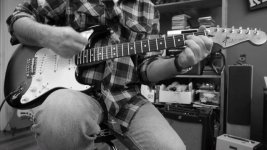
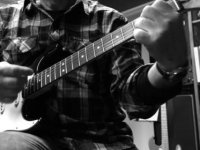
Here are a few frame grabs I shot of myself under fluoro lighting in my studio. I just happened to have shot these in BW for intended purpose.
The difference between the flatter and more contrasty shot was simply..I killed one row of tubes on the ceiling. There is no supplementary fill or additional lighting and these are ungraded direct from source footage . (ex GH2)

Guitar 4sm.jpgstrat 1sm.jpgstrat 2sm.jpg
 

Attachments

  • Guitar 4sm.jpg
    Guitar 4sm.jpg
    18.9 KB · Views: 0
  • strat 1sm.jpg
    strat 1sm.jpg
    19.7 KB · Views: 0
  • strat 2sm.jpg
    strat 2sm.jpg
    17.7 KB · Views: 0
Last edited:
Others have made some good suggestions. As was said, white balance and shoot some footage. See if you like it. One problem is that if there were a lot of people in the room, you might have trouble bringing in enough lights to light everyone (even if you want addfitional lights). My experience is that people get used to having you there, so bringing in equipment is not as disruptive as you might think. For closeups, (etc), you might use reflectors. If you can (more or less) match the color temperature, you might have one small light (possibly a LED) to act as an accent light. With omni lights, you can either gel or use a dicroic filer to get you closer to daylight. (The Fluorescents will probably be cool white). Or you may find you are fine with just the overheads. Good luck.
 
Sometime low-ceilinged flour-lit rooms can benefit from a gradient ND filter. This helps eliminate the overexposed ceiling / dark floor llook.
 
I might approach this particular shoot with the mind set..... that going with the existing lighting as it is...is part of the story.

Shooter, are the overhead flo's in your images the ones with small .5 inch grids, or do they only have the sheet of plastic diffusion?

I like the idea of killing a row of fixtures is possible, failing that you can skirt them as someone suggested, or possibly even use black foam core and tape right over them. Flo's don't get too hot usually.
 
Last edited:
For this piece I went 100% with existing ceiling flo's, no additional lighting. We skirted the outside row of flo's all the way around and opped the contrast a little in the grade.
http://www.youtube.com/watch?v=18t5V3gvfa4

For a documentary, unless one is really trying to push a mood, existing classroom lighting should be fine. The suggestion to scout ahead of time and request that oddball tubes be swapped out is a sound one. Skirting is best done with duvetyne, much cheaper than blackwrap for that amount of material. Cheaper still would be black visqueen (sold at most hardware stores as polyethelene sheeting).
 
For this piece I went 100% with existing ceiling flo's, no additional lighting. We skirted the outside row of flo's all the way around and opped the contrast a little in the grade.
http://www.youtube.com/watch?v=18t5V3gvfa4

For a documentary, unless one is really trying to push a mood, existing classroom lighting should be fine. The suggestion to scout ahead of time and request that oddball tubes be swapped out is a sound one. Skirting is best done with duvetyne, much cheaper than blackwrap for that amount of material. Cheaper still would be black visqueen (sold at most hardware stores as polyethelene sheeting).

That looks pretty great.
 
Charles, that looks great. It's amazing what putting a bit of shadow on a wall does. "less is more" as they say. :happy:

I love duvetyne. Yes its a bit on the pricey side, but it can be reused and useful on anything from preventing underneath fill, hanging in windows, flagging, etc..
 
Trying to light a larger room evenly without using the installed flu's is going to look patchy, the stands get in the way, and many UK schools have VERY strict rules on cables - is the US the same? I've never found for documentary style shooting that offices look flat - far too much junk in them to not look busy. Go with what they have - it's the only sane way!
 
Back
Top