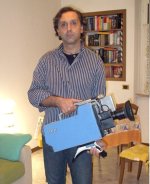
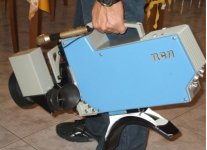
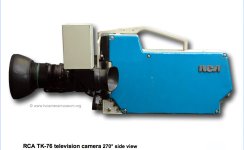
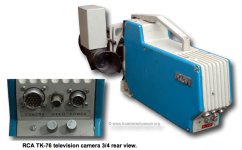
"Movie Studio Blows Whole Budget On Big-Name Gaffer"

Ha.. Yes we will now have to shoot this film with a TK-76 camera, use free actors, and serve cold pizza to the crew, but the lighting will be fabulous!
 
A local station I did occasional work for shot TK-76's as their standard news cameras for years. I personally owned an Ikegami ITC-350 which was almost identical in size, weight and overall layout (even the color). I still have a permanent list to the left from lugging those things on my shoulder. (And, seriously, I'm developing arthritis with chronic pain in my neck now -- don't know if it's related, but it might be).

- Greg
 
3/4" Umatic. The (BVU?) 50 was "smaller", record only. The 110 had Play, Rew and Ffwd, was a beast, but at least your shoulders were balanced.

I had to shoot a TK for a year (after shooting a nice Sony to 3/4" for 4 years).

I ran up and down NFL sidelines with both beasts for 4 years, then went from the TK to the first Betacam (BVP-3? which was the size of a suitcase) when it came out.

Maybe this is why my back is shot (and why I laugh when someone says a camera today is "heavy")?

Ahhh, 3/4" Umatic, of course. When I first started, my bread and butter was doing commercials, music videos and fashion promos, shot on Super 8mm film. I came up with a DIY film chain transfer system and went in after hours to a cable company post facility and, with bribes of expensive scotch, had "Our Guy" transfer and post everything to 3/4" Umatic. I never paid any attention to the cameras used (I admit it, I was a "Film snob"... sorry). We did work in what I thought was a pretty sophisticated environment, for a linear A/B roll editing suite, and I really dug the editing. I laugh now also thinking that I got an editing system at, what, at least 100 times more powerful than that multiple tens of thousands of dollar linear suite in a little box with 4 DVD-ROM discs for $1000.00!

I never shot video until the VX1000 came and screwed up everything, but I did shoot with an Arri 16 BL (A beast for sure) and Arri SRs and I also laugh when I hear about the "Heavy" modern cameras. Now, I am not a "Oh these kids today type". When I see what some people are doing now, with inexpensive HD-DSLRs on their laptops, I am frequently amazed. Ain't technology wonderful!!!


EDIT: Here is an example of a video that we did with a Super 8mm film transfer to 3/4 Umatic. That was a lot of fun!

 
Last edited:
So on a camera like that, what did it record to in the field?

Around here (mid-market local TV stations) it would typically have been a Sony BVU-110 or later, BVU-150, a portable 3/4" U-Matic recorder that used the smaller 20-minute sized cassettes. Some big-city stations might have used 1" open reel equipment when shooting commercials and such, but I think that was fairly rare for routine ENG work. This would add about another 15 - 20 pounds of weight on your opposite shoulder to counterbalance the camera. :-) Being a good ENG shooter favored strong guys with a stocky build -- which I wasn't.

My personal gear was a Sony VO-4800 from their "industrial" line, which performed about as well as the BVU-100 quality wise, but wasn't built as ruggedly and didn't have XLR mic inputs or time code. I always used an external transformer box so I could have balanced audio ins. The VO-6800 was a much improved model that we used at the local cable studio I managed, but I never owned one personally. The official spec for the 3/4" format was, I believe, 240 lines of horizontal resolution.

This would have been pretty much the state of the art around 1978 - 1984 when I was most active in shooting in the field. Makes you really appreciate it when you can get a 5-pound, $2000 camcorder today that shoots about ten times the amount of information per frame and records three hours on an SD card that costs about the same as a 20-minute (and effectively non-reusable) tape in those days. I'm not really nostalgic for it at all, but I do keep an old Ikegami HL-79 (originally a $50K camera) next to my desk here to remind me how far we've come.

- Greg
 
"Offsetting the substantial expense, noted Wainwright, is the fact that this genre of film essentially key-grips itself."

:grin:
 
Back
Top