combatentropy
Veteran
The third part of The Hobbit has some absolutely excellent action sequences. But that's not what I want I want to talk about.
The grade looks positively video-ish (or "videotic" if I can get the word to catch on). Some parts looked worse than others. Usually indoor scenes looked more like video. One intimate conversation in particular in the dwarvian fortress between Bilbo and Thorin looked so much like The Days of Our Lives that I felt even the rest of the audience noticed the cheesiness. This was the 24-frames-per-second version.
I couldn't find a still from that scene, but I scrounged the Internet for something might help you see what I'm talking about. Here's a shot that's looks videotic to me:
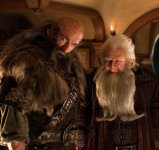
And here's my feeble re-grade (from 8-bit JPEG source material, mind you):
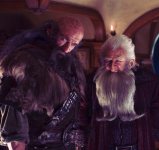
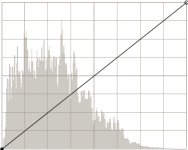
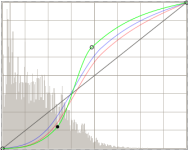
Low-contrast mids is one of the telltale signatures of video, and for me the one most egregious. The famous S-curve of film is an ingenious way to squeeze the twelve or more stops of a real-life scene into the 5-7 stops of theater projection. Basically the S-curve is low-contrast lows, low-contrast highs, and normal-contrast mids (or a bit higher-contrast mids for dramatic effect). This makes faces and things at least the same contrast as we see in real life, but tames the contrast of the shadows and highlights.
The grade looks positively video-ish (or "videotic" if I can get the word to catch on). Some parts looked worse than others. Usually indoor scenes looked more like video. One intimate conversation in particular in the dwarvian fortress between Bilbo and Thorin looked so much like The Days of Our Lives that I felt even the rest of the audience noticed the cheesiness. This was the 24-frames-per-second version.
I couldn't find a still from that scene, but I scrounged the Internet for something might help you see what I'm talking about. Here's a shot that's looks videotic to me:
And here's my feeble re-grade (from 8-bit JPEG source material, mind you):
Low-contrast mids is one of the telltale signatures of video, and for me the one most egregious. The famous S-curve of film is an ingenious way to squeeze the twelve or more stops of a real-life scene into the 5-7 stops of theater projection. Basically the S-curve is low-contrast lows, low-contrast highs, and normal-contrast mids (or a bit higher-contrast mids for dramatic effect). This makes faces and things at least the same contrast as we see in real life, but tames the contrast of the shadows and highlights.
Last edited: