Milky Picture in Hobbit - Battle of the Five Armies

The third part of The Hobbit has some absolutely excellent action sequences. But that's not what I want I want to talk about.

The grade looks positively video-ish (or "videotic" if I can get the word to catch on). Some parts looked worse than others. Usually indoor scenes looked more like video. One intimate conversation in particular in the dwarvian fortress between Bilbo and Thorin looked so much like The Days of Our Lives that I felt even the rest of the audience noticed the cheesiness. This was the 24-frames-per-second version.

I couldn't find a still from that scene, but I scrounged the Internet for something might help you see what I'm talking about. Here's a shot that's looks videotic to me:
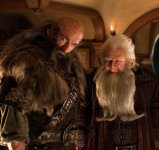
hobbit.jpg

And here's my feeble re-grade (from 8-bit JPEG source material, mind you):

hobbit-graded.jpg

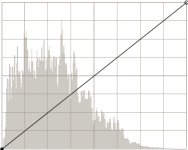
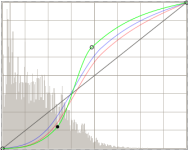
Low-contrast mids is one of the telltale signatures of video, and for me the one most egregious. The famous S-curve of film is an ingenious way to squeeze the twelve or more stops of a real-life scene into the 5-7 stops of theater projection. Basically the S-curve is low-contrast lows, low-contrast highs, and normal-contrast mids (or a bit higher-contrast mids for dramatic effect). This makes faces and things at least the same contrast as we see in real life, but tames the contrast of the shadows and highlights.
 
Last edited:
They are inside, lit by candlelight, why would they be magenta? Maybe if they were watching tv. The first grade is color-wise correct for the scene.
 
Going to show my ignorance here.

How do you adjust the contrast for highs, mids and lows? I'm using Sony Vegas, and I don't seem to have that kind of ability.
 
Not really seeing it, combat. In terms of contrast, the net effect of your color grade is that there's actually less overall, and detail is lost.
 
I know what you mean about the videotic look...I see it more often than I used to notice, and yes, it's hard to describe/demonstrate.
 
Over sharpening can look videoy as well. I think the amount of detail & sharpness in the Hobbit movies exceeds that of film; thus the more video like look. Maybe I'm wrong, but I don't remember being able to see the pores of peoples skin with movies shot on film.
 
Over sharpening can look videoy as well. I think the amount of detail & sharpness in the Hobbit movies exceeds that of film; thus the more video like look. Maybe I'm wrong, but I don't remember being able to see the pores of peoples skin with movies shot on film.

You're not wrong. The first time I really noticed it was Public Enemies in 2009. Wow! you could see every pore on the big screen! Not an attractive look! Way to sharp!

I think Peter Jackson has a penchant for the over sharp look, which is why he was pushing the 48 fps format. He just likes the video look over the dreamy film look. Just a personal preference I guess.
 
Over sharp... or just not gone through negative, several levels of intermediate neg/prints, till final projection print...

At this point I really don't know what the hell people are talking about when they call a film, presented for a theatrical release, (Digital or Film negative capture with Digital Intermediates, or olden days pure chemical process), 'video'.

First off... 'video' never had the resolution to look sharp unless one was 12-15 feet away from the TV. Second off... TV always had to have less dynamic range than any even 'badly exposed' Film film or Digital film, because the electronic that defined NTSC and PAL could not reproduce anything but a narrow range... and Third off... Interlaced artifacts were rampant.

No Digital film other than a special effect or obviously if they are shooting for Broadcast TV content, has any of these 'qualities'...

Look at around 3:30. If it looks like that, people describe it as "video".


It's been fairly well established through interviews that the filmmakers involved, most notably Jackson himself, were just phoning it in by the end of this overly drawn out saga. It's not at all surprising that the images aren't top-notch throughout.

OP: I think your "feeble re-grade"s aren't helping get your point across here. I agree with you, but I can totally see why you are getting the pushback that you are in this thread. Ditch your images and you'll have a much better argument.
 
I do think on the whole that these films were lensed more brightly than the original films, probably to compensate for the 3D. Another factor for 'milkiness' could be the theatre itself. In my 2D screening, there was a double image during bright scenes on the bottom third of the screen because the glass it was projecting through wasn't angled properly. This also caused an overall slight fogginess to the image. My suspicion is that this is caused by a theatre equipped primarily for 3D switching to 2D.
 
I do think on the whole that these films were lensed more brightly than the original films, probably to compensate for the 3D. Another factor for 'milkiness' could be the theatre itself. In my 2D screening, there was a double image during bright scenes on the bottom third of the screen because the glass it was projecting through wasn't angled properly. This also caused an overall slight fogginess to the image. My suspicion is that this is caused by a theatre equipped primarily for 3D switching to 2D.

The standard illumination for 3-D is 7.5 Footcandles per projector... for 2-D it's 14 these days. I've read that in the past, 16 was the standard...

The presentation of the last Hobbit installment I watched a few weeks ago, was 'fine' for me... dark/black was not 'milky'... which is one of the reasons why I hate 3-D... doesn't seem to really have good contrast even though the sum of the two channels is supposedly equivalent to the 2-D version...

When we turn to how most people watch 'film' these days... it's on HD monitors most likely, and the brightness values from the screen are greater on the one hand... but then... one is often watching in a 'bright' room, relative to theater projection room standards. (And depending the technology, there's the back illumination to deal with which never does get to a 'true' black...).
 
OP: I think your "feeble re-grade"s aren't helping get your point across here. I agree with you, but I can totally see why you are getting the pushback that you are in this thread. Ditch your images and you'll have a much better argument.

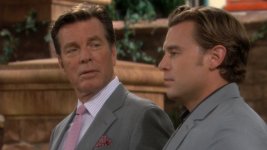
Thank you for your feedback. In my second post, I think my regrades are better. In fact the improvement is so striking I am surprised that no one has mentioned them. On the left are stills of various soap operas, which I pulled from the Internet. On the right are my adjustments. I just changed the gamma curves to more of an S-shape, adjusting the curve of each primary color individually (so in effect I also changed the white balance). Besides that, I may have desaturated them ever so slightly. Other than that there is no change. Yet the second column looks so much better to me. The acting even looks better. It has always been my contention that the "cheesy" acting in soap operas is actually a result of the video look.

As for the regrade in my very first post, it is too blue. I did it when my laptop's screen was in the warm setting that I prefer. So, sorry about that. Even so, the contrast there looks better to me. And I'll leave it there just because some people have already replied about it.
 
Last edited:
First, crushing the blacks does not equal a more filmic look. The S- curve thing is a farce. What we want is contrast, without sacrificing shadow detail. If I'm not using LUTS to assist the grade, I find raising the blacks slightly and crushing the mids will accomplish a more filmic look than an S-curve.
Second, judging the still from the Hobbit movie, I think a big part is the design. Everything looks too perfect: The beards, the wardrobe, they all look like costumes and not like real clothes or facial hair that someone lives with. Goes to show just how important production design is to getting the look.
 
This is not directly about the latest Hobbit instalment, but I saw Paul Thomas Anderson's "Inherent Vice" projected in 70mm film format this week, and I have to say that the 70mm film format looked soft and grainy compared to all the digital films I've watched over the past 5 years.

It's the first time I wished that the director had gone with an Alexa or a RED camera and shot digital, because this 70mm film format sucked compared to what I've grown used to.
 
This is not directly about the latest Hobbit instalment, but I saw Paul Thomas Anderson's "Inherent Vice" projected in 70mm film format this week, and I have to say that the 70mm film format looked soft and grainy compared to all the digital films I've watched over the past 5 years.

I find this hard to believe. I remember seeing Far and Away (shot in 70mm) at the Cinerama dome in 70mm and it was like looking through a window. If it was soft and grainy that might have been the look they were going for...but then why shoot in 70mm.
 
Back
Top