Microphone Wave Form Question

AlmaVideo

Active member
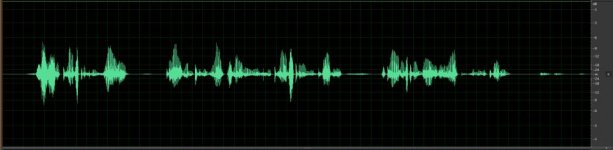
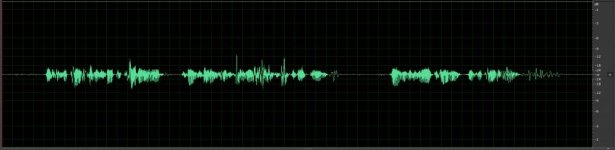
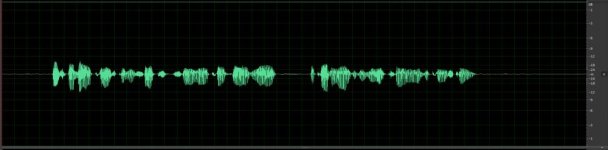
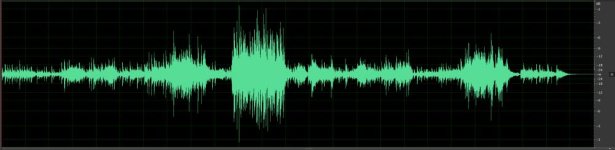
I wonder why the waveform from microphones is not symmetrical like the waveforms from say a commercial CD recording. I discovered this in testing my audio setup. I tried 3 different mics with identical setups to be sure it was the microphone (all unprocessed):

Heil PR 35

jpg.gif


CMC 6U

jpg.gif


CMIT 5U

jpg.gif


Oblivion (commercial CD)

jpg.gif
 

Attachments

  • Mic Offset Heil Screen Shot crop.jpg
    Mic Offset Heil Screen Shot crop.jpg
    33.7 KB · Views: 0
  • Mic Offset Schoeps Cardioid CMC 6U Screen Shot crop.jpg
    Mic Offset Schoeps Cardioid CMC 6U Screen Shot crop.jpg
    32.5 KB · Views: 0
  • Mic Offset Schoeps Short Shotgun CMIT 5U Screen Shot crop.jpg
    Mic Offset Schoeps Short Shotgun CMIT 5U Screen Shot crop.jpg
    30.2 KB · Views: 0
  • Oblivion Screen Shot crop.jpg
    Oblivion Screen Shot crop.jpg
    34.2 KB · Views: 0
I'm curious also... Alot, but not all, of my audio looks like the third one down... Normal looking peaks below but squashed, short peaks above. The audio sounds great and I can hear no difference between that on the audio like in the 4th example.
 
I used microphone to Tascam HD-P2 via balanced XLR, transferred file on CF card to my Mac, evaluated in Audition CC.

I think since the "quiet" line on the recording reads at zero in Audition, it is not DC offset.

I did a little more research, and a friend referred me to this article:

http://www.soundonsound.com/sos/may13/articles/qanda-0513-1.htm

My friend says he sees this a lot in his VO recordings. I believe I understand from the article that the answer is that the nature of the sound waves coming at the mic cause this and it is "normal."
 
Asymmetrical waveforms are perfectly normal. Newbies have been asking that question for years.
I see no "DC offset" in your waveform images. Asymmetry and DC offset are two completely different things.
Since you didn't identify WHAT we were "hearing" (actually SEEING) in your examples vs. the commercial recording examples,
I stongly suspect that we are seeing just a single instrument (or voice) in you examples vs. a full ensemble (orchestra, band, etc.) in the commercial waveform.
 
Thank you, David and Richard. Yes, a newbie. I came here to learn, and you have helped me. I seem to have not found the right keywords to find the answer in the search tool.

The first 3 tracks were my voice (silly content) testing 3 mics, as my testing had eliminated things downstream from there. The mics were about 4 inches above my mouth, 30 degrees off to the side. The last waveform was indeed a quintet playing Astor Piazzolla's "Oblivion."
 
Don't feel bad I had noticed this for years. Some actually had DC offsets (actually a bunch in the sound library where I worked for some reason did) but then I found a bunch where there wasn't the zero offset. Since they sounded fine and I have seen sounds that I knew were wildly asymmetric (gun shots can be very asymmetric around the peak) I didn't spend a lot of time worrying about it. So nice to actually have some knowledge to fall back on.

And I'm pretty far away from "newbie", good question. And thanks guys for the info.
 
Hello Alma,

An excellent observation! Surprise! Many sounds are decidedly not symmetrical! The symmetry of the individual human voice varies greatly. My voice, for example, has larger negative peaks than positive peaks. Unless, of course, someone reverses the polarity of the audio somewhere along the way. I know this after years of seeing my own waveform and studying the works of Bob Orban who used phase rotator circuitry in his Optimod in order to make the positive and negative peaks symmetrical.

I think the idea stemmed from AM radio modulation schemes. A good part of the power (coverage area) of AM radio is the result of modulation. The more consistently and completely you modulate the transmitter, the larger the coverage area and the larger the number of people you reach.

There's another human voice peculiarity; peak to RMS ratio. If you observe different people speaking using a meter that reads peak and RMS simultaneously, you'll notice that the space between the RMS and peak vary person to person. People with a very high peak to RMS ratio are difficult to record because you have to allow for those peaks or they'll clip. I'm not talking about people taiking LOUDER then softer, although they too are difficult to record.

Even when I'm recording only one person, I may typically ride gain on their pot to keep their level more even. It helps the people in postproduction. Some people maintain the level of their voices throughout a breath. Others start LOUD and then taper off as they run out of air. If the ambient noise is not a problem, I'll know when they are going to inhale and I'll tweek the pot back a bit, then slowly turn it up as they lose power.

Regards,

Ty Ford
 
I found it interesting that the positive side was emphasized by the dynamic mic, the hyper cardioid was more neutral, and the short shotgun (probably too close) was more negative.

Thanks for the info and encouragement, Scott and Ty. I've also appreciated Richard's insights. I have focused much more over the years on the video side, and I surely appreciate the need to learn more about audio.
 
I haven't observed a mic being able to make positive or negative peak differences. I HAVE noticed that circuit weirdness (DC offset or failing parts) can have an effect on the waveforms. Did you have each mic plugged into the same input or were they all three plugged into different inputs on a mixer?

Regards,

Ty Ford
 
Actually these were serial recordings, same hardware and settings, but not simultaneous. The short shotgun was placed very close, like the other two, and I wonder if that makes a difference in this issue. It's not worrying me, just curious.
 
Hmmm, I wouldn't expect distance differences to result in that serious acoustical variance. Interesting…...

Regards,

Ty Ford
 
I would posit that the differences you observed are NOT because of the pickup methodology (dynamic, condenser, etc.), but a result of the mechanical dimensions of the capsule and the complex design of the acoustic enclosure (front, side, and back) of each different microphone. It would be interesting to see how the waveforms change with distance and angle-of-incidence. Particularly the "short shotgun" which likely has some sort of interference tube in front of the capsule. And "shotgun type" microphones are much more sensitive to nearby reflections as well. Which is why the longer, more traditional "shotgun" mics are rarely preferred indoors.

Remember also that "distance" is only an isolated factor inside a good anechoic chamber. In AlmaVideo's tests, what he calls "distance" was more likely a shift of direct to reflected ratio.
 
Back
Top