GH5 MFT lenses VS "the greats"

My three lenses cost me as much as I pay for one Veydra Mini Prime. I think they can only be that affordable because Samyang is selling the same optics in two different housings and four or more different lens mounts.

While what you wrote is probably true it’s important to note the Veydras are built to a much higher standard then the Samyangs, & likely cost at least three times as much to produce.

If Samyang were to reuse the same optics in proper cine housings, like Zeiss, Sigma, & Tamrom, then the price would increase substantially.
 
Rokinon does have a more expensive option, their Xeen line of cine lenses. Not entirely sure I see a massive difference between them to justify the cost but for those that don't mind spending more they are slightly better optics.
 
The JVC LS300 camera uses a Micro 4/3 lens mount for a Super35 size sensor, and has no problems using S35 and APS-C lenses. It's too bad that JVC did not put a better sensor in this camera because it seems to have fairly limited dynamic-range compared to the Panasonic GH4/GH5 cameras. I was very keen on this camera until I saw footage that appeared to be DR limited. It also originally shipped without a LOG profile, which was later fixed with a firmware upgrade. I wish the GH6 had a body design like the LS300 with a S35 sensor.

No, the MFT mount will not cover true open gate S35 or FF, the larger Four Thirds Mount had a larger outer ring size and might work. The LS300 does not have a true S35 sensor, it is closer to a Std Cine 35mm image circle, similar to the BM UM 4K sensor, which is just slightly larger than the full MFT sensor size and they had to notch the corners of the inner mount to make it work. This was an interesting idea in a multi aspect/format sensor concept, but it did not sell well.

Cheers.
 
Rokinon does have a more expensive option, their Xeen line of cine lenses. Not entirely sure I see a massive difference between them to justify the cost but for those that don't mind spending more they are slightly better optics.

Forgot about the Xeens. A quick check showed the Xeen 50mm is six times the price of it’s dSLR counterpart.
 
The LS300 does not have a true S35 sensor, it is closer to a Std Cine 35mm image circle, similar to the BM UM 4K sensor, which is just slightly larger than the full MFT sensor size and they had to notch the corners of the inner mount to make it work. This was an interesting idea in a multi aspect/format sensor concept, but it did not sell well.

3 Perf Super35 film has a diagonal of 28.48mm. The LS300 uses a AltaSens sensor with a diagonal of 26.72mm in 16x9 aspect ratio, which means it's about 94 percent of the size of S35 film, and a fair bit bigger than a Micro 4/3 sensor when cropped down to 16x9 aspect ratio. So I would not have a problem calling the LS300 a camera with a S35 sensor, though technically it's a little bit smaller. ( the diagonal for the full AltaSens sensor is 28.2mm )
 
I decided to go with The Olympic Pro MFT Lenses, they offer hard stops for focus pulls and they’re all f2.8. I have the 7mm-14mm, the 12mm-40mm and the 40mm-150mm. The 12-40 is my go-to lens for almost everything and lives on my GH5. In 35mm terms this is coverage from 14mm to 300mm all at f2.8.
 
Im using the Olympus pro 12-100mm and the olympus PRO 25mm f1.2 and yes they have very good MF capabilities especially the 25mm which doesn't breathe, focuses extremely smoothly and gives you a 50mm f2.4 equivalent DOF which is optimal. I use the two for doc shooting and the leica 15mm f1.7 for Gimbal.
 
I decided to go with The Olympic Pro MFT Lenses, they offer hard stops for focus pulls and they’re all f2.8. I have the 7mm-14mm, the 12mm-40mm and the 40mm-150mm. The 12-40 is my go-to lens for almost everything and lives on my GH5. In 35mm terms this is coverage from 14mm to 300mm all at f2.8.

I hear those new MFT Olympus lenses are great (I know their old film lenses were). But for depth of field, if they're all f2.8 for MFT, isn't that more equivalent f5.6 or so for full frame 35mm?
 
Samyang=Rokinon=Bower and probably 3 or 4 more "brands", they are all designed and made by Samyang with the option to have your "brand" silk screen applied. Generally speaking it was once Rokinon and Bower in the US market, but things have blurred even more in recent years.
 
3 Perf Super35 film has a diagonal of 28.48mm. The LS300 uses a AltaSens sensor with a diagonal of 26.72mm in 16x9 aspect ratio, which means it's about 94 percent of the size of S35 film, and a fair bit bigger than a Micro 4/3 sensor when cropped down to 16x9 aspect ratio. So I would not have a problem calling the LS300 a camera with a S35 sensor, though technically it's a little bit smaller. ( the diagonal for the full AltaSens sensor is 28.2mm )

Thanks, always woundered which sensor thr LS300 used. Yes it is actually between 3-per 35mm and S35 in size, MFT is smaller than the 3-perf Acadmy format, but a MFT video sensor is 18x10mm in 16:9 crop (as used in the AF100 and now the slightly larger version in the GH5S and new BM Pocket Camera 4K), so a little larger than the GH4/5 smaller sensor 16:9 crop.

The main point remains, the LS300 pushed the MFT lens mount to its limit, to get its larger sensor to fit behind it, but it does show what can be done. If the LS300 had a true 10-bit, 4.2.2 recording and SDI output, it might have done better, and been the AF100 replacement camera.
Cheers
 
I hear those new MFT Olympus lenses are great (I know their old film lenses were). But for depth of field, if they're all f2.8 for MFT, isn't that more equivalent f5.6 or so for full frame 35mm?

Yes, there's about a one stop difference in depth of field when using lenses with an equivalent angle of view (remember, lens focal length changes DOF as well).

Per my understanding these should be all about the same in terms of both depth of field and your angle of view:

25mm f/2.0 on M43 (2x crop)
35mm f/2.8 on S35 (1.5x crop)
50mm f/4.0 on FF (0x crop)

PS no offense to those who hate referring to S35 as crop. I know, I know. It's just a way to bring clarity to the topic ;)

So if you account for keeping angle of view equivalent on your lens choices as it relates to sensor size, yes, f/2.8 on m43 is equivalent to f/5.6 on FF, when speaking strictly of DOF on the same equivalent focal length.

Or put another way, you need a one-stop change on your lens for every major sensor size change to keep DOF the same. If you prefer the f/4.0 look on S35, at any given equivalent focal length, that will be -1 stop for m43 (so shoot at f/2.8) or +1 stop on FF (so shoot at f/5.6).
 
On that note ^^, general lens performance question as it relates to m43 and their lenses.

"all lenses look the same at f/8" was quoted earlier in the thread. And many lenses perform optimally around f/4 to f/8 range.

Most films tend to favor f/4 to f/5.6 on S35 format for many many shots.

Which is around f/2.8 to f/4 range on M43.

I tend to find for most of my work I shoot f/2.0 to f/2.8 on m43.

This is "harder" on a lens in general, as to be equivalent to a top performing S35/FF lens in the same DOF you need to have a lens that performs better at a lower f/stop. That's a challenge, no?

Do M43 lenses tend to perform better in the f/1.4-f/2.8 range than larger glass? Or, are the lenses technically equivalent if comparing at f/5.6, say, but in practice on m43 you shoot more open so then their equivalence starts to diminish and you end up a technically comparable lens, but practically inferior for the way m43 sort of forces you to shoot more open (and thus at a "worse" spot on the lens) to replicate similar DOF of larger sensors?
 
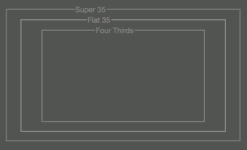
For those of you who want your movies to have the same depth of field as Hollywood, there is no reason to favor S35 over 4/3. Movies weren't shot in S35 until around the year 2000. I repeat, S35 is a new format. From the 1950s through the 1990s (so most of your favorite films) Hollywood used two formats:

(1) 2.40 anamorphic: 21 x 17.5mm but stretched 2x, so optically it had the same depth of field as if it were 42 x 17.5mm. This creates an optical diagonal of 45.5mm, which gives it a crop factor of 0.95 compared to full-frame 35mm. That's right, it's actually slightly bigger than full frame 35mm. This is why directors of photography complained about focus pulling in anamorphic, because the the depth of field was the same as full-frame 35mm.

(2) Flat 35. This was using a simple crop of the film, measuring 21.95mm x 11.86mm, giving a diagonal of 24.95mm, and therefore a crop factor of 1.73 compared to full-frame 35. I know many of you love anamorphic, but most of the movies you saw between 1950 and 2000 were shot in this format: The Godfather, Rocky, Back to the Future, The Shawshank Redemption, Jurassic Park, Saving Private Ryan, The Sixth Sense, A Beautiful Mind, Eternal Sunshine of the Spotless Mind. If any of your favorite movies during this period are not anamorphic, then they are this format.

Flat 35 is between 4/3 and S35. Its depth of field is just half a stop different. So to match f/4 in Flat 35, in 4/3 you would shoot f/3.4. Not that hard, is it?


"But bigger is better," someone might say.

I would argue that depth of field is a double-edged sword. Hollywood cinematographers were usually trying to get deeper focus, not shallower. They usually shot between f/4 and f/5.6 -- f/2.8 was about the minimum, and only at night. Sometimes they would use tricks to get deeper focus, like split diopters (All the President's Men) or a ton of film lights (Rear Window).

Frankly, I think shallow focus is one of those things that please the maker but not the audience. There are certain things that photographers pay attention to that general audiences are blind to, say the difference between an average lens and an expensive lens. But that's not what I'm talking about. There are certain things that makers love but audiences are just annoyed by: hyperactive camerawork, hyperactive editing, copious lens flares, super wide angles, super-shallow depth of field, surreal lighting are all annoying to most moviegoers (the exception are film students and other photo hobbyists). So pick your poison, I mean pick what slice of your audience you want to please. The largest slice by far doesn't care about these things, in fact is annoyed by you show-boating. So save yourself a ton of money, and put down the anamorphic lens. Just put it down. No, down.


"Bigger gives me more choices in wide angle."

You shouldn't be shootiing wider than 35mm (full-frame equivalent) else you're just annoying.

"But Terry Gilliam!"

Yeah. How 'bout those blockbusters.

"But Kubrick!"

Yeah, my mom loves him, not.

Anyway, they shot in Flat 35.


I see I have let my soapbox cloud a point that is much less controversial, which is that 4/3 is a perfectly fine format, and frankly it would have been easier on all of us --- even you Terry Gilliam admirers --- if Sony and Canon and even RED had just put down their Not Invented Here glasses and standardized on 4/3.

frames.png
 
Last edited:
Do M43 lenses tend to perform better in the f/1.4-f/2.8 range than larger glass?

I think it all depends on the lens. Generally M4/3 lenses have to be a lot sharper than their Full Frame equivalent because they are trying to pack in the same amount of detail on to a sensor that is one quarter of the size.

Take a look at this resolution test between a M4/3 200mm f/2.8 lens and a Full Frame 400mm f/4.0 lens...

Panasonic 200 mm f/2.8 Lens

Canon EF 400 mm f/4 Lens

Both lenses come close to reaching their maximum resolution at full aperture or very close to it. With the Panasonic lens the center of the image is sharpest at full aperture.

Here's the same type of test with two wide angle lenses...

Panasonic 12 mm f/1.4 Lens

Canon EF 24 mm f/1.4 Lens

With these two wide angles you have to stop down about 2-3 F-stops to reach their optimal sharpness. This is very different than the telephoto lenses.
 
Good stuff combat. Explains why I unwittingly just landed on "about f/2.8" as my preferred m43 look. Sounds like ~f/4.8 will be my preferred on EVA-1.

It's almost impossible to keep anything in focus as you open up more anyway. I think super shallow DOF will only take a few more years to die off... at least in terms of mainstream obsession (already seen it decline greatly)... at least it's not as bad as 2010 when the video world freaked out about it with the DSLR revolution... I suffered through way too many low budget presentations at various places shot by someone way too excited about their 5D, and who also had no understanding of shutter speed as it relates to motion blur... oh... the pain...

Have also found that the m43 format's crop factor is really not an issue. I don't even really like the look of anything wider than 24mm FF equivalent. That's about as wide as I like to go. Sometimes it's fun to play a tad wider (the voigt 10.5 is nice for a 22mm, the laowa 7.5 is cool for effect on non narrative work since it's pretty low distortion for a 15mm equiv) but 14mm (28mm and up) seems to be the most cinematic. Actually, I shoot almost everything on m43 on my voigt 17.5 and 25mm at f/2.8 with a VND and basically feel that everything else is used for when I need it about 20% of the time. Maybe 10% on a m43 ~12mm-ish, and 10% on a m43 42.5... and then... umm... random stuff on wider/more telephoto... sometimes...

And then I sort of feel bad that I have so many lenses...
 
Last edited:
Do M43 lenses tend to perform better in the f/1.4-f/2.8 range than larger glass? Or, are the lenses technically equivalent if comparing at f/5.6, say, but in practice on m43 you shoot more open so then their equivalence starts to diminish and you end up a technically comparable lens, but practically inferior for the way m43 sort of forces you to shoot more open (and thus at a "worse" spot on the lens) to replicate similar DOF of larger sensors?

We're starting to conflate a few things here.

Firstly, as a general rule, most lenses perform at their best a stop or two down from WHATEVER their maximum aperture is. There's exceptions to this rule and it's usually what you pay premium prices for in lenses (that they perform nearly as well wide open as a few stops down). That's a rule I've seen to be mostly true, but as to if it's truly important to your creative imaging outcomes....maybe not so much. Of far greater import is, can you keep the shot in focus rather than how sharp is the lens performing in my view.

So then secondly, we're looking at a dreaded phrase, almost as much as I dread the use of the words crop factor...equivalence.

There's a concern that to have the same DOF properties of a 135 format lens SHOOTING on a 135 format camera (how many of those are there again that we can use in professional environments) you are a stop or two out to have the same performance.

So while that's true I'd also say...

Aside from compressed DSLR / MILC format cameras there are very few truly serious 135 Vistavision shooting cameras in motion picture imaging.

You're also still getting the light gathering abilities of the m4/3 lens at that given aperture. Equivalence fascists will also argue that light gathering on 135 format sensors also should be considered, but I believe that practically speaking, there's not really much of an advantage.

So yes, the 2.8 zoom at a given ISO is still a 2.8 zoom in MFT, (equivalence fascists argue there's more noise) it's just that the amount of DOF is different WHEN COMPARED to a 135 format lens SHOOTING on a 135 sensor.

So you put a 135 format lens on a MFT camera and those differences go away...unless you're speedboosting of course.

So my pros...

Native micro four thirds lenses tend to outperform other lenses like for like by most metrics including MTF or sharpness.
They're generally physically smaller like for like.
They're generally cheaper like for like.

Cons

You can't use them on 135 format cameras seems to be the major one, so for someone who thinks they may end up shooting 135 then they're a dead end lens format.

JB
 
Traditionally native m43 lenses seem to holdup much better wide open compared to FF lenses. Of course they get better when stopping down but when a m43 lens has a MFT score at f1.4 that matches or exceeds a FF lens MFT score at f5.6 there is something to be said about how well the m43 format was thought out. I use mostly a Lumix Leica 25mm f1.4 lens and have no problem at all using it wide open at f1.4. I consider f2.0 to be its optimal performance in terms of looks but the f1.4 is still very usable. This is true across a lot of m43 prime lenses.

Forget about MFT scores for a second however. You just have to look at the sample images from the articles TheDingo posted to see how well the 12mm f1.4 looks at f1.4 compared to the Canon 24mm f1.4 at f4. Granted there may be better 24mm FF lenses out there but the point is just because a lens is FF does not make it instantly better. I have seen a lot of FF lenses suffer wide open and while usable I consider that edge performance, low contrast and overall softness and bloomy look to be just as damaging to material as noise. Both are indicators of low budget. The noise has been easier for us to scrutinize because it is so ugly and people notice it but that doesn't mean a soft almost dreamlike look is any better.

For me using a focal reducer is no longer really about sucking in more light because most of the lenses I would use on a focal reducer need to be stopped down to look good anyway (the Sigma f1.8 zooms being the exception here). A focal reducer and adapted lenses is really more about matching the FOV/DOF of s35mm and eliminating the in body lens correction. At least this is how I feel when it comes to primes. Zooms are an entirely different story.

Using zooms on a m43 camera is a bit of a drag. The more affordable native m43 zooms tend to suffer wide open and since they are so slow to begin with stopping them down really hurts the format. The f2.8 zooms are better but so are the FF zooms out there like the Canon 70-200 f4 and the Tamron 70-200 f2.8. That puts m43 and zooms at a low light disadvantage. Panasonic/Olympus/Sigma really need to figure out a way to make f1.8 zooms more of the norm on m43. The new f2.8-4 zooms are a step i the right direction but after you factor in the less sensitivity of the m43 sensor are technically more of a match to the f4-f5.6 kit lenses for APS-C. Optically they may be better than a kit lens but in terms of light gathering the m43 zooms really struggle. f2.0 or f1.8 should be the high speed norm for a m43 zoom and the f2.8-f4 should be used for the affordable kit lenses. If Sigma can build a stellar f1.8 zoom for a APS-C sensor then Panasonic can do it for a m43 sensor. Panasonic and Olympus also need to consider some longer faster zooms that don't cost more than my camera body. Even if m43 is a 2x crop factor that doesn't mean we don't also want/need 200mm and 300mm at f2.8. As it stands now when it comes to zooms I really am better off using a focal reducer plus a Canon 70-200 f2.8 that actually looks really good wide open and gives me a 50-150mm f2.0. Panasonic needs to at least match that to stay competitive on the zoom front. Olympus did it before with their legendary f2.0 4/3 lenses so they can do it again.
 
While I love the Voigtlanders, I've become extremely leery of all my focus-by-wire MFT (or Sony E) glass.

Why?

I have a 1st Gen Lumix 12-35/2.8... bought it when they first debuted, not sure exactly when that was, but it was a while ago. Great lens, workhorse, etc etc.

On March 1, the focus stopped working. Just stopped working. Wouldn't focus on any m43 camera I have.

Sent it in for repair, and Panasonic won't bother with it... they say I just need to buy a new lens. They can't (or won't) fix it. They charged me $100 in diagnostics and shipping and sent back my ~$1000 paperweight.

Now, I make money with my camera gear, sure, but that's still an awfully expensive "consumable." If some adapted Nikon lens' electronics go south, at least I can still use the optics manually.

If anything goes wrong with any of my electrolenses... tough crap, you're out ~$1000ish.
 
Last edited:
Is the MFT mount large enough to be used properly with an S35 or FF sensor, or is it specifically useful only for the m43 sensor size?

If that's the case, it's a shame that an open mount wasn't made supporting up to FF sensor. Imagine a universal, open E-mount utilized for m43, s35, ff. 1 Mirrorless short flange distance mount to rule them all.

Would that even work? Or, could MFT technically do that?

I remember that JVC Camcorder that they produced a few years ago had an S35 sensor and a m43 lens mount.
 
Traditionally native m43 lenses seem to holdup much better wide open compared to FF lenses. Of course they get better when stopping down but when a m43 lens has a MFT score at f1.4 that matches or exceeds a FF lens MFT score at f5.6 there is something to be said about how well the m43 format was thought out. I use mostly a Lumix Leica 25mm f1.4 lens and have no problem at all using it wide open at f1.4. I consider f2.0 to be its optimal performance in terms of looks but the f1.4 is still very usable. This is true across a lot of m43 prime lenses.
There's a flip side though on the far end of the aperture scale: narrow-aperture lens diffraction. With MFT sensors, sharpness isn't going to hold up past f11, so your lens really does need to stay sharp down to f2.8 at least. FF gives you both a broader usable aperture range and greater variety of wide-angle lens choices, making it well-suited to outdoor location shots. MFT gives you a workable DOF in close quarters and when dim lighting forces you down to f2.8 and below.

Also:
 
Last edited:
Back
Top