F55: Match C100 to F55

You can see from the chart I attached before that C Log definitely has a shoulder compared to Slog3 there its a straight line above grey.. i.e. a LOG curve.. thats the whole meaning of LOG ..no?.. C Log is way closer to hyper gamma 7/8 than Slog3..

Dont put yourself down.. you,ll get the hang of it.. just need to study a bit more.. seem your work its that demanding anyway.. have a nice cup of tea ..

You haven't posted a chart.

Try this one, canon-c300-markII-gamma-log-1.jpg
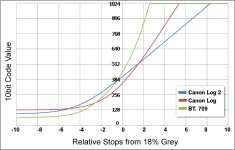
BTW, your punctuation was better when you were cutting and pasting someone else's words.
 
Hi All,

the equation for C-Log is:
Canon C-Log (IRE) = 0.529136 x Log10((10.1596 x Linear IRE) + 1) + 0.0730597

for S-Log it's:
Sony S-Log (IRE) = (0.432699 x Log10((Linear IRE) + 0.037584) + 0.616596) + 0.03

Sources:
CANON LOG CINE OPTOELECTRONIC TRANSFER FUNCTION
S-Log: A new LUT for digital production mastering and interchange applications

I hope that clears up that both of these gamma choices are in fact log curves, and that, sensor white clip aside, highlight compression is of the 'equal values per stop' nature of log when compared to 'doubling values per stop' nature of a purely linear response or the somewhere in between of a piecewise power function (Rec709 or sRGB).

I also have background papers for S-Log2, S-Log3, C-Log2 and C-Log3 and can confirm that those are all fundamentally log curves, albeit in those cases with linear portions in the shadows to simplify the conversion around absolute black. C-Log3 actually has two log sections to fit in with C-Log's midtones and shadows whilst allowing more highlight range, but that is a different kettle of fish and not something to worry about here ;-).

Thanks,

Ben

NB Linear IRE means reflectance divided by 0.9, ie 90% reflectance = 1.0 or 100% Linear IRE, 18% reflectance = 0.2 or 20% Linear IRE. Just to make things interesting! ;-)
 
Last edited:
I did post a chart.. well it came up as a link.. showing the data distribution of these curves.. I think its Bens actually.. and you can see its very different from either Slog.. yes both Log curves.. but in reality the DR of Clog is the same as Hypergamma 7/8.. about 12 stops.. its Log lite.. the new one is more like Slog.

I wasn't hiding the fact that I was quoting someone else.. ?

BTW Were you part of the Dunning-Kruger... :)


Really.. . just looking at the curve its not close.. more of an s shape .. looks like a hyper gamma curve.. the problem was the 8 bit recording.. thats why they came with the new one CLog2.. in the C300II.. thats very similar to Slog.. but the C300 isnt close ?

Donny you're making a tactical retreat from your claim C Log was S shaped and looked like an HG curve by now suggesting you meant Clog had a DR similar to HGs. Part of the Dunning Kruger effect is not realising what what written earlier in the thread is still there...

I'm pleased to say my most junior colleague would know the difference between Clog and HGs.
 
Look at the data distribution chart.. it has a bit of curve as does Slog2.. even my junior assistant knows that clog is alot more like a HG than Slog..

I,ll stick to the Krug.. meanwhile keep up the good work on the Dunning.. commendable you are giving your time for free sir :)
 
Donny,

I really don't mean to sound rude but this thread seems to have got rather personal between you and Nirv and I have to say that fundamentally C-Log is a different beast to Hypergammas. However, that is not to say that hypergammas can't be used as a base for matching to a C-Log camera. Canon's original CP Lock colours are a horror show (in terms of complexity in, for example, ACES IDTs) so if you find you have a good workflow match from hyper gamma then great and good to know your suggestions.

Having said that, to state that C-Log is more like a hypergamma and not a 'true' log is factually incorrect, so for the sake of people coming to this thread and hearing conflicting opinions, I thought I'd better come in with my understanding of things from reading a lot of manufacturer documentation, code and other papers. Apologies in advance for the long, tedious post. I'm a short, tedious man. :-)

Log curves tend towards a fixed distribution per stop, i.e. if you could keep recording higher and higher values the distribution will approach (but never quite reach) an equal distribution per stop; on an IRE vs Stop chart things will tend towards a straight, tilted line in the highlights.

All the C-Logs and S-Logs do this, though C-Log (1 & 3) and S-Log (1 & 2) are designed around relatively poor distribution in the shadows, to allow a reasonable chance of success at 8-bit but also to map reasonably closely in the shadows to the Rec709 that most productions will be graded for (i.e. not too much work for a pretty image). Shadows are reasonably contrasty and dark (though C-Log has quite a high black level) and just as shadow detail is hidden or lost, so too is the shadow noise with it.

S-Log3, C-Log2 and Arri LogC are geared towards higher bit depths (10-bit plus) which allow better representation in the shadows with more scope to pull detail out of the full dynamic range, but with the consequence that alongside the shadow detail becoming more available and (ungraded) visible, so too does the shadow noise (ungraded). All of these are true log curves, albeit that S-Log3, C-Log2 and LogC all get closer to the even distribution per stop quicker than C-Log, C-Log3, S-Log and S-Log2.

Hypergammas, cinegammas and ACES output tone maps tend to incorporate cubic splines in the highlights, giving a 'gentler' rolloff than a conventional hard knee, but still tending towards a flat asymptote, i.e. more and more highlight compression tending towards zero values per stop. On the whole hypergammas and cinegammas don't actually reach that point by white clip, but that is the direction they head in if the sensor didn't clip.

Cubic splines allow for a great deal of arbitrary adjustment or tuning, but this fundamentally makes the mathematics of inversion less clear cut. More and more compression in highlights (on values vs stops a flat horizontal line rather than tilted straight line of log) leads to too few values in the highlights to reclaim detail. Fine for a finished or near finished image, but fundamentally less useful to a decent colourist than an ongoing log distribution. Log as an approach is the most mathematically efficient way to convey image data within a limited bit depth.

I also feel I have to point out that the quotation that Donny made:
"Anyway, back to the Canon C300. From what I can tell, C-Log is an extension of the cinegamma type of gamma curve. It appears to have more in common with cinegammas than true S-log. It looks like the compression starts at around 60% and that there is a little more gain at the bottom of the curve to lift shadows a little. This earlier start to the compression will allow for a greater dynamic range but will mean fewer bits of data for skin tones etc. The raised lower end gain means you can afford to underexpose more if you need to. As the curve is not a full log curve it will look a lot more agreeable than S-Log on an uncorrected monitor, especially as the crucial mid tone area is largely unaffected by strong compression and thus a large gamma miss-match."
dates from an Alister Chapman post back in 2011. Maybe Donny didn't realise how old the post was and most of the points made are valid as you would expect, but it has to be said that the post was reflecting upon a very new bit of gear and its workflow, which was likely to become important. As the first paragraph states:
First let me say that as yet I have not used C-Log in anger, only seen it at a couple of hands on demo events and in downloaded clips.

I really wouldn't recommend treating someone's very first impressions, even someone as knowledgable as Mr Chapman, as being definitive gospel. It is really easy to get the wrong end of the stick about something, particularly if the misunderstanding is actually very subtle and documentation not (then) available, and then really difficult to unpick things. I do it so, so often that I spend ages with LUTCalc assuming I'm wrong in the hope of picking up on all the times that I am. Mind you, most of my c*ck ups (these days) tend to be stupid things in the code rather than mathematical or specification errors.

So, to make far too long a story a bit shorter, all the log curves mentioned are log, hypergammas and cinegammas are something different and to make a suggestion relating to the title of this thread, it might be worth shooting both cameras log, generating versions of a base look LUT designed for each, shoot charts as suggested earlier to fine tune your looks/LUTs and then play away. I have also been told that going Canon WideDR on the C300/C100 then creating a Canon WideDR/Canon Cinema Gamut LUT for the Sony with a bit of saturation adjustment can also work well, though I haven't tried it myself. Alternatively you could investigate an ACES workflow, using a C100 CP Lock IDT and an S-Log2/S-Gamut or S-Log3/S-Ggamut3.cine one for the FS5,

Ben
 
Last edited:
Donny,

I really don't mean to sound rude but this thread seems to have got rather personal between you and Nirv

It's just a bit of banter Ben. I'm not taking it personally and I doubt Donny is. Just a pair of wind up merchants. I am good value down to pub too.
 
Glad to hear it Nirv, in which case sorry for the endless post. I thought it was next stop Godwin's law considering the Dunning-Kruger talk. At least no one's mentioned that yet!*

Ben

* Oops, I mentioned it once, but I think I got away with it.
 
Guys yes sorry.. Im not trying to be personal at all.. Ive had some good witty repartee with Nirv before.. I didnt for one minute think he was getting upset with an idiot like me.. my post re good company at the pub was not sarcasm at all.. I think he a very funny and no doubt very clever guy.. he's very dry .. very amusing .. that Dunning post was genius.. really I was laughing at that once I looked it up.. sorry if you thought that I was being rude.. not intended..
 
Guys yes sorry.. Im not trying to be personal at all.. Ive had some good witty repartee with Nirv before.. I didnt for one minute think he was getting upset with an idiot like me.. my post re good company at the pub was not sarcasm at all.. I think he a very funny and no doubt very clever guy.. he's very dry .. very amusing .. that Dunning post was genius.. really I was laughing at that once I looked it up.. sorry if you thought that I was being rude.. not intended..

That is why he is nominated for the AAA Award, or even AAAA award
 
Back
Top