Mastering sound in post

Since I am currently screening a bunch of films that have been submitted to a local film festival the whole calibration issue has really hit home. There are films that are OK except that there is no way they could get screened with out a remix. The only way to get through them is with a hand on the volume knob.

The cheapest SPL meter you can get is going to be an ap for your phone. It's not going to be terribly accurate, though some are pretty good (a lot depends on the hardware - are the mics in the phone half way decent and is the production consistent enough that a profile can compensate). Because of the last bit iPhones probably have an edge since it's known hardware where an android phone is going to have lots of hardware possibilities. BUT you don't need it to terribly accurate, just repeatable.

For what you are doing the simple calibration is to get or generate some pink noise at -20dBfs. Play that in your editor with all of the software settings at unity (probably 0 on the fader). Bring up the level on your hardware amplifier for one speaker and bring it up to a SPL reading of around 80bD SPL ( This will be pretty loud, you can go lower if you like but always calibrate to the same level - so write down the number you pick). The SPL meter should be at where your head will be when you are working. Mark the dial position with something so you can get back to it. Now do the same for the other speaker.

When you have both speakers going at their calibrated level your reading will be +3dB from your calibration point.

Surround is more complicated.

You can go to the digidesign User Conference and get really detailed directions to do it "correctly" but since you are not in a treated room and this is just a hobby I would probably stick with the simple version.

I think I asked before but if you can't afford speakers why are you buying an audio interface? Especially one with multiple ins/outs?

On the products Focusrite has a pretty good reputation, M-Audio was bought by Digidesign and so might work better with ProTools (if you go that direction) but may have issues if you are using Adobe products because the two companies hate each other, at least that is the history.
Behringer has a very mixed history. Their QA has been traditionally poor so quality has varied a lot unit to unit. When their stuff works it has been of pretty good quality. I have a number of their boxes and I have seen some in places that could afford anything they wanted. Just makesure there is a return policy because I have had a couple of boxes that were broken when I got them.
 
For what you are doing the simple calibration is to get or generate some pink noise at -20dBfs. Play that in your editor with all of the software settings at unity (probably 0 on the fader). Bring up the level on your hardware amplifier for one speaker and bring it up to a SPL reading of around 80bD SPL ( This will be pretty loud, you can go lower if you like but always calibrate to the same level - so write down the number you pick). The SPL meter should be at where your head will be when you are working. Mark the dial position with something so you can get back to it. Now do the same for the other speaker.
I'll check what I can do then. My setup is temporarily. I'll move in less than 6 months, so I'll try to set it up correctly when I'll get my things moved.
As I said, it's a hobby, I want to learn as much as I can to improve my overall quality, but I can't afford something expensive, as it remains a hobby.

Surround is more complicated.
You can go to the digidesign User Conference and get really detailed directions to do it "correctly" but since you are not in a treated room and this is just a hobby I would probably stick with the simple version.
Thanks for the link, I'll have a good reading.

I think I asked before but if you can't afford speakers why are you buying an audio interface? Especially one with multiple ins/outs?
I said I couldn't afford high-end reference speakers. I'd like to have better ones, but for now, I have some Logitech ones that are from a THX certified package. You'll tell me it's more gimmick than anything else, but for now, it's been working ok for me.
I can't afford (for now) to get reference speakers, in a surround setup (FrontL, FrontC, FrontR, RearL, RearR). That's more what I wanted to say.

Also, as I'm not equiped with high-end mics and recorders, I think my sound recording is pretty basic, so no justifications (for me though) to have high-end reference speakers.

On the products Focusrite has a pretty good reputation, M-Audio was bought by Digidesign and so might work better with ProTools (if you go that direction) but may have issues if you are using Adobe products because the two companies hate each other, at least that is the history.
Behringer has a very mixed history. Their QA has been traditionally poor so quality has varied a lot unit to unit. When their stuff works it has been of pretty good quality. I have a number of their boxes and I have seen some in places that could afford anything they wanted. Just makesure there is a return policy because I have had a couple of boxes that were broken when I got them.

If I buy something, it'd be either from B&H (which I think their return policy is correct) or locally, which there's no problems if something doesn't work.
As for now, I simply have to decide what I need and up to how much I'd have to invest. All I need, a simple hardware box that can handle and process up to 6-8 channels for the software.
 
Actually THX is a bit of a gimmick even in large spaces. One of the early requirements (they provided a box for this) was to add noise to the sound to "mask out" leaked sound from other sources. It's chief purpose was to set some kind of theatrical standard since you need to be THX certified to play the second STARWARS film. Being the only real standard for theatres it does serve a use. THX "certification" on consumer gear is kind of a ? since they have no control over how and where it's used so what does the certification really mean? I suppose it means that the equipment won't trash your sound out of the box but?

If your doing 5.1 you also need the .1, ie subwoofer.

Part of the reason that calibration gets more complicated with 5.1 is for stereo you only really need to worry about the sound coming from the front. You don't want a bunch of bounced sound from other places but that is relatively easy to do an adequate job on. With surround you have to have all of your walls treated as a sound source and with the sub bass management becomes an issue.

Doing a good 5.1 mix isn't the next step past stereo, it's many times more difficult.

For instance a lot of low budget hobby filmmakers use a lot of production sound for their FX/ ambiences. That is generally not a great choice but you can squeak by if your lucky. All that goes out the door with 5.1. You need to actually do surround tracks and cover your ambiences. Plan for the sub. etc. You can even cheat in stereo and use your "stereo" production tracks with dialog on them, for 5.1 it's important to have your dialog go out the center speaker and not fly off to the sides. So either all your production is out the center or your dialog is all coming from off screen. Or more probably it will be centered with the phantom center of the L&R and your center speaker is pretty much out of the equation, unless you send stuff to it and then it won't mix with your dialog that is not coming out of the center.

Nine out of ten no-budget filmmakers who "have to do 5.1" have never done a full stereo post, so they haven't even taken the first step. It's like wanting to drive a motorcycle before you learn to walk.

The only reason I work at trying to dissuade folks from jumping in to the deep end is that you are really setting yourself up for one of those disasters that takes all the fun out. If it's a hobby it should be fun. If your making films you really want others to be able to see them or what is the point?

One short I just screened is not playable. The sound is just too horrible and all over the map. This guy has been making films for years and he still sent out this embarrassment. IF the sound was more in control it probably would get in because local guy and all but there is just no way to play this with out having someone sit and ride the level. Really that wouldn't even help because the jumps are sudden and hard to predict. Maybe it's still fun for him but it sure isn't for an audience.
 
Actually THX is a bit of a gimmick even in large spaces.
And I always thought it was some sort of certification that the audio (and video) was top notch. Apparently no.
If your doing 5.1 you also need the .1, ie subwoofer.
I have it, no doubt. It's quite powerful as well for what it is, in my humble opinion. Here's the manual if you're interested to read the specs, if it can change anything.
As I said a couple times, I'm only a hobbyist with good intentions! ;)

Doing a good 5.1 mix isn't the next step past stereo, it's many times more difficult.
I fully understand that. I've started from scratch and learned from basic experiments, but never followed any kind of "tutorial" on how to achieve a good stereo mix, and never properly calibrated my setup... In a way, I've been driving blindly.

[...]for 5.1 it's important to have your dialog go out the center speaker and not fly off to the sides. So either all your production is out the center or your dialog is all coming from off screen.
Usually, the center speaker serves for dialog mostly. But movies like Gravity takes it to the next level using the spatial experience to disorientate the viewer in order to follow what's shown on the screen. If a character moves from left to right, the dialog will follow. It's unusual, but might add to the global experience I think.

Nine out of ten no-budget filmmakers who "have to do 5.1" have never done a full stereo post, so they haven't even taken the first step. It's like wanting to drive a motorcycle before you learn to walk.
I understand that, and it perfectly make sense.
Could I ask how did you learned to do a proper stereo mix when you started? That could help me.

If it's a hobby it should be fun. If your making films you really want others to be able to see them or what is the point?
It's a hobby. It's a funny one. I also like to experiment when I produce some stuff. That's why the 5.1 option was considered. I had the tools to do it, so why not trying it? Could have been a disaster, but I could always rework it after.
Yes I like other people to watch my work. I don't plan to distribute it, but just for the personal achievement of having done a good surround mix, I'd try it. As simple as that. I know I couldn't really distribute it with surround sound, except with Bluray with PCM sound, and even then...
 
Actually probably the best way to "distribute" is to master to Dolby on a DVD and just don't use the logo or mention Dolby. The Player will detect the digital stream so you don't really need to.

Gravity did play around with dialog placement. But there are really sound reasons you don't want to IF you are going to a big screen. On a TV not that big a deal.

The two big reasons not to for the big screen are Volume and delay.

Think front row extreme right with quiet to normal dialog extreme left. Either it will be WAY too loud for the poor shmuck sitting front row left or way too quiet for you on the right. By the back of the house it evens out mostly but front of center and it's going to be a problem.

Delay is also a problem. You brain will figure out the delay and generally put the sound in sync with picture. It's only truly in sync at the mix position in a big theatre. There is about three frames of sync difference between the first and last row of a big theatre. But your brain is quick and as long as the sync is off the same amount for everything you care about it will compensate. But if the dialog (the only think you really care much about) has a diferent delay depending on where the actor is it will cause all kinds of havoc. If you have two actors at the extreme left and right of the screen and you are sitting to one side, one of those actors is going to sound out of sync. Your brain is great at compensating but it only has one delay setting so it's going to constantly be "re calibrating" the delay and someone is always going to sound off, and it's going to be exhausting to listen to.

It's a little like the problem with 3D. The new stuff looks great but it's exhausting to watch. Your brain keeps trying to focus on what you find interesting. When that is what the director focused on great but when it's not what the director focused on your eyes go crazy trying to "focus" on the out of focus bit you are interested in. If it was really 3D you would be able to focus what you wanted, but in "3D" films you can't. Yet.

For where you are and your attitude I would say go have fun. As long as you can roll with the possibility that you kind of hit a brick wall and have to just rethink, try whatever. If your not aiming at a big screen then you can pretty much do what you want.

IF down the line you want to do festivals though, you might then want to revisit what the big boys do and why because some of what is fun on a small project will kill you when you submit.

Of the 20 or so films I have looked at for this festival at least 1/2 I would bounce just on technical issues. Mostly sound, though really bad editing pops up here and there. A good quarter of the films are just not showable because the volume goes all over the place. A bunch of big areas where the dialog is just not understandable, even if you stop and try again (which of course you can't in a screening).

I would read through the 5.1 setup and calibration stuff in the Digi Users Conference (DUC) before you set up the speakers. You don't have to go crazy but if you know how it "should" be set up you will do a better job and it will play back better on other peoples systems.
 
Actually probably the best way to "distribute" is to master to Dolby on a DVD and just don't use the logo or mention Dolby. The Player will detect the digital stream so you don't really need to.
That's what I thought as well. As I said, I don't want to distribute any or my work in order to make money out of it. It's more like a personal achievement. I'd like to have it on DVD/BD with surround sound and be able to say: "Hey, as a one-man band, I've been able to do it all!". Simply!

Gravity did play around with dialog placement. But there are really sound reasons you don't want to IF you are going to a big screen. On a TV not that big a deal.
The two big reasons not to for the big screen are Volume and delay.
I get the point, and it makes more sense now!
Maybe I don't see it that big, as I always have in mind the home theater setup, with one person perfectly placed in the middle of the speakers.

It's a little like the problem with 3D. The new stuff looks great but it's exhausting to watch.
I second that. I think surround sound adds more to the experience than 3D can. But that's me.

For where you are and your attitude I would say go have fun. As long as you can roll with the possibility that you kind of hit a brick wall and have to just rethink, try whatever. If your not aiming at a big screen then you can pretty much do what you want.
Thanks for the words! Appreciated!
Of course I'll eventually hit a brick wall. Already did on my previous project: did all the mix in 5.1 and when I played it back on the surround system, the rear channels weren't loud enough (probably due to a bad speaker placement when mixing[too close]). So, when the track has been "compressed" and downmixed to stereo, it already sounded better. The "surround" was a lot more balanced and with a paid of headphones, it added some depth in the sonic experience, to me.

IF down the line you want to do festivals though, you might then want to revisit what the big boys do and why because some of what is fun on a small project will kill you when you submit.
I don't think I'll ever make any film festival, but I get the point. As I said, for now, I want to make the best I can, but it's just for the fun of it. It's my hobby and I really like that. But I don't think I'll ever make it further in film festival and push it into a career.

Of the 20 or so films I have looked at for this festival at least 1/2 I would bounce just on technical issues. Mostly sound, though really bad editing pops up here and there. A good quarter of the films are just not showable because the volume goes all over the place. A bunch of big areas where the dialog is just not understandable, even if you stop and try again (which of course you can't in a screening).
I perfectly understand that! When you don't have someone dedicated to the sound department, you can easily lose yourself fast. It seems easy, but it's not in fact. Sound is much more complicated that I thought when I started back 10 years ago. I always tried to make it sound as good, but not much more. The more I read, the more I learn about sound, the more I want to invest and make it even better from a project to the other.
But it always come back to the fact that, I do everything, from script to directing, editing and sound...this can also be, exhausting.

I would read through the 5.1 setup and calibration stuff in the Digi Users Conference (DUC) before you set up the speakers. You don't have to go crazy but if you know how it "should" be set up you will do a better job and it will play back better on other peoples systems.
Talking about calibration, what about this SPL meter? I know it's pretty cheap, but is that ±3.5dB is ok, or I'd be better to invest more? You know my actual setup and my needs. If this would do a good job, basically, I'd go with it.
As I said, for now (and the next 5-6 months) my setup is in a basement. I can't add absorption material as they recommend. I'll eventually get a room especially for that when I'll move. But for now, I can't.

Would it help a bit to calibrate the speakers using this SPL meter, or it won't make much difference in the end, as the speakers are placed in a "open" environment in a basement? I'm still reading and learning about wall reflections and other important things like that, but I'm wondering.
Thanks for all the info and the input, much appreciated! :)
 
Surround sound can add more IMHO than 3D because it brings a lot more information to the table than 3D does. 3D is fun to look at and the illusion part is cool, till it gets exhausting, but it doesn't bring more infor mation or a better understanding to the table. 3D is more of an experience for the audience than a story enhancing feature. Surround can add information about the world of the film that stereo can't. When I said "similar to the problem with 3D" I wasn't talking about surround but about having dialog follow the actors. This would be just as big a problem in stereo.

There are a TON of festivals, some very small and very local. I would actually encourage you to think about festival submissions for two reasons. First nobody gives better feed back than people you don't know. Friends, cast, crew, and family are all biased, a festival audience isn't. And there are very few rushes that match seeing a film you worked on screen for a room of strangers on a big screen.

That SPL meeter is fine. The one that used to be semi standard (and doesn't seem to exist anymore) was the analog one from Radio Shack at about the same price.

You can spend $$$$ on a high precision SPL meter and a calibration unit (if you need accuracy you need to recalibrate the meter regularly also) but this isn't brain surgery you don't need great accuracy.
 
I would actually encourage you to think about festival submissions for two reasons. First nobody gives better feed back than people you don't know.
Thanks for the kind words. I understand that. I've posted my last short film and actually never got any feedback here. I've also posted it on another forum. Got interesting comments, mixed as well. But I agree that friends and familly won't ever dare to tell you the "shocking" truth! ;)
That SPL meeter is fine.
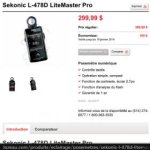
Good! I'll check for that then. I'm also currently checking for a light meter, found a deal on a Sekonic L-478D for 399$, localy. So I might jump on that one first:
Sekonic.jpg
You can spend $$$$ on a high precision SPL meter and a calibration unit (if you need accuracy you need to recalibrate the meter regularly also) but this isn't brain surgery you don't need great accuracy.
Yep, that's what I've thought as well. Might be some kind of precision or quality, but not worth a 100$+ price gap between models I think.
 
I've still got a problem with the idea that volume needs to be calibrated in a studio that is not designed to have precise audio performance, as prescribed by certification needs. We are talking modest budgets here - so room design, construction, treatment and equipment are all potential compromises. The notion of using a cheap audio device to read the volume level in a space, without any form of frequency response equalisation is, in my view, pointless. If we have a system with a 'sub', then unless this sub is sideband, eq decisions will be flawed, putting sizeable LF peaks into the spectrum, that a meter averages out poorly, and giving an inflated version of 'loudness' - so much so that the working volume of the system could be set far too low, making accurate mixing difficult or impossible. I was responsible for running a National examination where students all submitted work recorded and mixed on equipment with a minimum spec, and huge differences between the kit and the rooms really mess up what the examiners hear. After some tweaking, examiners were stopped from listening on headphones which revealed some problems but skimmed over others, so everyone bases their opinion on a fairly average system in an average room for replay.

The room itself really has an impact on the overall sound. There is (to me) no point setting a pre-set level for monitoring in an uncalibrated acoustic environment. Setting the correct level going to tape or file is far more important. Somebody with boomy subs will often produce a bass light recording, and somebody with limited bottom end produces something that is boomy and horrible on somebody else's system. Let's get eq sorted before volume?
 
I think you need to post links in other places since that section probably doesn't get a lot of traffic on it's own.
I posted some comments there.
 
I think you need to post links in other places since that section probably doesn't get a lot of traffic on it's own.
I posted some comments there.

I've posted it to the most relevent place possible I think. Where else could I post it for more feedback?
 
I think you put it in the right place but I think you also need to go to the specific areas (like sound, cinematography, etc.,) and put a link and ask folks to take a look. I think this was my first trip to the "user films" section and I doubt most people check there regularly.

So a post like yours earlier with here is my new film what do people think, will get sound folks to take a look and similar posts in other areas where you want feedback will also work. But if you only post it in the user films section then not a lot of people will notice it's there.
 
I've still got a problem with the idea that volume needs to be calibrated in a studio that is not designed to have precise audio performance, as prescribed by certification needs.
...

The room itself really has an impact on the overall sound. There is (to me) no point setting a pre-set level for monitoring in an uncalibrated acoustic environment. Setting the correct level going to tape or file is far more important. Somebody with boomy subs will often produce a bass light recording, and somebody with limited bottom end produces something that is boomy and horrible on somebody else's system. Let's get eq sorted before volume?

I agree with a lot of that but I disagree with your conclusion. For example IF those different systems that students were using had been calibrated for volume you would not have had that wide ranging level problems. You are right that it doesn't help for EQ but that is a bit like saying there is no reason to turn on headlights at night because it doesn't help millage. The volume calibration is just that. Volume calibration. And yes if someone has a crazy out of control sub the mix is going to be low probably on other systems but that is minor compared to the wild volume fluctuations that can happen when you just set your volume to "whatever" every time you work on a project. One problem at a time. You probably also don't calibrate your picture latency. I don't either but I know a lot of people who do. If you are working with a plasma screen you have a picture delay of up to about three frames. If I get a big budget project in here I will check the picture latency, though with my system it should be quite small, but the box that does it runs about $400 and my curent latency is it's small and doesn't change so...

IF you are mixing in stereo and not using a subwoofer and you are on nearfield monitors the biggest room issue is bounce. If you can get the room fairly dead there isn't a whole lot more treatment you need. You may indeed have bass concentrations in corners etc. but you are working nearfield so that doesn't have much of an impact. If you are not using near fields then yes the room comes a lot more into play. If you are doing a full 5.1 mix then the room should definitely be treated and scoped out. But you won't catch me recommending anyone do a 5.1 mix in a space not set up for 5.1 mixing so we are on the same page there.

I just bounced three films out of this festival because their volumes were so out of whack that the films would be unscreenable. Many of the films had EQ problems and some dodgy sound, but that is not going to kill the audiences ears the way the volume spikes would have.

And as I said I have been in many film editorial rooms, few had much/any "treatment" almost all were calibrated for volume. If not by the facility then by the editor.

I will grant you that when editors were working on mag and even the earlier days of digital few rooms were calibrated because all the levels were going to be set in the mix and nothing you did crossed over to the stage anyway. But since the late 90's anyway tracks sent to the stage come in with volume automation intact and your tracks are expected to play reasonably well with all the faders at zero. So it's become fairly important that your levels are in the ballpark of reasonable.
 
And incase you don't think editors (over here anyway) actually care about calibration the stickie in the Digi Users Conference on room calibration has 286 posts and 9,8731 views. ProTools even has a calibration mode built in.
 
I think you put it in the right place but I think you also need to go to the specific areas (like sound, cinematography, etc.,) and put a link and ask folks to take a look. I think this was my first trip to the "user films" section and I doubt most people check there regularly.

Thanks! I'll do that.
I was afraid that it would look like "spam" and be warned by a mod.
 
I see your point Scott, but frequently we have people on here working to very, very low budgets and they're trying to produce decent output with no real money. They might have a camera, but maybe the wrong lenses, or finance means feeding audio into a DSLR that has poor audio performance. These people have no hope with their room, and have to make the best of a bad job. The people you had to bounce because what was delivered was not just that their room was odd, was also because they presumably misunderstood audio quality in general. I'm just not comfy with the notion that listening level when you are mixing is the cause of the problem. Surely anyone should be able to at least provide the right level on their output medium. Levels that peak too high, or are at a really low level should be obvious - and easily fixable - even visually on a meter. If somebody mixes with their monitors too high, so they 'solve' it by dropping their master level then they've really misunderstood the basics, not the subtle detail. If their room and equipment have conspired together to give dreadful frequency response curves, then didn't they also listen on headphones, a different system or even their laptop to make sure their mix works?

Me - I'm a firm believer that the volume level you mix at depends on the source material. I realise that in the movie world, mixing for movie release, this is not appropriate, because every room should sound the same and a person should be able to move from facility to facility without acclimatising. However for me, this doesn't work. When I'm mixing classical piano, my working level is quieter. When it's rock and roll, it's louder. When I'm doing musical theatre, I'll be editing with the volume in the room up for dialogue, but cutting it for the musical numbers. In speech sections, I really need to hear the background noises. I really cannot mix all this at the same level in the room - my room is just not good enough. For the final mix, then I'll set an appropriate room level and not adjust it for the entire project. Wrong this might be by big budget standards, but it's worked for me for a long time.
 
I also don't edit necessarily at the calibration level. I often edit lower because I'm doing LONG days and if the material is inherently loud, as some music is, then my ears would be shot long before the day was over.

Your mixing with the level set is basically what I'm arguing for and what a lot of low budget filmmakers don't do. The reason to use something to set the volume to a known point is so you can come back to that session and be able to play it at the level you worked at before. You could kind of do that by just marking the dial so you know where to set it back to. The down side to that is it only works where you edited and is not transferable.

My work ranges from projects where my editorial is going to a facility to be mixed to projects entirely in house. If I'm sending them out I do kind of need to be in the ballpark or it looks like I don't know what I'm doing. Also on projects where there are multiple people working on it you want all to be working to a common reference so it's not a big mess when you assemble the parts for the mix. On all inhouse I could work at any level. But I often have multiple projects that have significant overlap and some that get revisited months or years down the line so I want to be able to go back and hear the levels I set.

So I think we both agree that mixing at a set level is very important and basic. The calibration point may have more to do with what kind of projects you do and what your work flow is.
 
It's been a little while since I've posted in this thread, but recently, upgraded to an audio interface: M-Audio 410.
Works well, and I've been pleased with it since I got it. Works a lot better than my old Audigy 2 card.
I'll have to get some decent studio monitors to get with it, but so far, with my speakers, it works pretty well.
 
Back
Top