
Navigation
Install the app
How to install the app on iOS
Follow along with the video below to see how to install our site as a web app on your home screen.
Note: This feature may not be available in some browsers.
More options
You are using an out of date browser. It may not display this or other websites correctly.
You should upgrade or use an alternative browser.
You should upgrade or use an alternative browser.
Main difference between AF100 and 5D???
- Thread starter owaltec
- Start date

KyleProhaska
Veteran
One is a DSLR with video capabilities, and the other is the video camera.

owaltec
Well-known member
One is a DSLR with video capabilities, and the other is the video camera.
I guess I meant in visual quality.

Matt Gottshalk
Resident Preditor
Far less to no moire and aliasing.

Ian-T
Veteran
Full frame vs micro 4/3s which means very shallow DOF vs more 35mm film-like DOF (as what you see in theaters). The main advantage on 5Dll will be low light capability (but that's debatable). Other than that the image from the AF100 holds up better..is more tweakable...more realistic colors.
I really don't know how to answer this question other than the obvious. So why don't you go on Vimeo and see for yourself.
I really don't know how to answer this question other than the obvious. So why don't you go on Vimeo and see for yourself.

DavidBeier
Veteran
Full frame vs micro 4/3s which means very shallow DOF vs more 35mm film-like DOF (as what you see in theaters)
Actually, my understanding is that they're about equally different from your standard Super 35mm film frame. 5Dii (fullframe) is ROUGHLY 60% larger than Super 35mm film and the AF100 (4/3 sensor) is about 60% smaller (unless my math is off). Essentially it means that while both cameras are very close to the range of lenses and DOF one has in your average 35mm production, the AF100 is going have a bit deeper focus and the 5Dii a bit more shallow. Canon ASP-C Cameras (7D, 60D, 600D) and a number of pro HD Camcorders like the RED, Alexa, and S3 all have sensors which are almost the exact same size as 35mm movie film.
Anyway, from what I've judged, the AF100 is a better choice if you can afford it as it's a real video camera instead of a stills camera with video features. Things like real camera controls, XLR mic inputs, real video controls with real zoom lenses, and built in ND filters are just some of the many things that make it much nicer to use. It's more expensive to be sure but not a HUGE amount so considering you can find the body for $4,000 which, compared to a 5Dii body ($2,500) isn't bad given all the extra features you get. Going with an HDSLR makes more sense in the 60D or T3i range since those are WAY less than an AF100 ($800 or $900).
That said, I still am annoyed that the codec on the AF100 sucks. HDSLRS have an excuse for using an uber compressed codec since they're video features are new and they're primarily still cameras. Something like the AF100 is idiotic since it's a pro level camera and Panasonic had great codecs like DVCProHD. Lord knows why didn't think to put maybe a P2 slot on the damn thing so that those of us with HVX200s or other P2 cameras could get some use out of our old cards...
i think its more like 20 or 30% smaller than s35Actually, my understanding is that they're about equally different from your standard Super 35mm film frame. 5Dii (fullframe) is ROUGHLY 60% larger than Super 35mm film and the AF100 (4/3 sensor) is about 60% smaller (unless my math is off). Essentially it means that while both cameras are very close to the range of lenses and DOF one has in your average 35mm production, the AF100 is going have a bit deeper focus and the 5Dii a bit more shallow. Canon ASP-C Cameras (7D, 60D, 600D) and a number of pro HD Camcorders like the RED, Alexa, and S3 all have sensors which are almost the exact same size as 35mm movie film.
Anyway, from what I've judged, the AF100 is a better choice if you can afford it as it's a real video camera instead of a stills camera with video features. Things like real camera controls, XLR mic inputs, real video controls with real zoom lenses, and built in ND filters are just some of the many things that make it much nicer to use. It's more expensive to be sure but not a HUGE amount so considering you can find the body for $4,000 which, compared to a 5Dii body ($2,500) isn't bad given all the extra features you get. Going with an HDSLR makes more sense in the 60D or T3i range since those are WAY less than an AF100 ($800 or $900).
That said, I still am annoyed that the codec on the AF100 sucks. HDSLRS have an excuse for using an uber compressed codec since they're video features are new and they're primarily still cameras. Something like the AF100 is idiotic since it's a pro level camera and Panasonic had great codecs like DVCProHD. Lord knows why didn't think to put maybe a P2 slot on the damn thing so that those of us with HVX200s or other P2 cameras could get some use out of our old cards...
5D has a LOT more shallower DOF
avchd codec is fine. could it be better? yes, but its fine as is.
i have a feeling there will be a HPF1XX or something next year. thats just what i think.
KyleProhaska
Veteran
David is correct that the 5D is much larger than 35mm film. It's the size of a 35mm STILL frame, but not normal 35mm film used in movies, that's closer to the AF100 or Canon 7D size. The AF100 isn't 60% smaller than 35mm film, it's 60% smaller than 35mm FULL FRAME film, which is not what normal 35mm films are shot on. It sucks that the information is so confusing, because the AF crop factor is far less than anyone thinks, and much closer to what shooting on 35mm film would give you. The 5D is like VistaVision.
Ian-T
Veteran
David is correct that the 5D is much larger than 35mm film. It's the size of a 35mm STILL frame, but not normal 35mm film used in movies, that's closer to the AF100 or Canon 7D size. The AF100 isn't 60% smaller than 35mm film, it's 60% smaller than 35mm FULL FRAME film, which is not what normal 35mm films are shot on. It sucks that the information is so confusing, because the AF crop factor is far less than anyone thinks, and much closer to what shooting on 35mm film would give you. The 5D is like VistaVision.
++++++1
Kyle said it better than I did. It's amazing how much people get that information wrong.

Mike Harvey
Veteran
That said, I still am annoyed that the codec on the AF100 sucks. HDSLRS have an excuse for using an uber compressed codec since they're video features are new and they're primarily still cameras. Something like the AF100 is idiotic since it's a pro level camera and Panasonic had great codecs like DVCProHD. Lord knows why didn't think to put maybe a P2 slot on the damn thing so that those of us with HVX200s or other P2 cameras could get some use out of our old cards...
Jan has stated that inclusion of P2 would have raised the cost substantially, out of the range of many in the target market. That is why there's the HD-SDI socket... it helps keep the cost down, but allows folks who want to to add a mountable external recorder.

That said, I still am annoyed that the codec on the AF100 sucks.
Actually it holds up rather well compared to similarly like long gop codecs. And having given it a great deal of thought, I completely understand why they actually didnt go P2. This coming from someone who asked and asked for to begin with.
To make the AF100 remain within a mass market price range it was kept to 8bit, pretty much the standard for onboard recording apart from a few exceptions around this price range. P2 is designed around two Pana codecs, DVCProHD and AVCIntra.
BEWARE MY PERSONAL OPINION FOLLOWS
DVCProHD is an older 8 bit codec. It was a broadcast mainstay for a number of years, but simply the codec is now older, it is not a full raster codec. AVCIntra is full raster 10bit.
So, compared to DVCProHD the newer AVCHD codec is far more efficient and is full raster. To use DVCProHD would be an utter waste as you would need to reduce your overall resolution and it can be argued theres as much info in a long gop full raster codec as there is in DVCProHD. Plus its far more efficient, meaning you can make the choice to stay AVCHD and limit drive space requirements or transcode to a 4:2:2 i frame codec which is more drive hungry but much less process intensive. i.e. it sits well to suit both sides of this price bracket.
AVCIntra as I said is 10bit. Theres simply no advantage to recording direct AVCIntra from the AF100 UNLESS you'd prefer to edit in AVCIntra as opposed to another codec such as prores.
The difference of course would be if the AF100 was a 10bit camera. That would make AVCIntra worth the extra thousands and why I asked and asked for it.
Back OT.
Yes the 5DMKII is vista vision size sensor, minus the resolution. I wouldnt want to watch it on an IMax screen for example. If the 5DMKII came as a video camera with pro video features like the AF100 without the aliasing and moire and with a better codec straight up it would be an even bigger hit than it already is. I had a 5DMKII and IMO still consider it the top dog in the HDSLR's. You can argue the GH2 is far better for aliasing and moire, but the 5DMKII is a 21 megapixel stills camera. YES~ a 21 megapixel stills camera and thats why it wins that market for me. I shoot motion images for a living however.
KyleProhaska
Veteran
Cost benefits in getting a DSLR are taken away as well with the things you'd have to add to it and surround it with that the AF100 already has. Also, size/weight isn't as big of an argument as some think since the AF100 with a simple Nikon Prime weighs as much as the 5D with the standard 24-105. I think the AF100 feels really solid and love the handle on top. The 5D is solid and rugged as well, but it's more compact and heavy feeling like a brick. The waveform, red focus assist, zebras, etc. make the AF100 a better choice for me (although that could be solved on the 5D with a good external monitor). The XLR is another reason. Again, the 5D is a DSLR with video capabilities but it requires lots of other things to be ready for full production use (in my opinion). The rolling shutter, moire, etc. are a big problem but if you can learn to avoid it you'll be happier than most. The AF100 includes internal ND which is FANTASTIC and makes shooting so much faster. HD-SDI out allows for a huge number of recording format possibilities, albeit at higher cost.
The simple way to put it, the AF100 is a cine camera, the 5D is a camera that people are surrounding with things to strong-arm it into being a cine camera. Not saying the 5D can't be used for big stuff (look at the HOUSE finale) but by category it's not a video camera and depending on your needs might not be the best choice. For others, it's the best thing since sliced bread, so look at all the factors and decide what you need.
It's not about your camera, it's about what you and your image/script/characters/etc have to say...

chrismagicc
Well-known member
Watch The Great Camera Shootout 2011 and decide for yourself.
here's the first episode:
http://vimeo.com/24334733
here's the first episode:
http://vimeo.com/24334733
Matt Gottshalk
Resident Preditor
Because to get a dslr to perform like a proper video camera you have to outfit it like this:
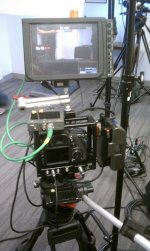
And by the time you've spent all that money, you could have bought an AF-100 instead, rather than a still camera whose video function will always an add-on feature rather than the primary one.
And by the time you've spent all that money, you could have bought an AF-100 instead, rather than a still camera whose video function will always an add-on feature rather than the primary one.
Alpha Beta Omega
Veteran
I have worked with Canon 7D/5D for about two years in different commercials and corporate films and I've used the AF101 since January. I think a DSLR works fine if you don't put all gadgets on it. It will soon become a monster of a camera when you do. The AF101 on the other hand has almost everything already built in so it's one easy camera to operate.
Image quality differs in that a 5D will look great many times straight from the camera but also provide less to work with in grading. You can adjust the AF101 to many different shooting styles and it always grades better than a DSLR. But it will most of the time look lesser, straight out of the camera. In the end there's no problem matching the two.
Image quality differs in that a 5D will look great many times straight from the camera but also provide less to work with in grading. You can adjust the AF101 to many different shooting styles and it always grades better than a DSLR. But it will most of the time look lesser, straight out of the camera. In the end there's no problem matching the two.
To make the AF100 remain within a mass market price range it was kept to 8bit, pretty much the standard for onboard recording apart from a few exceptions around this price range. P2 is designed around two Pana codecs, DVCProHD and AVCIntra.
For our current world, I was happy that the internal codec on the AF100 was long GOP, which is better for some applications with high volume footage like documentary. DVCProHD would have been silly to use now days. For narrative work with a budget or commercial work, I never understood the drama for P2. You can use external recorders on other cameras, and you can continue to use them as you upgrade your gear. A nice external recorder is an investment that could at least make it through two generations of cameras. I don't want to be stuck with proprietary media. P2 would mostly make sense to people who invested in the media some time back.
Now of course 10 bit without long GOP would be better, and that is probably the near future of indie priced professional cameras. As the costs of media and hard drives go down, we will be seeing better codecs. For now, AVCHD is fine for some work, and an external recorder is a decent investment that might outlast the camera.
IMO one of the lesser points on the MK2 is the reason why some people wants it; for the very shallow depth of field.
It takes a lot from the camera operator to keep focus on a moving object in low light conditions even in normal light with a apperture of f4 or wider.
One other very minus point is the fact that the output during recording is not HD, but SD. Only the 7D gives you HD out during recording. If you can live with that, than that is no problem at all.
For commercials the MK2 is an exellent tool, but for making movies, I would stick to the AF100 with B-camera the MK2 or 7d or 60d or T3i or GH2(lately hacked to what panasonic refuse to give the user:thumbup or NIk5100. Oh yeah, you have the Sonies too.
It takes a lot from the camera operator to keep focus on a moving object in low light conditions even in normal light with a apperture of f4 or wider.
One other very minus point is the fact that the output during recording is not HD, but SD. Only the 7D gives you HD out during recording. If you can live with that, than that is no problem at all.
For commercials the MK2 is an exellent tool, but for making movies, I would stick to the AF100 with B-camera the MK2 or 7d or 60d or T3i or GH2(lately hacked to what panasonic refuse to give the user:thumbup
or NIk5100. Oh yeah, you have the Sonies too.I don't think anyone in cinema would consider the MK2 as an "A" cam. The aliasing and artifacts are
quite strong. Plus, you have the shot-length limitation and lack of time-code sync (without external LTC
lines). Audio? forget about it on the MK2.
It's a great sensor and you can get great shots from it .. but .. it has it's limitations as a video device.
One plus for the MK2 is the lens situation. If you like Canon L lenses, there's no problem on the MK2. Until
the Birger mount ships, Canon glass on the AF100 is cumbersome.
On the AF100 .. I think the jury is out on the Lumix lenses and how well they work for video. Having
to re-tool for the MFT format means you have to factor that cost in. The Nikon lens adapters are
pretty good.
You can get PL mounts for the AF100 too. But, you have to plan for that.
If you already have 35mm glass .. the Canon might be a better choice (now).
I'm not sure I illuminated anything with this post
jeff
Last edited:
The relevant question to ask yourself is "does the consumer decide?", and once you made up your mind about that one, do find out the actual answer. You put 100 non-tech peeps in a room on two normal size screens showing random footage, majority would say 5D looks best. On the other hand, you show them a set-up scene that shows AF100 at its best, 5D is a fracking crap camera; because, it is -- if you know what you're doing. Percentage 5D users knowing what they're doing? Compared to the buyer ratio <-> knowing what they're doing with AF100? Stop, let's go back to the initial question... there, no answer, because you can't compare them any more than you can compare 550D and Alexa. It's not relevant, it's not fair, and the consumer still decides (ie, doesn't care a bloody bit EVEN IF she would detect a/the difference).
Will people stop kitting DSLR's because they don't need to anymore? Will people start buying Alexa because it's actually better? And why the heck was there a "dslr revolution" in the first place -- real 1080p cameras were out there?
Yeah, you get the point...
Will people stop kitting DSLR's because they don't need to anymore? Will people start buying Alexa because it's actually better? And why the heck was there a "dslr revolution" in the first place -- real 1080p cameras were out there?
Yeah, you get the point...
Last edited:
DavidBeier
Veteran
Sorry for my misinformation on sensor size. I worried my math was fuzzy and I might have been overstating the smaller nature of the 4/3 inch by a tad.
Not sure if I believe that actually. I think there are certainly a big generation of filmmakers who believe that the more shallow the DoF, the better. I think that largely comes from a shallow DoF being quite illusive for low budget filmmakers who were stuck with 1/3-2/3 sensors and 16mm film all of which have a much deeper DoF. I think this has contributed to a shallow DoF being some kind of holy grail.
That said, I don't think this neccesarily is true of your average audience. I don't think they like super deep DoF from weak directors who can't compose a shot to save their lives but I also don't think they neccesarily go nuts for a haze of blur the way so many aspiring filmmakers do. I think your average audience probably cares a lot less about DoF that we realize and saw no problem with a number of HD films shot on cameras with 2/3 in sensors.
The relevant question to ask yourself is "does the consumer decide?", and once you made up your mind about that one, do find out the actual answer. You put 100 non-tech peeps in a room on two normal size screens showing random footage, majority would say 5D looks best. .
Not sure if I believe that actually. I think there are certainly a big generation of filmmakers who believe that the more shallow the DoF, the better. I think that largely comes from a shallow DoF being quite illusive for low budget filmmakers who were stuck with 1/3-2/3 sensors and 16mm film all of which have a much deeper DoF. I think this has contributed to a shallow DoF being some kind of holy grail.
That said, I don't think this neccesarily is true of your average audience. I don't think they like super deep DoF from weak directors who can't compose a shot to save their lives but I also don't think they neccesarily go nuts for a haze of blur the way so many aspiring filmmakers do. I think your average audience probably cares a lot less about DoF that we realize and saw no problem with a number of HD films shot on cameras with 2/3 in sensors.