
Barry_Green
Moderator
A few months ago I tried to get to the bottom of what "low light" capability means, and to me, it doesn't get much lower than the light given off by a single candle.
A tiny little tea candle, to be precise.
Yes, one of these.

So I set out to light a shot using only one candle as the entire illumination for the scene. This gave me a chance to try out the AF100's 3200 ISO capability, as well as the hyper low light sensitivity of the Voigtlander Nokton 25mm f/0.95 lens.
And the results were pretty good, in general -- I got this:
http://www.dvxuser.com/V6/showthrea...How-about-NO-light-test-with-Voigtlander-25mm
And that was fun and all... heck, people accused me of not being serious, that it wasn't really a single candle after all, someone even said it looked like it was lit with a 300W fresnel!
... but still... I don't know, I felt it was still lacking something. Especially the background. It didn't look like a fully-lit scenario. And I couldn't get any manner of usable edge light or hairlight. Could it be improved on? Could I actually get a complete 3-point lighting setup from one single source (and that source being a single candle?)
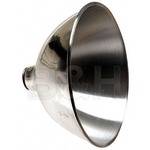
Enter... the parabolic reflector!
http://www.bhphotovideo.com/c/product/53903-REG/Testrite_24_24_10_Parabolic.html
Now, parabolic mirrors are specially-constructed to provide the absolute optimum efficient usage of light. Any light that would otherwise have been lost off to the sides or out the back, well, the parabolic mirror design grabs those stray photons and re-routes them forward. So with that bad boy channelling and focusing all the light that my little tealight candle could provide, I figured we were probably in good position to go pushing the limits to see what you really can accomplish with just one candle.
We were out shooting insert shots and pickup shots for The AF100 DVD, and it seemed like a great time to bust out the reflector and candle and see what we could get. The setting was a sound stage that was painted black. Basically a pitch black room. The light kit consisted of one tealight candle. And the light-gathering equipment was a 3200-ISO AF100 with the Voigtlander f/0.95 lens.
The parabolic reflector really intensified the candle's output. The subject was seriously overexposed (yes, overexposed from one candle!) so we had to move the candle back to about three feet(!) to keep her from blowing out. And we actually used diffusion (so yes, that key light you're seeing is diffused candlelight). The parabolic reflector was big enough that we could cover half of it with diffusion and aim that directly at the subject, and leave the other half uncovered so we had a good strong beam of light that could be caught and bounced around. And with the help of a couple of mirrors, we did exactly that -- we got a good fill light and lit up the background (a deep brown wood flat) and we also managed to even grab some light from above and bounce that down as a hairlight. (You can see how strong that raw beam of candlelight is, look on the couch on the left side of the screen, that's the result of the photon cannon that is a candle in a parabolic reflector.)
And, unlike the prior video, we had full exposure right in-camera. On the prior video I had to bring the levels up in post some, but on this video there was no exposure compensation -- the candle provided plenty of light for full proper exposure. Only post manipulation I did was to mildly adjust the white balance (it was a tad orange) and used Neat Video to smooth out some of the 3200-ISO noise.
And, to satisfy some of the doubters, I also documented the setup so you can see that this is truly a single-candle environment.
Here's the results:
Thanks to cinematographer Billy MacTavish for shaping the light and helping it turn out so nice!
A tiny little tea candle, to be precise.
Yes, one of these.
So I set out to light a shot using only one candle as the entire illumination for the scene. This gave me a chance to try out the AF100's 3200 ISO capability, as well as the hyper low light sensitivity of the Voigtlander Nokton 25mm f/0.95 lens.
And the results were pretty good, in general -- I got this:
http://www.dvxuser.com/V6/showthrea...How-about-NO-light-test-with-Voigtlander-25mm
And that was fun and all... heck, people accused me of not being serious, that it wasn't really a single candle after all, someone even said it looked like it was lit with a 300W fresnel!
... but still... I don't know, I felt it was still lacking something. Especially the background. It didn't look like a fully-lit scenario. And I couldn't get any manner of usable edge light or hairlight. Could it be improved on? Could I actually get a complete 3-point lighting setup from one single source (and that source being a single candle?)
Enter... the parabolic reflector!
http://www.bhphotovideo.com/c/product/53903-REG/Testrite_24_24_10_Parabolic.html
Now, parabolic mirrors are specially-constructed to provide the absolute optimum efficient usage of light. Any light that would otherwise have been lost off to the sides or out the back, well, the parabolic mirror design grabs those stray photons and re-routes them forward. So with that bad boy channelling and focusing all the light that my little tealight candle could provide, I figured we were probably in good position to go pushing the limits to see what you really can accomplish with just one candle.
We were out shooting insert shots and pickup shots for The AF100 DVD, and it seemed like a great time to bust out the reflector and candle and see what we could get. The setting was a sound stage that was painted black. Basically a pitch black room. The light kit consisted of one tealight candle. And the light-gathering equipment was a 3200-ISO AF100 with the Voigtlander f/0.95 lens.
The parabolic reflector really intensified the candle's output. The subject was seriously overexposed (yes, overexposed from one candle!) so we had to move the candle back to about three feet(!) to keep her from blowing out. And we actually used diffusion (so yes, that key light you're seeing is diffused candlelight). The parabolic reflector was big enough that we could cover half of it with diffusion and aim that directly at the subject, and leave the other half uncovered so we had a good strong beam of light that could be caught and bounced around. And with the help of a couple of mirrors, we did exactly that -- we got a good fill light and lit up the background (a deep brown wood flat) and we also managed to even grab some light from above and bounce that down as a hairlight. (You can see how strong that raw beam of candlelight is, look on the couch on the left side of the screen, that's the result of the photon cannon that is a candle in a parabolic reflector.)
And, unlike the prior video, we had full exposure right in-camera. On the prior video I had to bring the levels up in post some, but on this video there was no exposure compensation -- the candle provided plenty of light for full proper exposure. Only post manipulation I did was to mildly adjust the white balance (it was a tad orange) and used Neat Video to smooth out some of the 3200-ISO noise.
And, to satisfy some of the doubters, I also documented the setup so you can see that this is truly a single-candle environment.
Here's the results:
Thanks to cinematographer Billy MacTavish for shaping the light and helping it turn out so nice!
Last edited:


