Loose lens adaptor? Try this fix!

Logan LeBlanc

Well-known member
I'm mainly doing this to save someone time/energy. A lot of these cheaper adapters (Fotodiox, etc...) arrive loose or may become loose over time.

This is how to fix it.
NOTE: Some adapters may not have these notches!

1) Find a small flat head screwdriver and slip it into each of the notches.
2) CAREFULLY Turn the screwdriver, bending each notch equally. It's probably a good idea to keep a lens close by to fit it.
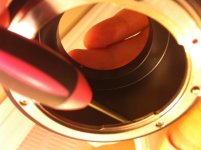
photo 1.jpg
That's it!

Hope this helps someone.

LL
 

Attachments
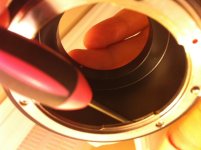
  • Pic Rotate.jpg
    Pic Rotate.jpg
    64.5 KB · Views: 0
Last edited:
I had the Fotodiox... it literally fell apart in the middle of a shoot (with the lens still attached!). My fix? I ordered a Novoflex two days later. I think that's what Shooter has in mind as his solution. Seriously, it's worth the coin to not have to worry about it.
 
I have the novoflex which is a more expensive adapter. I needed to do this trick to tighten it up as it loosened over time. I also did this to a cheaper adapter- just a heads up, you definitely can make things too tight, so be careful
 
I have many cheap adapters I bought on Ebay that are still tight. A couple I've bought have been loose but the majority have worked and continue to work quite well. Maybe leaving them on the lens makes a difference over time.
 
The screws in the Fotodiox definitely become loose but some thread blocker does the trick.

Thanks for the replies fellas, but I'm not sure how helpful the "man, cheap adapters are crap man" posts really are.
Everyone knows that you get what you pay for. This is simply a fix; that's it.
 
I'm only saying that because it becomes exhausting seeing it eeeeeevvvveeerryyy thread.

In my tiny pea brain I'm picturing someone following your advice, not knowing how far out the tolerances are on the adapter, bending with a screwdriver, overcompensating in the other direction, and then screwing up the lens mount tolerances on the lenses you attach.

I think I prefer Craig's common sense advice!

All the Best!

Dave
 
Having owned Fotodiox adapters (5 for different mounts) for two years, can't say that I've ever lost $150-250 worth of time/fuss/worry in adjusting them (let alone $1250). A while back I thought I'd splurge on an authentic Panasonic MFT-Leica R adapter, but it really wasn't significantly better. Sometimes, it's the only sensible choice, say, if you have only 1-2 lenses in a particular legacy mount that you don't even use often. Little tips like this help get the most out of these lenses the few times you use them... heck, you can buy one for each lens, leave them on there, and still be well below some of the specialty offerings, costwise.

Novoflex is nice if your budget and inclinations can afford it. If you're reasonably observant, careful, and handy and prefer to have an extra $250, Fotodiox and its ilk are just peachy.

I'm not certain why some people get torqued off that others aren't spending as much money as they are.
 
If I use a relatively inexpensive adapter on an SLR lens, like the Metabones Leica-R, I buy one for every lens and use 1/4" black gaffers tape to permantly secure the lens. I don't have the Fotodox, but I will say that even the pricy Novoflex adapters that I have for FD lenses need tape - of course it could be the fault of the older lenses. But even then there's some play at the camera mount. The best adapter I have is a Panasonic, it fits the camera mount well - unfortunately it's on a lens I don't use anymore (14-54 Zuiko).

I don't like adapters much. They just aren't as good as they were before they were mass produced (ie, I have a CA-1 to Aaton adapter that I bought from Birns & Sawyer in 1992 that is still snug, and feels very precision-built). It's one of the reasons I've accumulated some native MFT lenses like the Noktons and the new Lumix zooms.
 
I'm not torqued or hating that someone was being thrifty... but after having a lens fall off in the middle of a shoot, I'd just rather not take any chances :)
 
I'm only saying that because it becomes exhausting seeing it eeeeeevvvveeerryyy thread.

There are a lot of pros here and I suppose that's why. Sometimes, as in the case of most tripods and fluid heads, to name two examples, it is absolutely correct (excluding Manfrotto and some other pretentious brands). But paying 10x what you can for extra batteries, to list one example, just baffles me. Lens hoods, too, especially (ones that are specifically fitted for a particular lens). Or you can pay $105 for an 11" magic arm or $15. On B&H's site, there's a complaint that the $105 one wobbles with a 5d and 24-105. A lot of times, it's the same exact product made by the same exact factory. Simply the brand name is missing. Anyone who has been to Hong Kong understands this.
 
I can understand that there are pros, but some of the replies are pretty useless. Take the tip from the threads in the spirit in which they are given.

If you don't have the adapter etc./any useful input, why bother putting anything?

Promise. Last post about this, haha.
 
The screws in the Fotodiox definitely become loose but some thread blocker does the trick.

Thanks for the replies fellas, but I'm not sure how helpful the "man, cheap adapters are crap man" posts really are.
Everyone knows that you get what you pay for. This is simply a fix; that's it.

Word. Good tip, thanks for it.
 
Here is another side to the "you get what you pay for" angle.. to contemplate

I purchased a well reviewed and very expensive adaptor as soon as I got my AF102.

We , soon after , discovered this seemingly well engineered and precise fitting adaptor had a serious issue. It leaked light!

We advised the manufacturer..with our tests , conclussions and advice.

They redesigned it (and gave us a new one).

But generally " you get what you pay for" is still advice that stands the test of time and experience.

Totally understand that a forum like this has a mix of pros and indies and budget and attitudes differ to suit needs. No problem with that but the caution is still worthwhile.

"The cure can be worse than the illness"
 
I'm a big fan of Shooter and his work, but I think he was a bit quick to criticize here. Frankly, I don't understand the concept of people choosing up sides on advice about something as simple as adjusting the leaf springs on a lens adapter.

What the O.P. details is the leaf springs that many adapters use -- even some of the expensive, name-brand ones. These can be carefully adjusted to tighten, or loosen, how the lenses fit onto the adapter.

I have made such adjustments and it has helped achieve a better fit -- again, even with my pricy name brand adapters.

If you don't feel competent, or mechanically-inclined enough to adjust the leaf springs in an adapter, then by all means, "Don't try this at home!" But, this whole concept that people are choosing up sides on such a thing is just absurd. The O.P offered a tip that can apply to any adapter, cheap or expensive, that uses such a leaf spring arrangement, use it or don't, it's your choice.

NOTE: There are typically three such leaf springs. If you do attempt this, try to adjust them all evenly. Also, employ caution and adjust them in very small steps.
 
Back
Top