lighting for green screen cove

I'm in the process of building a green screen studio for our company to be used both by us and to rent out as well. We plan to rent out as either an empty studio or as a fully equipped production facility with grip and lighting package. I'm trying to figure out some gear to purchase for the actual lighting of the cove. It's a 2 wall cove approx 15x30 feet. We have a decent set of lights that we've amassed from our own productions - kino 400s, flathead 80's, arri 1ks, 650s, etc, but wondering what to buy for the actual cove lighting - a few space lights/skylights? Perhaps a set of knock off kinos? Cyc lights? On smaller green screen shoots we normally light with kinos, but on a cove this big I have no idea what would be the best choice that hopefully won't break the bank to purchase.
Any suggestions would be appreciated.
 
Can we infer that the lights listed meet your internal needs and any additions would be in support of potential renters?
If your needs are met, I'm thinking location dictates potential rental market impacts what a prudent budget might be.
If you edit your profile or otherwise reveal your location you may even get some responses from actual potential users.
 
Profile edited. Thanks for the feedback. I'd like to keep the flatheads available for talent preferably... plus I don't think they'd cover the full cove evenly. I'm kinda leaning towards a handful of kino knock offs hung from the grid, but I'm not sure this is the best or most economical way to go about things. I think 8 lights (4x55w) might work. I'm probably leaning towards this option as it's closest to what I've done in the past on a smaller scale.
Thoughts?
 
Personally, I'll never go back to tungsten for lighting a screen. Flos just do it so well.

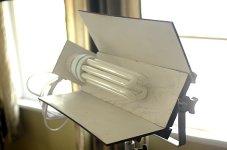
There are really (to me) two overall greenscreen lighting scenarios: one being where you want fairly soft natural light for the finished key, and just have a lot of HMI bag-style fixtures hanging, some flagged towards camera. The other is more dramatic lighting, where you try to only hit the screen. And you really need some physical depth for this, to separate the talent from the BG. The biggest issue with lighting this style of screen is the lower center of the screen; flos up high and on the side can make sort of an inverted "U" of light. I finally made some DIY fixtures that hold those really big 85 watt flo bulbs. They filled the trouble spots quite well, but needed to be kicked down with diffusion - they are really bright.

I had a lot of 1/8 plywood scraps and some 1/4-20 knobs and tossed these together in an afternoon. They look fairly DIY but break down flat and are insanely handy - haven't seen a commercial fixture as useful as these for specific needs. Intense, somewhat-soft but pretty directional. Throw in that including the bulb and stand adapter (these use china ball fixtures screwed into a round hole) they're about $40 a pop.

diy-flo.jpg
 
Thanks Michael, something like your DIY project seems to make a lot of sense. I wish there was something exactly like that, but pre-made, but perhaps the DIY route is the way to go.
 
Cool lights used to sell a small softbox using those big bulbs and it was affordable - thing is, every use of the big tubes has been "straight out" from the socket, and doing it horizontally like above worked better for my needs.

I gotta say, I use the heck out of those things though. For my uses they don't look like duct-tape DIY and my clients don't view them as such, probably because I bring so much damn gear to a shoot, and they seem to fit right it.

Twin-biax flo's are really quite similar light-wise though, and these days you can find them for well under $200. I even have some of those cheap plastic "flo light" jobs with the goosenecks. The goosenecks pretty much suck the rectums of roadkill donkeys, but they are crazy-lightweight for a twin biax - I've even hung them from ceiling grid clamps with no problems. I love love love a twin biax for rim/hair lighting - the shape is really nice for getting that "hard white" edge that reaches the edge of a cheek bone and shapes hair and shoulders.
 
Back
Top