Lighting Cars

A client of ours has a car dealership. They have a big indoor room that they want to use to photograph or take video of their new cars after they’ve been cleaned and processed so that they can put the images on their website. The cars will be various colors from white to black and everything inbeteeen. They asked me:

1. What color should they paint the room?
2. What lights should they buy?
2. How should they setup the lights for the vehicles?

They want to make it easy, so they can just drive a car in and shoot. Any ideas?
 
Start with the room dimensions including ceiling height, along with any details like are there any windows in the room.

A general budget would also be applicable for lighting and installation.

Also is this going to be dedicated to this use, or will it be a multi-use room with prospective buyers entering as well?
 
I believe that the room will be strictly for photographing cars. The client will have their own photographer do the shoot (probably not an expert), so we need to keep it simple. I think they really just want to hit a light switch and be ready to shoot -- which doesn't seem completely realistic to me. I don't believe it has windows. I am going to check out the location soon. I was going to suggest:

Use a camera with a circular polarizer to cut down reflections.
Use a 50mm lens (or more telphoto) to make the background smaller/more compressed (not a wide lens).
Paint the walls gray, so it looks good with both dark and light colors.
In case there are windows in the room, use daylight balanced bulbs.
Build a big soft light above the car using silk? I am not 100 percent sure about this. Will you be able to see the silk reflecting all over the car? Are they better off with just using a few big soft lights on the floor?
 
Usually a white cove with a full overhead diffused light.

Polished cars are mirrors, anything else will reflect.

Yep. If the ceiling is high enough, a humongous light box (minimum of like 20x20 feet) is your best bet. With cars it's all about controlling the reflections off the cars.
 
Thinking on a more architectural/construction grade, perhaps assembling 6 or 9 2'x4' florescent light fixtures into a 6'x8' or 6'x12' soft light surface area. This will allow them to change bulbs easily and easily wire into the circuitry of the building. This will be your top source. It is recommended to skirt it a little with some duvetine, so that you can isolate that top source mostly to the car, keeping it from hitting the background as much as possible. The reason being is that you then want to have a few of the same florescent housings all connected on a dimmer, to light the background. This way, if you have a white car on a white background, you can dim the background to make the car pop a bit more.

While I said florescent, it could also be LEDs.

https://www.1000bulbs.com/product/192376/PLT-20021.html

The drawback is that the color rendering is not as good as professional lighting equipment for photo/video, but if it's just for their website for non-professional use and such, this may be an approach.
 
1. So it sounds like a white background is the way to go. Light it pure white when you need it to be that and then dim it if you are dealing with cars that look bad on a white background?

2. For the above lights, perhaps use standard florescent fixtures to save money. Would you need to add silk below the lights for more diffusion? The black duventine would help control the light from above and keep it off of the background, right?

3. As far as the floor, they will be rolling cars in and out of there a lot. There's no way they will want to paint it white -- they would mark it up in no time. I wonder if a black surface would stay cleaner?

Thanks for these great ideas, guys.
 
This seems like a job for qualified builders all round - I would limit my involvement to "consultant" (and charge "consulting") fees.

I'd certainly use led - maybe commercial not "cine" fixtures
 
Just so you guys understand, this client appears to be photographing cars in a large room with existing lighting with an iPhone. The walls and floors are not in great shape. They photograph all of their used inventory after it has been inspected and cleaned. The owner is not happy with the look of their photos and asked how we can turn the room they use into a better place to shoot. Baased on your feedback and my research, I am going to tell them this:
---------------------
Current Room/Photo Examination

Issues:

1. The wall has doors, windows and a rough paint job. This distracts from the car.
2. The floor is messy. This also distracts from the car.
3. The light in the room is not ample. The individual lights in the room can be seen reflecting on the car.
4. The camera is shooting wide angle and the photographer is close to the car. This is not a flattering look. The shape of the car appears distorted in the shot (see the nose of the car).
5. Some of the exterior car shots are too bright or too dark.
6. Interior car shots are lit harshly.

How to fix these issues (the basics):

1. The wall should be flat, with no visible doors or windows if possible (no outside light should enter the room). The walls should be painted flat white (not glossy).
2. The floor should be finished and easy to clean. It should be a material that is not shiny or highly reflective.
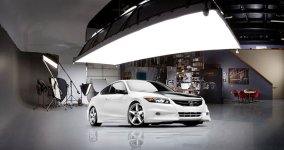
3. The light in the room should come from overhead. A bank of LED lights should filter through a large Silk (or some other Diffusion Material). This creates 1 large soft light that is bigger than the car or truck that you are photographing (typically around 20x20 feet). No individual lights will be reflected in the car. The car will be evenly lit with no harsh shadows. Pro video shops sell this equipment, but it might be too expensive (depending on your budget). Industrial lighting fixtures may also work and save money. All of the bulbs used should be the same color temperature (around 3200 or 5600 degrees Kelvin). These lights must also not flicker.
4. A better quality camera should be used with a zoom lens. Zooming in to around 50mm and standing further away from the car will show less background and not distort the shape of the car. The camera must also have the ability to be white balanced so that colors are captured accurately. The photographer needs to understand how to adjust exposure and focus.
5. After the cars are photographed, the photo files should be brought into a program like adobe photoshop where they can be prepared for the web. Minor adjustments can be made here to fix pictures that are too dark, too bright or need to be cropped.
6. A moveable, dimmable LED light on a stand with a soft box on it can be used to light the interior of the car (when shooting interior car shots). This will look more natural (less harsh) than the current way you are shooting interior car shots (with a flash).

How to improve the shots even more (more advanced steps):

7. If we want to take the studio to the next level, the white wall background can be lit with dimmable LED lights (strategically placed to prevent reflections on the car). For darker cars, the lights can be at full brightness to create contrast between the car and the background (making the background more white). When a light colored car is being photographed, the background lights can be dimmed (causing the background to look gray). This will also improve contrast between the light colored car and background.
-----------------------
I believe that if they even follow a few of these suggestions, their pictures will look a lot better.
 
Great idea about the flooring.

So let’s say the client goes for the 20 x 20 overhead light box. He mounts the led industrial lights in the ceiling and hangs a silk from b and h below it. How many lights does he need, how far apart should they be from each other and how far from the lights should the silk be hung?
 
A client of ours has a car dealership. They have a big indoor room that they want to use to photograph or take video of their new cars after they’ve been cleaned and processed so that they can put the images on their website. The cars will be various colors from white to black and everything inbeteeen. They asked me:

1. What color should they paint the room?
2. What lights should they buy?
2. How should they setup the lights for the vehicles?

They want to make it easy, so they can just drive a car in and shoot. Any ideas?


Continuous spectral highlight.

Automobiles are essentially mirrors. Whatever the source, it will be reflected in the paint / metal surfaces of the cars. If the source is not a single, continuous sources but instead multiple sources the reflections of the source on the car will be multiple reflections. Imagine lighting an 8-ball. If you light the 8-ball with 3 sources, there will be 3 reflections on the 8-ball. If you light the 8-ball with a single source, there will be one reflection on the 8-ball. If the source is small ( a point-source ) the reflection on the 8-ball will be small. If the single-source is large ( a broad-source ), the single reflection on the 8-ball will be large and continuous. The reflection will be uninterrupted.

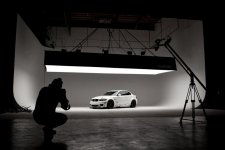
Generally speaking, when automobiles are lit professionally for photography a very large single-source is used. Most times a soft-box the same size as the vehicle or larger than the vehicle is used.


I just don't see it being likely that any auto dealership would install the sort of lighting needed to produce the photographic result seen in professionally lit car commercials. Such would entail a ceiling that is one giant soft source. A single-source achieved via diffusion. The lighting used in professional lighting is of a temporary nature. That is, the lighting isn't designed to exist permanently.

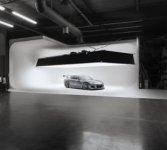
Were the facility to install lighting of a nature similar to lighting that is used on car commercials, it would entail something along the lines of a bank of florescent lights in the ceiling grouped as closely together as possible and concentrated in an area of a size roughly the same size as the floor area occupied by the vehicle, a single or double layer of some sort of diffusion between the lighting units and the vehicle, all fixed at a height as low as possible over the vehicle without entering the "frame" of any photography, and, depending on the distance of the walls from the vehicle, "cut" off the walls of the space. That is, "contained" so that the spill hitting the walls is minimal. Essentially a high-sided, giant, inverted "bathtub" of soft light.


photography-studio-a-bp-imaging.jpg

9455737598_9de2415175_b.jpg

photography-studio-a-bp-imaging.jpg
 
I totally agree - I currently use an F2 Chimera Box which I believe is 15 Feet x 30 Feet and I power it up with a bunch of Power Packs - I have it rigged so I can easily move it around and lock its position with a C-Stand

ROCstudios_F2Box.jpg
 
I too have my doubts about building this set, & would suggest they look for a outdoor space where they could photograph the car at dusk. If they have a good wall, & some open sky, they might even be able to pull it off in their parking lot.
 
Back
Top