Lighting A Home Studio with Chroma Key

Ken1212

Well-known member
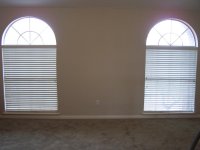
I am hopping some of you can help with ideas on how to setup a chroma key studio in my 16ft wide by 20ft long room and a 9ft ceiling. I have two windows where I plan to put the green screen which is the 16ft wall, I am attaching a photo of the two windows. This is a game room with another window on the far side wall and a wide open entry on the opposite side of the widows that generates daylight from three windows in the living room. All windows have blinds with the exception of the upper half moon section as pictured. My goal is to set up a 10ft x 20ft green Muslin. I prefer to use the 16 wall with the windows so I can use the longer depth to setup my camera. I need to be able to take full body shots.


First of all do I need to totally block the light entering from the two windows with a black curtain, or is it okay for that light to hit the back of the green screen (notice the sun never enters through the windows). I know I need to use lights with at least 5000k because of the daylight coming in.

Second is replacing my ceiling light fixture to a one or two 4ft Fluorescent fixtures with 4 banks each to light the floor a good idea. I have some 4ft lamps that are daylight temperature. can I buy fixtures and electronic ballasts at home depot.

I am doing this on a budget, I already have few Fresnels including a Lowel DP Kit which I can use some CTB with, but don't want to overload my circuit and they can get hot. Do you recommend the three light fluorescent kits on eBay for about 300 to 400 dollars.


Would it be better to install a rail in the celing with pantographs.

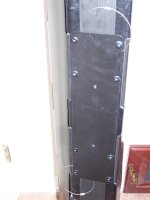
I am attaching a photo of the back of a Vedenssence Fluoresent fixture that is like a Kino Flo, I've three single bank fixtures, can I use those and how would I mount it, please see photo attached.

Thanks for your input.
 

Attachments

  • 100_5244.jpg
    100_5244.jpg
    67.7 KB · Views: 0
  • 100_5245.jpg
    100_5245.jpg
    38.6 KB · Views: 0
Absolutely block the windows. You want to have 100% control (or as close as you can get to it) of the light in the room.

The trick to the greenscreen is getting even light over the entire thing. Fresnels and open face lights are not your best bet, even with diffusion. Fluos work well because they're long and even, and work with the green of the screen instead of against it (assuming they're standard or daylight fluos and not tungsten-balanced, of course).

Keep in mind that with the wall color you have, and the almost-certainly white ceiling that goes along with it, combined with it being a smallish room (for greenscreen), you're going to have green bouncing everywhere. There will be much spillage, so you're going to have to take steps to counteract it, probably both by trying to cover as much of the walls and ceiling as possible, and also with how you light your subject.
 
If you really gotta do this -

Get some flo's; get a couple twin-biax jobs for the side walls ($200 each if you look around). Get some baby nail plates for the side walls - you have no room for stands.

You can hang 4' twin flo banks from the ceiling. Just use the chain that comes with them, you can control the angle just fine with them. The biax stuff may outgun the 4' shop lights, so get some white mesh or gauzey-stuff - just wrap it around the flos to cut them down a bit.

If you're going to go stand-less, try to mount things to studs (get a stud finder). A nail plate can support a fair amount of weight with good drywall anchors (like a small flo, not a 2k fresnel). Look for the new kind of drywall mounts that don't require drilling a hole first - they have a phillips slot around the screw hole, and you just drill 'em into the wall. Less mess and very fast.

If this will be a semi-permanent screen, get some 3/4" thick lumber and make a frame that will allow you to stretch the screen with a-clamps. Basically you want to "lift" a flat surface a couple inches from the wall - think of a "C" shaped channel made of 3/4" lumber, with the open end pointing to the sides. You can stretch a screen on this and clamp it. (You can even staple it but it will stretch over time. Unless you have a hell of a camera & codec, you want to get rid of every wrinkle). You won't have decent room for BG stands. And paint your walls and ceiling black, or staple up some savage seamless (comes in 9' wide rolls and 3' wide rolls).
 
Can you bounce light of the white ceiling to light up the screen?

For the upper portions of the screen this may work, but you need a lot of light. You will most likely need to light the sides of the screen too, depends on how tall your shots are going to be.
 
My screen will be 8 foot high, 10 feet wide and about 10 feet of flooring space. I just don't want to have to paint the room black. Do you think Aftrer Effect or Premiere CS5 will do a good job on spills, or do I realy have to paint ceiling and side walls black or use black paper?
 
If you want the best results, you need to get rid of as much spill as possible. If it were just a little spill around the edges, then software can do a good job of dealing with it. But in a room like that, green haze will be coming from literally everywhere. The shaded areas on your subject will definitely pick up some green, and it'll key out along with the greenscreen. Software can only compensate so much. You'll have to do layer after layer of work and getting a passable key will be a ton of work.

What do you plan to do with this studio? If you're going to be doing a lot, and particularly if you're doing it for money where pristine results are essential, then you'll want the most ideal environment you can get. If you're doing it only occasionally and for your own hobby purposes, then perhaps you can live with the results or the tons of extra work you'll have to do.
 
To help get rid of spill then it makes sense to use the smallest green screen size that would achieve my needs! What is the least length that I could use for a full body shot and still get the proper key, assuming the height would be 7 feet.
 
You just need a screen which will cover the entire body and any movements (arms, etc.). As long as the subject is entirely surrounded in green, it's big enough. Everything else in the frame can be taken out with a garbage matte.

However, as you want some distance between the subject and the greenscreen, that'll still be fairly big. And you want a true full-body shot, head to toe, you'll need to have it on the floor, too. (Numerous ways of doing that.)
 
In the second Hollywoodcamerwork DVD series called 'Visual Effects for Directors' there's complete information on all the different kinds of greenscreen setups including immersive setups if you want 3D tracking etc. They cover making your own greenscreen immersive studio in your basement as a step by step guide as well. A lot of people have already covered the basics here with good advice. Effective greenscreen isn't that difficult with a bit of practice. The main thing is to separate lighting the screen from lighting the talent and eliminating as much spill as possible by using something like black duvtyne to cover and drape over areas which are going to be garbarge matted out.
 
Thank you guys. I just have a scenario where I am doing this at home in our game room and have limitations with size and being an open room I am trying to do with out using black paint or paper. I am thinking 7 feet high plus 8 feet floor that gives me a total of 15 feet muslin. In this case I can have my talent about 6 feet away from the screen. I am going to try it with my Lowell DP light kit, I've three of those, a Lowell tota, and a Richardson 1000k soft zip. I am going to use some gels on the Lowell's to soften the light.
 
Last edited:
We have two sizes of seamless green screen paper - 9' wide and 12' wide. They are 36' and 50' long respectively. As David said, you can simply crop out the offshoot with garbage mattes, but it is nice to have some room for the talent to play from side to side. What is good for portrait photography isn't usually good for widescreen format video work.

A product that you might consider is the Poker light from Westcott - which give you a big soft source for illuminating your backdrop. They have skirts and you can drop different fixtures into them, depending on your set-up.

e
 
David I was able to setup a 10'wx16'h green screen as follows, I am using three cool white 4100k single fluorescent tube fixtures, one on each side and one from the ceiling and screen is lit nicely. One tungsten talent background light with tough minus green gel, two lowel DP's for Key and fill with 1/2 and softbox on fill. Should I be using minus green on the lowel tungsten?. Also the green spill is major, even though I was able to get an acceptable key in adobe, I need to do something about the walls and ceiling, Is there a particular gel I can staple to the drywall that would kill the spill such as the Tough Minus Green Or ND? Is my only option to paint black or black blankets? Lastly the talent would be standing straight middle under the ceiling lights which uses two household bulbs, should I keep them off or can I place couple 4100k CFL bulbs to help light the front portion of the floor.? Thanks
 
You need some graph paper and a scale;e drawing of the room in section and elevation, and a bit of maths to give you your lens field of view in horizontal and vertical planes - then you can see how screen size, subject and camera distances work.

Spill is a HUGE factor in keying quality. Especially when you have people with no hair. Light skin tone picks up green spill so easily. If you are dedicating the space, then personally, I'd have white walls and then dark curtains on a track so you can have both. I love white ceilings for bounce, but for green screen it's a pain, so I'd have the ceiling between subject and screen black. In studios light needs to be controlled. I do a fair bit of green screen in clients premises and windows and white ceilings cause me the most grief. I can cope with slightly uneven screens and a few shadows because one machine here still has the original Serious Magic software, before Adobe bought them and ruined it - and it copes well with uneven green - but skin tone tinged with green, or worse still, white shirts - make a nice clean key very difficult. Especially when you only get to try it when it's all shot and people have gone!
 
Thank you guys for the input, vey helpful. Dave I like the idea of the linoleum and thanks for the paint color coordinates. Since I already bought a green screen will try to use it and get my money's worth for the time being. I do like the idea of harder material to walk on though. Since the room is smaller I am debating between black foamboard or black shipping pads such as the ones used at U-Haul (Leaning towards the pads as it will help with audio), I also thought about a rail with black curtains as Paul suggested. Do you guys only use minus green on the back ground light or can it be mixed with my key and fill lights along with CTB? How will that change my color temprature as I am using 4100k fluorescent tubes on the screen?
 
Back
Top