Lighting a dining room in a mansion

sdanzig

Member
I'm in pre-production for a no-budget short black comedy I'm going to shoot in mid to late August. It's set in a secret restaurant that serves human meat. Everyone but the protagonist acts completely normal about it.

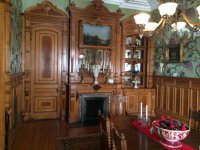
I managed to get permission to film in a mansion for three days, six hours each, and the main day scene will be in the first floor dining room, shown in the attached picture:
dining_room.jpg

I want the room to seem opulent, but not particularly moody. That's reserved for the kitchen scene. Here's a reference pic that shows what I'd be happy with:

reference.jpg

3 will be seated mostly along the left, with the hostess appearing on the right, in front of those glass double doors that lead to the solarium, and I'm shooting from various angles. The protagonist will be standing when returning to the table for one shot, seeing his. We don't have free reign to put up tape or cat poles, etc, and we need to completely clear out our equipment each day.

I'd like to confirm what I'm doing makes sense and get advice on anything I can do which might result in a better product and/or make life easier.

There's light spill all over, but I'm able to block out most of the ambient light. I can close the thick window curtains. I can tape duvetyne behind the glass doors, but it's cheaper and maybe quicker to set up my large photo background frame with a black sheet over it in the solarium (rather than messing with a ladder, as the doors are 10 ft/3.3m high). I'm thinking, throughout the three days, I can try to get whatever wider shots I need (including the window and the glass doors) when the light is about right, and then otherwise angle it so it's just solid walls in the background, or tight and blurred. I thought about maybe hanging something that looks right on the photo background, or maybe even the green screen, but I figure I shouldn't rely on that looking right.

I would have wanted to have the overhead light on, but I'm planning to have it off for simplicity's sake.

For lighting, I have a Rayzr 7 300-Daylight (a pretty bright LED fresnel), a Lowel DV creator 1 3-light kit (with 3 tungstens: 750W broad light, 500W light, and a 200W light), and a lot of 20x24" rosco color correction/effect gels. When everything is closed up, I was planning to bounce the LED set to wide beam off a white board. Then use color correction gels over the tungstens coming from the solarium and from the other side, although I'll have to soften those too. I'm wondering what are some go-to strategies for softening lights are that maybe I'm not considering. All are dimmable. I'd be nervous about using all four lights. I'm not sure if I'll have access to a breaker box.

I'm shooting on a Sony a7sii and have 24mm,35mm, and 90mm lenses. I'll probably be using the EC1 Beholder gimbal stabilizer for some shots. I'm planning to crowdfund and spend up to $2k on this film, but cast and crew are working for free, and I own my equipment.

My cinematographer and I, and a small crew including an experienced grip and a sound guy, have some experience, but I'm sure it's going to be tricky, and I probably won't have much opportunity if at all to experiment beforehand. Any advice is appreciated, and I'll add another picture, or an overhead diagram later if you guys think it'd help.
 
I think your challenge is blocking.

These locations eat light.

If you are keeping the windows out of shot (or it is night) then all should be good.

Shooting against those windows.. well your recce shot demonstrates the problem.

--

I was on the set of Sense and Sensibility.. they built full black boxes tents outside with large HMIs in them to control the light.

--

If you keep the windows out of shot then a regular setup, a lights (a razyr) though some diff should do the trick as the key (in the getty pic it is 'downhill of the talent', cheat it in for the CUs, the light coming in the windows may help too (you may have to control it with diff/showercurtain/muslin if you fully block it you may find the location too dark for your package.)

Sprinkle the tungstens about for mood and put that chanalier on if the scene needs it :)

--

The mirror is trouble too.. becuase you may see the crew and also need to light anything seen in the mirror.

The back room must be controlled too - diff down the EXT and get your tungstens in there to give 'depth' ??

S
 
Thanks Morgan! A bunch of useful tips.

I was planning on having the window in one shot, just at the right time at dusk. I'm thinking I can also time 2 other shots around then to show the backroom, so I don't have to hide it all the time.

Replacing bulbs in the overhead light fixture is definitely not going to be allowed, although I think it is on a dimmer. Wouldn't using it as a light source screw up my color grading? I like the idea, as long as it doesn't make noise, of having it on just for ambiance though.

I was planning on having my 10x12 foot black photo background on a frame setup for blocking the back room (behind the glass doors). I'm a little nervous about light coming in from other entrances too, so I was just planning on closing the doors.

That's an interesting point about not having enough light. The Rayzr is fairly powerful, and if I diffuse rather than bounce it, I think it might be enough, plus the a7sii does pretty well with low light also, so I think it should be okay. But I certainly can leverage the window light while it's available, so I can plan the wider shots, or those that show the back half of the dining room, during the day. Interesting.

Will have to definitely do overheads to get a feel for how to avoid the mirror. Great tip on "depth" in the backroom. I'll think about what I can do there, thanks.
 
While not a lighting answer, I will add... Be sure to record plenty of clean room tone everywhere you are going to shoot sound.

Also I would imagine you will not be allowed to shut off noise makers like the refrigerator and such. So be sure to record those to provide a noise reduction profile for post removal.

I shoot in places like this all the time, and I would hate to see you get hosed come edit time after all your hard work.

All the best!

Dave
 
Your biggest challenge will be the 6 hours at a time schedule. I assume that means that you will have to take down any gear each day. That means you have to do minimal setup/teardown of equipment or you won't have time to shoot. Consider using some simple large paper lanterns on C-stands with arms. Load them with daylight or tungsten sources. I've seen people use LED ribbon lights wrapped around the center post as a low weight & low power light source, but the old school solution was to use photoflood bulbs. The lanterns will raise your ambient levels and if you can position them close enough to talent (like almost over the table) then the natural dropoff of the light plus the dark surfaces will create some natural contrast in the illumination. You can then use your Rayzr to do edge lighting or as a directional source. This is the fast way to go, because setup is minimal and repositioning quick.
 
It looks good the way it is. You've got that beautiful diffuse light from the window and some from the other room. If that stays relatively even through the day, I would use it, placing the camera on the window side. Open up those drapes and you have a nice soft 6x6 light source (assuming the sun doesn't shine directly in which it looks like it does not). I'm thinking you will have achieved most of what you are trying to do in your example with the light you already have. The shot you have shooting towards the window fails, but I'll bet it will look nice shooting from either side or from the window, especially if the room bounce fills their faces on the shadow side. If you want to shoot towards the window, your complicating things significantly. Leave that as the 4th wall.

You may want to supplement the daylight with something, but I'd have to be there to make suggestions.

I was discussing lighting with a friend in a coffee shop yesterday and we laughed about how great the light looked and how much effort it would be to reproduce in a studio. You may already have most of what you need.
 
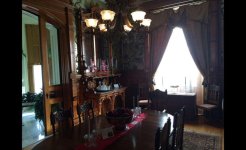
Just for more detail, here's a view of the other side of the dining room that I found... I estimate it's about 18 feet long by 12 feet wide by 12 feet high.

dining room.jpg

Mitch Gross: Yeah, I agree that's the worst part. If I had time to play around, I might not have thought to ask people here for advice. But instead, I'm planning to feed the crew in the parking lot and have all the equipment ready to go, and I changed the script a bit to be able to film more outside. I'm also planning to recruit a couple more PAs and have overheads with a workable plan for all the shots. I'm nervous about it still, but I'm pretty diligent with planning when I'm nervous. I have a C stand with an arm and this would probably be an excuse to get another. I do like the idea of a lightweight thing craned overhead, and it's easy enough to find motivation for... I think I need to really figure out my angles. I think I can do most of the medium shots avoiding doors and stuff, but there are a few that are going to be hard to avoid. I do have three days in there though, and if I'm just trying to match the natural light, then it might be easy to just film with mostly natural light, the way Paul F is suggesting, and rely on the Rayzr and lanterns for everything else. What wattage of photo bulbs would you recommend? If I'm estimating the space to be around 18 long x 12 wide x 12 high?

David W. Jones: Definitely. I think I might actually be able to shut off the fridge, and there's a fountain behind those glass doors I'm definitely shutting off. But definitely will get some room tone anyway. Last shoot I didn't pay enough attention to sound and I got scolded by the sound editor, so I'm planning to get my act together.

Paul F:

It does look good the way it is, I agree, but my three shoot days are 5pm to 11pm and sunset is going to be ... 7:47pm. So I think I need to do it the hard way. I was hoping that the Rayzr 7 would have a chance at lighting most of the room. I do want to film the window once, but I figure I can just wait for the sun to be dim enough then shoot it once. I really wish I could do it the easy way :/
 
Photofloods are tungsten 3400K and your natural light is daylight, around 5600K. So you should try to get some LED ribbons or highly corrected compact flourescents to stick inside the lanterns. Get REALLY bright ones, the highest you can find. In a photoflood I would go for 250w and 500w. Try to find similar output equivalent daylight bulbs.
 
Im not feeling what Mitch says.. or rather using the razyr - your most powerful light for edge.

Id get a 4.4 diff panel and your razyr and place it bythe window (not infront of it!) for the wides and pull it in really close for any CU shots. Id use your tungsten (maybe some with 1/2 ctb) to have as backlignts and to lift the room.

Camera blocking.

Im assuming a 'normal shotlist' wide, m-CU OTS.

Id shoot the wide(s) from the window end - - the wide is the challenge - everything else is easy - basically from 45 degrees from that mirror

you can shoot from that room over the three to your protaganist (also get everyone to dump crap in that second room) cheat the diffed razr closer and pong something on the wall we have not seen for depth

and then do a reverse in to that room again some deptlights in there

the window never gets in shot unless you cross the line.

done
 
morgan_moore:

I agree that I wince at the idea of not using the Rayzr. I want to at least use that. If I can figure out a safe, easy way to get the china ball going, I like the idea of the ambient light (time really is a concern), but unless I can figure that out, I think I'll probably go with two more tungstens, color corrected. The script calls for another table, in that solarium (behind the glass doors) to have other people sitting there... populating the "restaurant". If I have it blacked out with lights for "mock depth", then the room pretty much becomes unusable as far as the story is concerned.

What do you think of my idea of getting the wider shots I want when the light is actually right, and then try to mimick the light for the tighter shots that don't need to show that solarium, or the window, which we'd have more time for? It's involving moving stuff around mid-shoot, it might not be easy to match the natural light, and the window for getting those wider shots probably would be not very long... it'd probably feel like a 30 minute magic hour shoot, but it's possible, no?
 
I cant really say more because DP is knowing the score on the ground and making safe and instant choices with the tools you have.

Simply I keep it safe with a big soft source on the subject in the main.

Magic hour.. yep that is great until your sched goes awry.

I shot a day dinner scene once.. basically two OTS shots and then food continuity slowed things so much It was actually dark for the second character - at least I did the one with the window in shot first!
 
I own a lighting and grip truck. If I didn't and were in your position with limited lighting instruments, I would write a curtain pull into the script. "pull the shades so we can get to eating James" That way you don't have to deal with outside daylight issues. I would gel your daylight LED to match your Tungsten lighting and shoot 3200K. Maybe it's just me, but I almost expect to see Tungsten style lighting and candle sticks in a 100 plus year old mansion.

Dave
 
I expect to see a yellow background - aka shoot 5500k, and gel the tungs up with 1/4 or half ctb - they will still be yellow - if you shoot 3200 the tungs wont be yellow and any daylight ingress will just look horrid.
 
A large room with several characters in six hours won't leave you with many takes. Might have to do a quick wide pan and just stick with the CU's after that. This is a scene that needs a lot of rehearsal time regardless of the lighting issues. Maybe you can get the reaction shots somewhere else. Or something,
 
morgan_moore:
Yep, we'd have about two tries at it, but I agree, we'd be limited. Maybe it's not THAT tight a window, but certainly under an hour. Why do I do this to myself? Question... the diffusion panel... is there a reason I'd want to go for that rather than just clipping a diffusion gel to the barn doors? The LED fresnel can give me a beam about... I think 56 degrees wide on its own?

David W. Jones:
The curtain pull is an interesting idea and easy to work into the script. I'm not sure if that's a complete solution though, as there's plenty of light spill to worry about other than just the window. Some of it will need to be controlled.

DLD: Well, 6 hours for three days, although one day is reserved for the kitchen scene (without windows), so it's two days. Hopefully after the first day, we'll know exactly what to do for the second day. I'm predicting about 9.5 to 10 hours total of shoot time, assuming the first time we're filming within an hour, and the second time it's within half an hour. And if I keep it to maybe 30-40 shots max? Ambitious but not impossible. I have my rehearsal scheduled.
 
30-40 shots? In a total of 18 hours of shooting? With 3x load in / load outs? There is no way. That's just crazy talk.
No offense, but have you ever shot a scene with such complications before? It sounds incredibly ambitious given your constraints. Most shooting you're lucky to spend an hour each on load in / load out, then 30 min. per shot if all is moving smoothly and simply. 6x loads in/out leaves 12 hours of shooting, so 24 shots. Realistically, and that's if everything goes smoothly.
 
sdanzig,

Do you have access to do a pre-shoot/tech-scout on location. Even if you're not setting up any lights, you get a sense of what will be necessary to get the shots you want.

It seems as if you are under-powered, depending on the look you want.

What ratio are you hoping to achieve between your key, fill and background?

Gelling your tungstens will make them less usable as soft sources...as you know. And simply adding diffusion to barn-doors will not create a softer source. Diffusion and softness are not the same thing.

It is a very difficult thing for anyone to answer in a forum.

As a vague approach, I'd try to use the window as motivation for lights (assuming Day Int). I'd hang shears on the windows to allow you to clip in a more interesting way...assuming you don't have the light power to compete. To deal with light changes, I'd flag outside the window, and put all your tungsten units pushing in through the window. The shears should be enough to diffuse and make it a larger source. If you can't afford to gel the tungsten to 4300K (due to light loss), then leave them at 3200K and commit to a sunset look. Set your camera to 4300K to retain some of the warmth of the tungstens outside the window blasting in. This "through the window" approach can fall on faces as a side light on your CUs two shots, and can also be "up-stage" when shooting into it. You can also shape the tungsten throw to add textured shapes onto your background if desired. Then you can use your LED at 4300K through a 4x4 diffusion, to be your top light out of frame above the table, for your wide (allowing it to bounce off the table, while keeping it from spilling onto your walls. Then you can use the LED as eiter a key light or fill light on your CUs and two-shots, depending on what levels you are getting from the tungsten units outside.

This is just one approach out of many, and it is not necessarily perfect. In any case, I hope it is at all helpful, and best of luck!
 
A diffusion panel is not to make the angle of the source wider it is to make the source larger (the diff panel is the source)

Id get a 4.4 or ideally a 6 or 8.4 panel - I use lastolight, california sunbounce and a homebuild with lee filter on (the latter being the best but most fragile)

Probably the light would be about 3 foot back from the panel

maybe google film making, shower curtain :)

S
 
Mitch:
Well, I think 30 is probably about the max... you're right that 40 is crazy talk, but I've definitely managed 20 minutes per shot when I had a fleshed out plan and worked with rehearsed actors. I did some metrics to verify this :) I might float the idea of getting another day though if I need it, and I'm thinking through ways to maybe trim down the shots needed.

abreu-canedo:
I did do a promo shoot in this mansion with my Rayzr 7... not necessarily in the dining room specifically, but the larger foyer area with sprawling staircase outside. I really did have to dim down the Rayzr a lot to not be overexposed. I know I lose some light with the diffusion I'd need, and maybe bouncing, but it really does seem like it can handle lighting that room. Maybe not as brightly as the window can do, but certainly enough for the a7sii. I'm not sure about the specific ratio I'd be looking for, but it doesn't have to be dramatic. Just a soft light coming in from the window that shows off the woodwork would be nice, with enough ambient light to see the actor's faces easily.

morgan_moore:
Now I understand what the purpose is. I'll have to see if I can find a quick way to set up a shower curtain. Maybe two PA's?
 
Back
Top