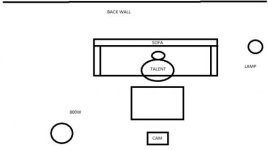
light noob starting a no-budget feature- a few questions.

oh what a great reply, thanks..
yea i think i managed to understand how to deal with the daylights.
i'de also like to hear your advice on the evening living-room test problem please..
the help of the 800w can solve most of the underexposure, but how to correctly place it to minimize fake shadows?
i will try Ronald's tip on the subject (spotting to one surface and not corner ceiling above lampshade), but it's far from perfect, and still limits me from any actor movements.
you could see the room sketch and jpegs in previous replies.
only if you have time, of course :)

Since I don't know the exact conditions of your test shot, I took the liberty of cleaning it up a bit. I used simple Photoshop 'curves' and eye droper on the presumably white strips on the shirt, to clean up the 'whites'. Then I used levels to adjust for 'brightness'.

The result is 1) I don't see the shadows you are concerned about, 2) the biggest thing for me is the 'hot' light in the corner. That sort of moves the eye out from the central figure on the couch.

This may be where a 'dimmer' would be in order, or, some form of neutral density material to knock the light down from the practical.

Do you have a light meter so you could indicate what the reading was for this setup.

In terms of 'mood', if the mood goal is 'down/depressing', the brightness on the left side seems too bright. This may be just a consequence of pointing your 800 W into the corner and letting the light go where it may. Perhaps some sort of rig where you can screen the light so it really is going more towards the subject, and less 'just out into the room everywhere, while still maintaining the apparent origin from the practical.

To soften the shadow side of the figure on the couce perhaps some form of bounce just outside of the camera view on the left to put some light back into the face.


attachment.php
 
Roel, what kind of weird shadows are you seeing? Are they coming from the wrong angle? Is the quality of the shadow weird? What is going on with the shadow?

I believe that at this point, placement doesn't really matter - what matters is that you are hitting that corner with a spot light and you are making sure that the light beam from the 800w is not hitting the lamp shade. Other than that I don't know what to say. Some fill like a bounceboard on the left side of the room will help even out the exposures. If this still isn't working out for you then I suggest that you shouldn't use the 800 w in this scene, perhaps you can scrim it down alot and use it to raise the general ambience of the room by bouncing it off the ceiling. Perhaps you shoulld try the china ball technique. Try a 250 w china ball (paper, not nylon - because paper is softest) - and float it above the practical. You will get shadows and omnidirectional lighting and falloff that will be well complimented with your practical.

If you have any video footage of the weird shadows that you are talking about I'd like to see them to see what's going on that's wrong.
 
Also, don't be too concerned with viewers being aware of the trick. Just because you are aware of the trick doesn't mean that viewers will be.

You really should consider getting the book Reflections: Twenty-One Cinematographers at Work. You will see many ways that DPs 'trick' the audience - all for a good reason of course.

Philippe Rousselot, ASC, AFC uses a 250 w china ball to motivate the small flame from a lighter. (WOW, HUGE difference in positioning and type and size of light source) - but it works!

Also see how David Mullen uses softboxes above the motivated source to motivate light.
035_35.jpg

UST40.jpg
 
You really should consider getting the book Reflections: Twenty-One Cinematographers at Work. You will see many ways that DPs 'trick' the audience - all for a good reason of course.
I've wondered about that book and I hope you're right because you just got me to part with $85 for it :) I'll let you know . . . .
 
I've wondered about that book and I hope you're right because you just got me to part with $85 for it :) I'll let you know . . . .

It's much better than any other cinematography book I've read. Each cinematographer has his own chapter in the book. These are workshop assignments, meaning that these DPs actually went to a film school and taught a class how to light one setup. It shows easy to read light diagrams and placement of lights. It shows all meter readings, lens choices, stock choices, etc. Really beautiful I must say....

Also New Cinematographers is also a fantastic book.

EDIT: I'd like to also add that it comes with some great on-set photos as well as images from the final developed image.
 
oh what a great reply, thanks..
yea i think i managed to understand how to deal with the daylights.
i'de also like to hear your advice on the evening living-room test problem please..
the help of the 800w can solve most of the underexposure, but how to correctly place it to minimize fake shadows?
i will try Ronald's tip on the subject (spotting to one surface and not corner ceiling above lampshade), but it's far from perfect, and still limits me from any actor movements.
you could see the room sketch and jpegs in previous replies.
only if you have time, of course :)

On your last close-up I do not see too much problem at all. The wide master shot however is under-exposed for some reason. I think you are exposing for the practical lamp instead of the scene. Expose your scene first, then dim your practical so it does not appear "hot".

For your shadow concerns here are a few things you can try separately or in combination with each other:

1.) With the light pointed to the corner, use a flag to block any spilling light onto the actors face. To do this, place your flag just out of frame at a height exactly between the actors head and the light source. You will still get the corner bounce look but avoid any spill light onto the actor.

2.) Soften your light source slightly by adding spun to it before spotting it in towards the corner. More diffusion is softer light which is less shadow, but at the expense of lowering the overall brightness or exposure of the scene. Spun will also make it spill more so you need to control it.

3.) You are shooting an actor on a couch right against a wall. The trick to eliminating any shadows if they fall on the wall behind him is to move the wall back 1-2 feet. Since your set is not fake, instead move everything else 1-2 feet forward (table, couch, actor, lamp). Then lower your camera to eye level and we won't even see his shadow fall onto the back of the couch or behind it onto the wall.
 
On your last close-up I do not see too much problem at all. The wide master shot however is under-exposed for some reason.


I was going to mention this, but it seems like all Roel Z's shots are underexposed, to me about 1 stop's worth. Even the one from another thread where there was an MTS file for dowload/review, it was under to my 'aesthetics'...

I thought perhaps it was due to me not calibrating my monitor in sense of 'recent'... but when I looked at the histogram of the stills, they were shifted down to the left (lower values/exposure).

I would ask, what f-stop was used, as I recall Roel mentioning using something like ISO 1600, which to me should have given better settings at 24 fps and 1/50 shutter speed (or even 1/60 as that's less than a 1/3 stop difference...).

I believe he used 800 ISO.
The image that he used with the corner bounce looks about right to me in terms of exposure for the key side. The key side is exposed at key and the shadow side is two stops under which is quite normal.
 
> The trick to eliminating any shadows if they fall on the wall behind him is to move the wall back 1-2 feet.
> Since your set is not fake, instead move everything else 1-2 feet forward

+1

Look at any film, 98% of actors are away from the walls, usually in the center of the room.
Look at student films, 75% (or more) of actors are against a wall.

Interesting I will look out for this...
 
Ok, but if I move the set forward wouldn't I cause complicities?
Where will the lamp be? I'll have tons of new shadows on the back
Wall.. Wouldn't I ?

* i mean, maybe this could help me understand? (try to draw on the sketch)
LIVING ROOM SETUP 2.jpg
 
Last edited:
Couple things,

As Ronald pointed out don't get too caught up on some of the tricks regarding shadows and light placement. And I will add that if you're going to spend time, spend it on the "right" things.

At this point is there a shot list or has one been developed? Chances are your wide shot will be seen for a couple seconds and your medium shots, close-ups and inserts will dominate the scene. So I'd be more concerned with making those shots look great. Remember you can re-light for each shot instead of thinking to light it once and use that for everything (a dream come true if you're lucky to acheive that). So if the wide shots are going to be edited fast, blast the corner, get the wide shot and move on. Spend more time with the other shots. For your medium and close up shots you can tweak your 800W to give you the look you want.

Don't be afriad to move your set to get the look you want or need - for example on the medium shots you can get rid of the practacle all together and use the 800W to simulate it and have a fill card on opposite side in low angle up to fill in eye sockets.. If you don't have room for that - slide the couch, actor and painting to the left. Make room.

Back to your master wide shot:
As for moving your set forward, not only will this stop any lighting from creating shadows on your wall but your shooting with 35mm lenses and likely want a 35mm film look so why not add some depth to your scene? Many people confuse depth of field with f-stop and shoot wide open but think of creating depth by adding "distance" too. You could have a wall table under the painting with flowers on it behind your actor and who says there is no walkway there? Then, if you want gradations along your entire back wall and want to hide the spot, you can hang a short black curtian right across your ceiling along the back wall (1-3 feet from back wall) pinning it up until it is out of frame.

Suddenly your character is separated from the background, and now if you really want to step it up a notch get that focused flood light someone here recommended, and give your character a hair light!
 
Hmmm.. Thanks.

You're right about being concerned with mediums and CU's.
I just don't want to get carried away with 'light for every shot'..
I think I might lose consistency and pay for it later (gotta be careful.
I won't have a monitor).

This weekend I'll try to make final decisions.
 
Hmmm.. Thanks.

You're right about being concerned with mediums and CU's.
I just don't want to get carried away with 'light for every shot'..
I think I might lose consistency and pay for it later (gotta be careful.
I won't have a monitor).

This weekend I'll try to make final decisions.


The shadow issue is a problem and worsened by shooting at a location where one can not arbitrarily hang lights, rip out walls (or not build them on a set...), etc.

From the stills you posted, I don't have a problem with the shadow cast by the painting on the wall, as the shadow 'reads' that it is from the practical.

If you have your talent 'in motion', and there's a shadow from any additional light(s) which you put in to soften the contrast or due to your 'cheat' on the practical, then it may be that
you will have to change lighting from a 'wide' to a CU. A careful look at many movies will show that the CU shots are often lit differently than the master/wide, and is
a significant difference between 'movie' lighting and 'TV', where frequently, at least in studios in the past, the tv show was shot with a 3 camera setup, and so, lighting
had to work for all three cameras at once, with the director selecting the camera that was on the air, without any adjustment in the lights, pretty much 'on the fly'...

I do recommend getting a spot light meter. I have the GH-1, and I sometimes find that the in camera indications, histogram, etc. don't actually give me the exposure I like to have. I do set
my exposure to place 'fair' complexion people one stop open from The Meter reading, and then take a check of the highest value in the scene, as 'seen' in the camera framing, and
check if that results in too high a contrast. At that point, one has a choice, blow out the highlights, or figure out some way to bring them back down via screening, if outdoors, or in a
artifical light environment controlling the light to lessen the contrast. (As a note... I don't have the resources to overcome sunlight to soften shadows with 'big lights', so my choices are 1) find a suitable
location, 2) bounce some sunlight into shadow areas, or 3) rig up a screen for the talent and set up the shot so the backround doesn't look too obviously blown out....)

On meters, I prefer the spot meter for determining such things as lighting ratios on subject faces, or the scene in general... it's much easier to determine than trying to use an incident meter, and shielding,
orienting, etc to determine this sort of thing... you can also from the camera 'know' what the camera 'sees' with a spot and add light or 'subtract' to get a dramatic effect.

Others may have different opinions on this subject...
 
Back
Top