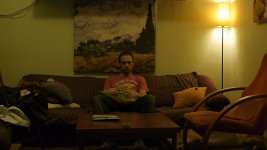
light noob starting a no-budget feature- a few questions.

Yeah, if you like it then don't change it...

The only time it might go bad is if the wall looks as bright or brighter than the subjects face. (except for silouette) In that instance, you would want to flag some of the light off the wall so that it won't compete for the viewer's attention.

I take it this is interior daytime in the script?
 
Last edited:
I love it. Looks beautiful! Stick with natural light!

seriously? at first i thought you're terribly cynical...
glad to hear it :)
thanks.

I take it this is interior daytime in the script?

yea these will be most of the apartment scenes. i bought a blue daylight gel, and some diffuse 'paper', just in case.
tonight i'll try to take some shots of the night look ( the way i wish it would look).
the living-room will be tough cause i need to think how to light it as if the scene lamps are the light source,
+ i need to find a way for the sofa shots to be decent, with the lack of depth and 'boring' look.
 
Last edited:
The pics look good. I think they are a little bland contrast wise though. I think I would augment the natural light with more light so that you get more contrast. You'll need to figure out what the color temp of the light coming through the window at the time of shooting is and then gel a light accordingly and then shoot it through the window as well. You can then proceed to adjust your fill light. This will both allow you to use your lenses at a sharper F stop and have more ability to create more contrast if you want.
 
The problem with mixed light color temperatures, is that the camera will only allow for an 'adjustment' that matches one, not both... sort of obvious...

Let's talk about that for a moment. Some of the best advice I ever got about good lighting, from TC Christensen, ASC, was to constantly observe lighting in real life and tuck it away in memory, to be summoned when needed. One thing that taught me is that the world is full of mixed color temperature lighting. Look around any room where lights are burning. They're very often of different type and color.

As practitioners of the lighting crafts, maybe we like to come into a room and correct every source so it looks white, but why must we always do that? We don't. Say the key is white. The edge lights often look great if they are a little higher or lower or both in color temperature. A slightly warm hair light, a slightly cool kicker on the cheek, often are visually appealing. As simple examples.

It's mostly a matter of aesthetic preference but I think various color temperature lights in a scene very often mimic real life and add color interest, variety and richness. Some scenes are supposed to be stark, a lighting and color palette deliberately muted and bereft of color. But color in the art direction and use of lighting are great visual tools to delight the eye or tell the story so making all our lights look white most of the time is not a choice that appeals to me very often.

Of course, there is no arguing matters of taste, as the Romans reminded us long ago: "De gustibus et coloribus non est disputandum."
 
Let's talk about that for a moment. Some of the best advice I ever got about good lighting, from TC Christensen, ASC, was to constantly observe lighting in real life and tuck it away in memory, to be summoned when needed. One thing that taught me is that the world is full of mixed color temperature lighting. Look around any room where lights are burning. They're very often of different type and color.

That is true. But human eyes will 'correct' quite a bit, whether it is in the actual cones and rods, or in the 'pre-conscious' processing, or even in the conscious processing... that peice of paper being lit by sunlight from the window, and tungsten light from the lamp on the desk "must be white" therefore it is "white'...

But the sensor does not do that... and so by adjusting the K temperatures either in camera, which affects all light sources, or correcting the lights, either individually or in 'color groups', one will minimize the disparity, while keeping the 'natural' multiplicity of K temperatures...
 
OK then you can bounce the 800w off the ceiling if the ceiling has a white ceiling or light brown ceiling. If your ceiling has a color other than white or light brown then you can pushpin a bounce board on the ceiling or tape up some bleached or unbleached muslin on the ceiling and then bounce your light on that (unbleached will slightly warm the image almost like putting a 1/8 cto on your light). The bigger the light source the softer your light will be.

This will give you a nice softish overhead look.

But it won't be very cinematic. If it's a look you want, then fine, but if you're looking for a good traditionally cinematic look, you won't get it that way. It won't have any particular mood or feeling or dramatic depth to it.

Light coming down in a big soft wash from the ceiling is what you see in sitcoms or reality TV or, if really poorly done, home movies shot in your kitchen.
 
I do agree about mixed temperatures in real life,
But in reality it's often very delicate and hard to mimic,
At least for beginners,
So this is very often being re-done Too dramatically
and the result looks like a theater stage.
 
@David Jimerson - totally agree with you David. When done poorly the wash can look horrible and sitcomy and flat and boring.

But when it's done tastefully it looks natural and pretty.

You just kind of have to play around with it and see which one's the best look. Instead of a big soft wash try a gentle 'practically lit' looking wash. Or a controlled dramatic toplight by taping up some duvetyne and make some skirts for your bounce source so that you can create some shadows on your walls to create a more dramatic look. While you are rigging up your muslin or bounce board on the ceiling you can also take time to put some duvetyne skirts up on the ceiling as well - these need to be strategically placed so that you get the best looking shadows.

Please check out Lance Acord ASC (Lost in Translation, Marie Antoinette, Where the Wild Things Are) being interviewed by Creatasphere. I really love this interview because it shows how simple things really are.
http://www.createasphere.com/En/pan...ciate-editor-at-american-cinematographer.html

I transcribed some of it.

Question: In most of your films you do almost like the opposite of what those two lekos are doing right now, which means that the lighting, the characters doesn't look lit. So my question is, what is your favorite fixtures, or if you like bouncing or if you place a lot of emphasis on the practicals?

Lance: I think that for interior lighting that the two units I use the most are, for smaller interiors, when it's supposed to look practically lit, I light pretty much everything with either chinese lanterns or muslin lanterns. And then with source 4 lekos, which are probably what these are (pointing to the lights in the room) but on the floor bouncing off the ceiling and then use different types of reflective surfaces on the ceiling or muslin on the ceiling or sometimes the ceiling or off a board but it's a very efficient way of keeping the heavier, harder to rig elements close to the ground and out of shot under frame, and then if you're working on location especially in spaces with low ceilings like an average apartment or house or whatever you don't have to contend with limiting your headroom at all because you're using just bounce boards stuck to the ceiling. And like often times you can come in and just with push pins - you can just push pin - so you don't even really have to rig anything to the ceiling. But it's usually a combination of those two things---for interior practically motivated lighting.


You can also check out the ASC podcasts at http://www.theasc.com/ac_magazine/podcasts.php

They are really informative and also fun to listen to.
 
That is true. But human eyes will 'correct' quite a bit, whether it is in the actual cones and rods, or in the 'pre-conscious' processing, or even in the conscious processing... that peice of paper being lit by sunlight from the window, and tungsten light from the lamp on the desk "must be white" therefore it is "white'...
No, that's missing the point. What I'm saying is that I can readily see differences in color temperature of different sources in the same room. Anyone can with practice. I'm not saying that I can't see them because my eye/brain are correcting them. I'm further saying that the differences, common as they are, can be attractive in the final image when managed well, on the set, in the camera and in post.

But the sensor does not do that... and so by adjusting the K temperatures either in camera, which affects all light sources, or correcting the lights, either individually or in 'color groups', one will minimize the disparity, while keeping the 'natural' multiplicity of K temperatures...

Are you suggesting that mixed color temperatures shouldn't be deliberately used? It's done by the masters all the time. White key, white fill, white hairlight, white background light, white kicker = boring. Control these colors and put them where you want.
 
I'll support my case with a resort to authority :)

David Mullen said:
Color temperature is a HIGHLY creative visual tool and I find it more useful than problematic that different lights have different colors. I find it only annoying when I'm dealing with a green cast on blonde hair and pale faces, then it's a bit tricky to deal with in post. But contrasting the warmth and coolness of different sources is a great way to create interesting looks.
 
Are you suggesting that mixed color temperatures shouldn't be deliberately used?

No. What I'm suggesting is that the human processing produces a more subtile effect in mixed color temperatures, and it takes more skill than 'just filtering/gelling' lights/windows to make everthing 'match', to create that effect in the camera.
 
I'll support my case with a resort to authority :)

I don't disagree with him, and I'd even up the stakes by saying that not only can you use color to create layering and other visual language, but using different colors and color temperatures in conjunction with the white balance function gives you a powerful tool for making colors really pop (we cover a lot of this on the Lighting DVD, by the way, with examples from the short films to illustrate).

But you have to know what you're doing and use it judiciously, and understand what effect something's going to have on the image. When it's bad, it's bad, and you can't always see it when it's going wrong -- but the camera will.

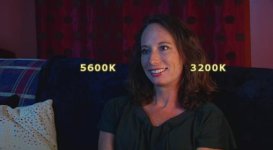
In one of the shots I posted above, one side of the model's face is grayish blue, and the other is orangish (though it actually isn't very; it just looks that way contrasted against the blue). This could be a fine look if you want it to look like she's watching TV. But you probably don't want it for a naturalistic portrait shot or typical conversation. Either way, standing the room, you might not even see a difference in the lighting. So, you have to be careful or you may end up with things you really don't want.
 
@David Jimerson - totally agree with you David. When done poorly the wash can look horrible and sitcomy and flat and boring.

But when it's done tastefully it looks natural and pretty.

That's fine if it's what you want, but overhead light isn't typical of cinematic lighting, and that kind of a look -- natural and pretty -- isn't necessarily appropriate for many kinds of moods and feelings and artistic purposes. It also doesn't necessarily produce the most common kinds of looks we associate with "cinematic."

There really are no rules, and an experienced member of the ASC knows what he wants and how to get it -- but if a self-described lighting "noob" asks how to light something, chances are, he's wanting a typically cinematic look, at least to start. I would not start him off with throwing light at the ceiling.

But, that of course all depends on what he really wants.
 
No. What I'm suggesting is that the human processing produces a more subtile effect in mixed color temperatures, and it takes more skill than 'just filtering/gelling' lights/windows to make everthing 'match', to create that effect in the camera.

Sorry, I apologize but I don't quite understand that statement.

I don't mean to beat a dead horse I just want to say that in my opinion and that of many others mixing color temperatures can produce great looking images and there is no artistic or technical reason not to use mixed color temperature sources in a shot. Obviously, done wrong it stinks. My guess is that you agree.
 
That's fine if it's what you want, but overhead light isn't typical of cinematic lighting, and that kind of a look -- natural and pretty -- isn't necessarily appropriate for many kinds of moods and feelings and artistic purposes. It also doesn't necessarily produce the most common kinds of looks we associate with "cinematic."

There really are no rules, and an experienced member of the ASC knows what he wants and how to get it -- but if a self-described lighting "noob" asks how to light something, chances are, he's wanting a typically cinematic look, at least to start. I would not start him off with throwing light at the ceiling.

But, that of course all depends on what he really wants.

I think that's all true too and I'd add that you have to be really careful when bouncing off the ceiling that you don't spill light all over the walls, which can cause flatness and lessened contrast making your subjects disappear. The walls in that case are also usually lighter towards their top, and most of the time, that's just the opposite of what you want.
 
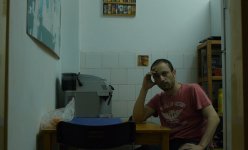
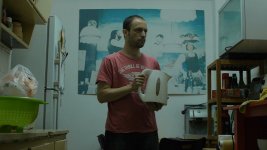
well, these are the night shots.. obviously, a bit more problematic.
the kitchen of course will be replaced with the 800w fluorescent fake, but i hope i could get to a more precise feel, appropriate for shooting, but i like the cold kitchen look.
the living room is the main problem. that is AROUND what i'm looking for (the temperature and green/yellowish feel is NOT so good, of course)
here i really need your input on creating the right atmosphere, starting from the nice lamp in the corner, and to get these colors, but in a nicer and more efficient way.
and still keeping it as natural as possible.
feel free to change any aspect in this set to get a decent result (for example, the picture behind might be ruining the whole background, or not..)
my only pro example that i can think of right now is a kind of David lynch feeling.
livingroom night 2.jpgkitchen night 1.jpgkitchen night 2.jpglivingroom night 1.jpg

thanks !
 
I don't think the picture in the back is ruining the shot - it is much better than seeing a boring flat wall. How did you light the living room picture?

What is much nice if you float a china ball near the top of the practical light. Or in that same corner where you see the lamp practical maybe but a bit of muslin on that corner and bounce your movie light into that.

Also, if you can adjust your color temperature in your camera do so if you want it less warm.
 
well, these are the night shots.. obviously, a bit more problematic.
the kitchen of course will be replaced with the 800w fluorescent fake, but i hope i could get to a more precise feel, appropriate for shooting, but i like the cold kitchen look.
the living room is the main problem. that is AROUND what i'm looking for (the temperature and green/yellowish feel is NOT so good, of course)
here i really need your input on creating the right atmosphere, starting from the nice lamp in the corner, and to get these colors, but in a nicer and more efficient way.
and still keeping it as natural as possible.
feel free to change any aspect in this set to get a decent result (for example, the picture behind might be ruining the whole background, or not..)
my only pro example that i can think of right now is a kind of David lynch feeling.
View attachment 31634View attachment 31635View attachment 31636View attachment 31637

thanks !


I really do have to get my display calibrated, as it's been quite awhile... but all of these shots look underexposed.

One my problems coming to making moving pictures is that as a still photographer I was use to using strobes to dump a bunch of light into a shot, or maybe shooting at 1/10, 1/8 second shutter speed...

That's not possible for continuous lights and movie shutterspeeds of 1/50 or 1/60.

So, I started asking about how much 'continuous' light was needed for a 'good exposure'. I didn't get a very good set of answers... for the following reasons:

1) I was using a 'video' camera and 'video' cameras have db gain adjustments not ISO values,
2) Video cameras are 'spect' such that they indicate the 'minimum' amoutn of light, in lux/fc values (frequently) but that does not really produces a 'quality' image, just one that beats the other manufacturers for the camera price.
3) People bandy about 'watts' for lights, when there is an assumption about the watt to actual light output, based on either some 'famous manufacturer standard tables', or Tungsten, etc.
4) The meter I have available is a reflectance type meter, and does not give footcandle/lux readings directly, but even so, doesn't help in a priori estimations of required light.

So over the last year or so, off and on, I've looked into how light is spec'd and how light is measured, and what tables are available that make an estimateion of 'what I need for my camera'.

Since I've gotten the GH-1, and it's 'light sensitivity' is indicated in ISO values, I've felt more like I'm getting the understanding I need to give a better estimate. (One can still quibble on how ISO is measured for digital
cameras vs. film... but it seems that my reflectance light meter gives better 'estimates' of what to set on the camera than previously trying to estimate what db gain setting, etc...)

So one 'law' is the following:

for 24 fps, and f-stop 2.8, a shutter speed of 1/50 @ ISO 100, the light falling on the scene needs to be 100 FC, or 1076 Lux. Different Fstops and ISO values can be calculated from there, for example, at ISO 400,
one would need 250 Lux, or 25 FC for the same camera settings.

If you rent a light, one of the name brand ones, there should be 'photometric data' supplied by the name brand manufacturer that will list out what the light is at various distances. These can be found online as well, so you rent what you need.

However, that won't help alot if you are doing a more complex setup than having the light shine on the subject directly. You can estimate the drop in light going through filters or screens, but it would be better
if one had an incident meter to measure the light that actually gets to the scene.

If you are not using name brand lights, then things get even more difficult. Lights sold at stores are notoriously ill described... 'warm light', 'bright light', and with the CFL's even worse because they often
don't really have any indication of color temp. and lumen output is often obscured, and forget about spectrum, if it is indicated in any way, it's by CRI which may or may not help... etc.

What does seem to be the case is that the CFLs do have a higher output per watt efficiency than the Tungsten. There is no free lunch. The spectrum of the CFL do not match tungsten, and so one has color shifts.

Putting that a aside, it seem one can set up a 500 W 'light volume' output with 4 CFL's fairly cheaply, and then with that 'cheap' DIY light, measure the actual light intensities at various distances, and come
up with one's own table for how things go.

One can get an gross estimate, in noting that the CFL usually does have the Lumen output listed... but then that's output in 'all directions', so one would have to estimate if one put a reflector on the bulb, then what 'cone'
of light that created, then calculate the amount of light per sterradian, the mathematics of which most left in highschool or college, if they ever knew at all...

Better to just make empirical measurements.

I did buy a cheap incident lightmeter that measures Footcandles directly... from a garden supply store for the 'indoor gardener'... where one uses light bulbs to generate the light for the plant to grow... for about $50...
cheaper than a Sekonic L-558 cine meter... albeit not so accurate...

Once you know you are getting enough light on the scene and subject, then you can start adjusting the 'colors'... as well as arranging the lights for a 'cinematic' look.

In terms of arrangement, for the couch shots, I'd probably have a 'boost' light coming from the same side and nearly the same direction as the lamp to the right of the couch. I'd have it pretty 'soft' so that
the boost light would not cast shadows, and 'look' more like the light coming from the practical.

For the Kitchen shots, top light with enough flat fill from behind the camera to soften the shadows from the top light.

Other people may have other ideas at this point...
 
Last edited:
thanks for all the new info :)
yea i didn't bother to be precise on exposure, just to catch the feel i like at the moment.

ok, in the meantime, for the livingroom, the main thing to do is to start with adding, let's say, a china ball to support the practical lamp, right?
what about using my 800w? right now it would 'kill' all the other lights i guess.. how can i use it to support the feel?
i'm still not sure about the picture. feels a bit stuck.
 
Back
Top