light noob starting a no-budget feature- a few questions.

roei z

Veteran
Hi-
i dug in the stickies for a while but had a hard time focusing on my needs.
maybe you could refer me to any material on this, if available..
i'm still not familiar with all the light 'language', so be gentle please.

and forgive me for maybe being naive and confused, but i just don't have many options.
i HAVE to get all i can with a very basic setup.

first-
i need to think about a simplest lighting for a flat, mostly in living-room & kitchen daylight scenes.
i have a regular 'orange' halogen 800w.
is it possible to 'help' available daylight in the flat ? it's pretty well lit in daylight, i like it as it is.

second-
when i'll do a few night scenes, while i can solve the living lighting i guess,
what do i do to recreate the kitchen fluorescent light, which i basically like ?

again, i probably sound like an ultra noob, but my situation is: using available light where i can (higher iso's), or helping or creating basic light for 'tough' scenes.

thanks in advance for your patience and understanding.
 
If you like the look of the flat with daylight as it is, then there would be no use 'helping' the daylight with another lamp. Just simply place a 4ft by 4ft foam core or the biggest white surface you can bounce on (preferably bigger than 4ft by 4ft) to fill in the shadows. Perhaps two or more bounce boards might be necessary depending on how bright you want your shadows.

To recreate the flourescent light use Kino Flos like a 4 ft 4 bank or 4 ft 2 bank or a 2 ft 2 bank, depending on how big your kitchen is.
 
Three questions:

What exactly do you mean by "orange 800 watt" light? Is it a film light or a shop light?

What do you mean by no budget? Nothing to rent? $400(usd) to buy? $100 to buy? $10 to buy? What exactly are we dealing with for your production budget?

What is your role in the production? DP? Gaffer? Producer? Director? All of the above?

thanks.

the 800w is a professional light.
no budget means, money left for only minor things as bounce boards, and such.. (after investing the rest on camera & sound)
and i'm doing it all myself, except producing.
:)
 
If you like the look of the flat with daylight as it is, then there would be no use 'helping' the daylight with another lamp. Just simply place a 4ft by 4ft foam core or the biggest white surface you can bounce on (preferably bigger than 4ft by 4ft) to fill in the shadows. Perhaps two or more bounce boards might be necessary depending on how bright you want your shadows.

To recreate the flourescent light use Kino Flos like a 4 ft 4 bank or 4 ft 2 bank or a 2 ft 2 bank, depending on how big your kitchen is.

thanks for the bounce tips..
i'm afraid Kino Flos is way out of budget now..
 
OK then you can bounce the 800w off the ceiling if the ceiling has a white ceiling or light brown ceiling. If your ceiling has a color other than white or light brown then you can pushpin a bounce board on the ceiling or tape up some bleached or unbleached muslin on the ceiling and then bounce your light on that (unbleached will slightly warm the image almost like putting a 1/8 cto on your light). The bigger the light source the softer your light will be.

This will give you a nice softish overhead look.

EDIT: make sure all the 'real flourescent lights' in your kitchen are all turned off otherwise you might get a flicker from those lamps and a green tint to your image - plus multiple shadows which you probably don't want.
 
You could also use some gels and match your tungsten to the sunlight and bounce off some foam for fill.
 
Agreed with the above.

The most inexpensive fixtures I know of are aluminum scoop clamp lights from the hardware store. Use the brightest daylight compact fluorescents you can get and use a Y adapter so you can use two bulbs in one fixture if you need to. Use 100W equivalent or brighter bulbs. The fixtures cost about $7USD. The bulbs should be less than $5USD ea. The other very useful cheap light at night is an 18" or 20" white paper Chinese lantern, typically called a China ball in movie lighting parlance. Use three Y adapters so you can put 4 bulbs inside.

Coleman-Cable-Reflector-Clamp_CD68A02D.jpg


BTS7_JakeChinaBall.jpg


You need to find a gaffer :)
 
Oh, and you seem to have a grasp of color temperature. You'll need to get a piece of color temperature blue color correction gel, CTB, so your movie light will match the color temperature of daylight. At night you don't have to gel it but you will have to get bulbs with the right color temperature which is specified as 3200K, Unfortunately, your choices in CFLs are usually soft white, about 2700K same as ordinary incandescent bulbs, or cool white, usually 4100K. Personally, I often get away with 4100K, white balance the camera to that, and let the color of the movie light look a little warm yellow. OTOH, some people hate mixed color temperatures in the same scene. All depends on you story and aesthetic sense.
 
Agreed with the above.

The most inexpensive fixtures I know of are aluminum scoop clamp lights from the hardware store. Use the brightest daylight compact fluorescents you can get and use a Y adapter so you can use two bulbs in one fixture if you need to. Use 100W equivalent or brighter bulbs. The fixtures cost about $7USD. The bulbs should be less than $5USD ea. The other very useful cheap light at night is an 18" or 20" white paper Chinese lantern, typically called a China ball in movie lighting parlance. Use three Y adapters so you can put 4 bulbs inside.

scoop clamps and china balls :)
good ideas, thanks.
 
This is a great thread:

http://www.dvxuser.com/V6/showthread.php?230146-Learning-to-light-cinematic.

There's nothing like testing. In fact, I use his progression to show students what can be improved by testing.

If I were you, I'd get a big 36" china ball (ikea) and then you can put in compact fluorescent lights or tungsten lights to help "improve" the natural lighting as needed.
If I had those two lights, I'd use the 800w to bounce of the ceiling for wide shots, and for close ups I'd use the china ball for rembrandt lighting and the 800 in spot mode bounced off the ceiling for fill and room base level lighting. (A trick is to spot the light on the ceiling then move it around to different corners. See what looks best in camera and use it.)

If you are a lighting noob, rembrandt lighting will serve you best 95% of the time.

http://www.m-1.ca/2010/04/07/anatomy-of-light-rembrandt-lighting/

Also, I wouldn't add a fill light unless needed. Start without one. Most noob lighting set ups use too much fill and it ends up looking flat.

Also don't under estemate the power of a back light. In pro lights, it would be a 650 or less. In no budget lights, a clamp light with a 75w spot tungsten bulb (make sure it's spot not flood) inside with a dimmer will serve you well.

For general no-budget lighting, that's the best advice I can give. It would be good to see location stills and some lighting examples of what you are looking for.

(expanding on what Slondon said...)
 
Last edited:
Oh, and you seem to have a grasp of color temperature. You'll need to get a piece of color temperature blue color correction gel, CTB, so your movie light will match the color temperature of daylight. At night you don't have to gel it but you will have to get bulbs with the right color temperature which is specified as 3200K, Unfortunately, your choices in CFLs are usually soft white, about 2700K same as ordinary incandescent bulbs, or cool white, usually 4100K. Personally, I often get away with 4100K, white balance the camera to that, and let the color of the movie light look a little warm yellow. OTOH, some people hate mixed color temperatures in the same scene. All depends on you story and aesthetic sense.

hate mixed temps personally.
ok, so i need to get some blue gels.
the GH2 have a tweakable WB temperature , so i guess it might help a bit.
i guess the living-room night scenes will turn up to be the toughest, if i'll need to create a minimum atmosphere apart from off ceiling 800w bounce.

great beginners help from you guys, dvxuser is a lifesaver.
 
this getting better and better :)
it will take some time for testings and decisions but it's already very fascinating.

thanks.

i will definitely upload scene jpegs! excellent idea.
 
hate mixed temps personally.
ok, so i need to get some blue gels.
the GH2 have a tweakable WB temperature , so i guess it might help a bit.
i guess the living-room night scenes will turn up to be the toughest, if i'll need to create a minimum atmosphere apart from off ceiling 800w bounce.

great beginners help from you guys, dvxuser is a lifesaver.

The problem with mixed light color temperatures, is that the camera will only allow for an 'adjustment' that matches one, not both... sort of obvious...

The other thing about Compact Fluorescents is they have 'spikes' in their spectra, and so, certain colors that correspond to the spikes may appear 'brighter'
than what may be seen in a 'natural' sun/tungsten setting.

This may or may not affect you, as happy accident may eliminate colors that may offend, or, perhaps won't be noticed...

While I won't make the statement with absolute certainty... I'm tending to think of B&W (aka monochrome) for my material that I'd actually send off to fests. Then these issues of color temperature disappear, and
allows me a choice of higher wattage, at 'industrial' prices... (I'm going to do some tests on some of these mercury vapor, or HID type lights for 'monochome', see how that works...).

This of course may not be for everyone...

Otherwise the use of bounce cards, supplemental lights, etc. is all worth testing with.

Oh, yeah, one more note... this color shift under different lights is well known outside of 'film', the technical name for it is 'metamerism', and affects such areas as 'printing' where the 'proof light' is different than the ordinary viewing light by the end user. Paints on various items in a 'matched set', when the objects are manufactured by different processes and the paints used differ one to the other in terms of their spectral response...
 
Last edited:
I've bought 5500K CFLs and 6500K CFLs at the hardware store before too.

Also, I know that Roscoe sells gels for killing green spectra in Flo bulbs. Look for minusgreen gels.
 
Ok, a lot of new info. :)
I'll dive into all the linked threads to get educated,
And tomorrow I'll upload scene photos.

Thanks again for all the info and tips for now.
 
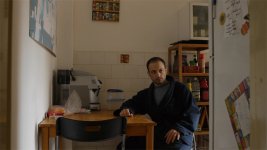
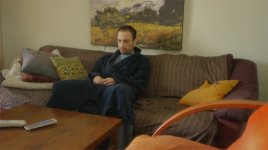
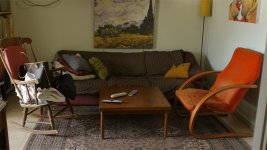
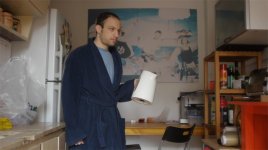
ok, these are the daylight locations. i like the light as is.
of course these locations are still not set for shooting - living room will be set up differently, and i suppose the kitchen will have a bit more space.
but i dig the natural look. is there anything i should consider fixing or 'helping' light-wise?
kitchen day 1.jpglivingroom day 1.jpglivingroom day 2.jpgkitchen day 2.jpg
 
Back
Top