Light meter - recommendations?

Capture.JPG

Milk production from my dairy cattle improves if I whisper daily "I love you" into the ear of each one. It is a case of in one ear and out the udder.
 
I don't know if I will end up using it. But I'd like to achieve more regimented and consistent contrast ratios and with faster set-up times on my interviews.

In particular, I did an interview day recently with 4 set-ups that followed a pattern of plenty of time for the 1st set-up; rush to reset for the 2nd set-up; plenty of time for the 3rd; rush for the 4th. I'm not dissatisfied with the results but I think it would help to nail down a consistent look throughout, and to do it in a hurry, if I metered my lighting and locked down my ratios.

Similarly, I did a recent shoot with plenty of time for the main set-up and then 6 quick set-ups (with less lighting) at various locations around a gallery.

I primarily use false color to judge exposure. Light metering would be an additional tool with a different purpose, and also subject-independent.

Once I set exposure for the key light using zebras and a white card, I prefer to adjust contrast ratio of the fill, kicker, backlight, etc. visually by looking at my field monitor. Going by some sort of ratio formula on a light meter, or other guideline, would be too regimented and take longer. Every face, location, abd setup is different. So, making those judgements while looking at a monitor is the best way for me. Different strokes.


Milk production from my dairy cattle improves if I whisper daily "I love you" into the ear of each one. It is a case of in one ear and out the udder.

I understand the individual components of this post but not the overall message
 
Once I set exposure for the key light using zebras and a white card, I prefer to adjust contrast ratio of the fill, kicker, backlight, etc. visually by looking at my field monitor. Going by some sort of ratio formula on a light meter, or other guideline, would be too regimented and take longer. Every face, location, abd setup is different. So, making those judgements while looking at a monitor is the best way for me. Different strokes.

I don't trust my field monitors enough to rely on them for a visual sense of the scene. I do like false color, and that's generally what I go by to determine how things are shaking out. But I'd like to see how incorporating a meter will affect my process, especially since I can stand on the mark and dim my lights by remote while metering them, and do so without the subject around. Especially if I dialed in a look at the start of the day and just want to replicate the relative EV levels of that set-up, being regimented is probably a good thing. But we'll see.
 
There are certain aspects of lighting that I find metering falls short, such as a hairlight. You can measure to your heart's desire, but hair color and texture can reflect light so differently. Moving people through an interview setup, two people can have exactly the same shade of brown hair but if one is straight and shiny and the other thick and curly, you could be as much as a stop and a half different in what actually looks right to eye or monitor. Even a spot meter falls short here because it's not just a reflected value of the highlight, it's the overall appearance of the entire head of hair that one is looking at.

I also find visual continuity to be challenging when a set is being re-lit for different angles, and/or one is working with daylight. No-one is going to meter and write down readings for every plane and object visible in a given location, yet to properly match environments it becomes relevant. My method of taking frame grabs for each setup and then being able to pull them up on my primary monitor and A/B or do wipes with live picture makes this an insanely simple process. We have often caught "mistakes" where light is returning back onto a wall behind the subject because of a relight when looking at the reference image, but who runs around the set metering everything visible? I liken this kind of workflow to editing non-linear vs the oldschool of tape to tape or film, where counting frames and calculating timecode was replaced by pure visuals. Metering is a lot of numbers and math and while I can do it because I had to back in the day, it feels clunky now.
 
Finally, I'm already using my phone, a tablet, and 2 burner phones for various monitoring and remote control purposes..

I 'never' use phones on set for controlling stuff. It is indeed hells younger brother.

The reason why I suggested investigating a phone for a light meter is that is see it very much as a tool for 'recces' and setting up. Those recce days..
-can be months in advance so making a record is super important if you have no memory
-you dont want do be having a christmas tree of kit on the coach.
-you may be sending info to a gaffer, or other crew member, a physical pic/grab is good.

For onset Id either use the camera tools, a DSLR or the cheapo sekonic

For example lighting (evenly) a greensceen - a wander around with the sekonic feels like the correct thing to do.
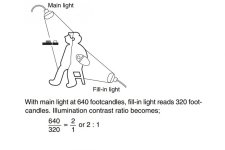
And spotting* the ratio across a face**


*using the spot meter facility - dome slid back
** the lighting ratio across interview subjects face from key side to fill side.
 
Last edited:
I 'never' use phones on set for controlling stuff. It is indeed hells younger brother.

I rather enjoy it. Of course, I don't work on "real" sets. But the only issue I have is that switching connections between different gear can be slow or unpredictable. That's why I use a bunch of devices, each dedicated to a different piece of gear. My phone on wristband for A camera control with Monitor+ app, a tablet with Accsoon See taking wireless feed from A camera, burner phone with Monitor+ connected to B camera, burner phone for Sidus Link, burner phone for gimbal remote control if needed.
 
So I just bought a 308X-U on ebay auction for $174 shipped. I was going to buy it new at B&H since it's only $229. But then I didn't. I look forward to seeing if it finds a place in my routine.
 
For example lighting (evenly) a greensceen - a wander around with the sekonic feels like the correct thing to do.

I find it far easier to use false color and waveform to check lighting on a green screen. You can instantly see which sections need to be brought up without the wandering around part, and how adding a light to fix a section blends into the existing lighting. If I had to do it without camera I'd do it standing back and scanning with spot meter rather than walking around with incident meter, certainly easier to meter the sections above one's head or down by one's feet.
 
It’s basically just simplified false colour but this app is good for lighting a green screen.
 
I find it far easier to use false color and waveform to check lighting on a green screen. You can instantly see which sections need to be brought up without the wandering around part, and how adding a light to fix a section blends into the existing lighting. If I had to do it without camera I'd do it standing back and scanning with spot meter rather than walking around with incident meter, certainly easier to meter the sections above one's head or down by one's feet.

Indeed so.

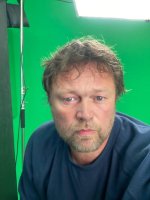
The last green I lit I was 'gaffer' and had to build the lit screen at 1000hours for when the main crew arrived with camera at 1200hours. I did send (at 1046 hours) some selfies to the main unit so they would understand the setup was 'in the park' for when they arrived..
 

Attachments

  • IMG_2060.jpg
    IMG_2060.jpg
    46.4 KB · Views: 0
I find it far easier to use false color and waveform to check lighting on a green screen. You can instantly see which sections need to be brought up without the wandering around part, and how adding a light to fix a section blends into the existing lighting. If I had to do it without camera I'd do it standing back and scanning with spot meter rather than walking around with incident meter, certainly easier to meter the sections above one's head or down by one's feet.

sort of seems like false color/spot metering is more useful when we know the value we want to achieve, either in absolute terms (white/gray card) or relative terms (green screen needs to match itself). and incident metering would be more useful otherwise. of course, it's possible that you always plan your shot around the values you want to achieve (if you want to plant part of the image in the shadows or highlights, etc). And that's largely what I've been doing. But I'd like to try incorporating a subject-independent exposure component into the mix
 
Nice picture Sam!

im fooling .. but not really... this was a genuine pic on a genuine job.

What I see..

Well exposed green
lots of hairlight easy to dial down it is the F21
keylight from the right (it is two godox 200)
a black poly not doing enough neg on the left.

As the DOP knowing I was walkiing in on that I would know I can 'make the day'

----
Generally. To me the use of the lightmeter (or not) is really all about using something when the camera is not there.
 
Generally. To me the use of the lightmeter (or not) is really all about using something when the camera is not there.

If I'm looking at key/fill sides of talent on monitor, I don't necessarily know where these should fall in the exposure range without looking at a white card in the light or using an incident meter. I can choose to put them somewhere...

And then let's say I shoot an interview set-up and I want to repeat the look in a new set-up. It may be helpful to know the relative exposure values of background to key to fill and try to repeat those as closely as possible. I can usually get close enough that a little grading will match it. But it doesn't always work quite as well as I want. And if you're handing the footage off for someone else to grade, you're at their mercy.

Charles' split-screen shot comparison method sounds pretty smart. I'm not sure I'm equipped to do that at present though perhaps I could work it out. It's not an instantaneous solution, though. For a simple 2-4 light set-up, metering your units may not set you back much time.
 
For sure. A light meter can be useful on set.

My comment should read that I mainly see the use of a lightmeter or other device when a camera is not present.
 
Back
Top