Light for booming for interviews

One thing I'm finding out about the lite cloth is that the velcro is wearing out, which makes it tough to hang. I had my light since Christmas and it's starting to wear out. I'll have to look for some stronger velcro replacement.

I've always been concerned about this. Have you spoken to Intellytech about it?
 
I've often wondered about the benefit of the somewhat common rigging of larger, heavier sources on booms behind/to far side of talent vs maximizing the relative size principle of much lighter and smaller LEDs on a speed rail substitute running alongside talent. For OMB or small crew/mobile, imagining a few sections of connected grip arm sized metal attached to two c-stands on either end. 2 grip heads with spuds able to slide back and forth along the axis to position a diffused key as close as possible but out of frame.
 
Because I ended up with a few 1x2 Wescott flex panels from a cooking show I shot last year I will sometime build 2x2 frames out of the frames they come with and boom them out over talent. It gives a nice light weight 2x2 200w source. The flexible lighting matts are the only style of light I feel comfortable booming over talent without some serious rigging.
 
Should a boom not be balanced and therefore exert minimal torque on its pivot? Desiring teeth on a pivot shows a lack of balance in the rig?

Yeah, that was my thought. The boom should be balanced. I would be really nervous if it wasn't since the center of gravity is not centered over the stand and you are drastically increasing your chance of the entire set-up tipping.
 
For lightweight and easy set up you're describing I use a Litemat 4, on an Avenger Mini Boom, on an aluminum combo stand.
-Aluminum Combo stand provides wide feet for stability while being very, very light. Lighter than a c-stand? I think, but would have to confirm.
-Mini Boom is a good compromise between weight, reach and speed. I use a sandbag or two on the counter-balance side of the boom, for safe reach.
-Litemat 4 has great soft wrap and output (for the weight) and is bi-color. Very light, doesn't need much counter-weight. I rarely use rgb on talent for interviews. More for splash of color on background. Of course, I can see more stylized interviews would use it, but when I just need kelvin spectrum I prefer bi-color...when it has to be LED. But Litemat 4 is my recommendation for sure. Not the cheapest, but is worth three times its weight in gold. Disclaimer: I don't have lots of experience with other products, so I can't compare from experience.

Booming a foam bounce is also a good idea. The downside is it can get tricky to get certain angles in certain locations. When doing this technique, I recommend leko barrels, because fresnels can have unwanted spill that requires more flagging, black wrap, or sometimes complicate angles.

Alternatively, you can do the old school big back light and just bounce it back onto talent for your key. But that big light may be heavier and defeat the purpose.
 
I hadn't considered the use of foam core for this type of interview set-up even though I've seen it used in a similar way for narrative shoots. You wouldn't necessarily need a Leko. An HMI Par with barn doors would work pretty well.
 
I hadn't considered the use of foam core for this type of interview set-up even though I've seen it used in a similar way for narrative shoots. You wouldn't necessarily need a Leko. An HMI Par with barn doors would work pretty well.

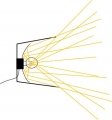
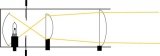
A HMI par cut with its barndoors will have more spill and will be more difficult to limit to the foam core surface area than would a Jo-leko. So yeah, you can accomplish something similar but not as well. With a leko head ( ellipsoidal light head ) you can cut the light right up to the edges of the foam core without much spill and the light on the foam core will be of a consistent luminance. No hot spot. With any par-light, the barn doors do not produce a clean cut. You get multiple edge shadows and an un-clean cut. Same with flags used with pars. Pars don't produce clean cuts because pars are not a point-source. The light is emitting from a reflector panel that produces multiple light rays or paths.


20.jpg


32.jpg


Now, all that said I recognize that a Jo-leko is a comparatively costly unit and not something that us mere mortals typically have around.

And, again, the "problem" with using a big bounce as a key source is that the bounce is less directional than the output from a soft-light unit. The bounce will more bring up the level of the entire space. It will be bouncing off the ceiling above the subjects. Which is okay if you do not need falloff and want a flattish, more "natural" look than typical interview lighting. But you'll have more difficulty getting anything to fall off to black. You'll likely end up with a more low contrast look. And being that a bouncing a key will reduce its output significantly, you'll also have greater difficulty competing with exterior windows in the backgrounds. Which means more ND or use of bobbinette.

If anyone reading this is ever looking for bobbinette ( aka "Cinenet" ) in bulk direct from a theatrical supplier, it can be sourced here:

https://www.rosebrand.com/subcategory157/fabric-by-type-bobbinette.aspx

Check out a product Rosebrand calls "Transfer Net", a netting that doesn't tear as easily as bobbinette:

https://www.rosebrand.com/product3533/39-Transnet-FR.aspx?cid=157&idx=1&tid=1&info=Bobbinette%2bFabrics

wow, I really went way off topic. But hopefully it was productive and the links are useful.
 
Eric, a good way to see what setups are used by others is to google-search something like "CNN interview bts" or "Entertainment tonight interview bts". Or " <insert famous person> interview behind the scenes".

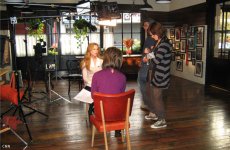
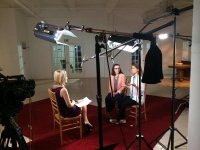
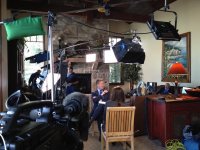
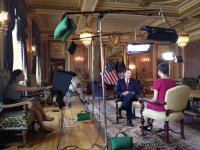
Here are an assortment of photos of setups acquired via online search, images that are informative as to what light booms are being used and what types of lighting units:

kidman_3.jpg

Screen Shot 2018-08-07 at 7.11.30 PM.jpg

aaatv.jpg

aaaadateline.jpg

aaafox.jpg


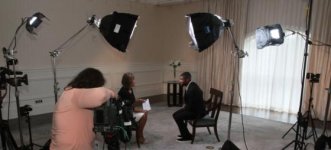
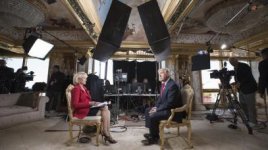
Anyone have a guess as to what the key lights are in the setup below? I'm thinking they are Litemats because of how clean the rear of the units, and also because of how even the light in the front-face of the unit. Note how these have been "boxed" with what appears to be showcard or "poster-board" and gaff tape.

dsc09698-1600x1600.jpg


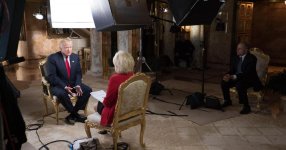
Positioning of the keys is everything there. Note how the keys are placed directly over the head of each person so as not to impact the lighting of the person positioned under the light. That is, the key lights are positioned so as to only hit the person they are keying. The female in the photo has an Astra with softbox attachement as a backlight / hairlight. It appears that the male in the image has more of a point-source as a backlight / hairlight. Possibly a LED fresnel of some sort or a dedolight. The positioning of the key-lights and the size of the key-lights results in the key-lights flagging the backlights off the person for whom they are not intended. The backlights aren't hitting the front of the person opposite. Note also that they used a C-stand for the light flown over Leslie but used a more beefy and more secure combo-stand for the light flown over Trump. Always use the heavier stand for the light hanging over the person more likely to sue you. :D

Screen Shot 2018-08-07 at 7.36.31 PM.jpg

link to higher resolution image of above:

https://wtop.com/wp-content/uploads/2016/11/AP_16316841586833-1877x1254.jpg

wth are those keys? Litemats? An early version of Litemats? Or a homemade LED softlight?
 
Last edited:
What I find interesting about all of those pictures is that almost none of those set-ups include a wide camera in front. The purpose of that lighting style appears to be to have as flat a lighting as possible with almost no shadow fall off. If they wanted more contrast between the sides of the face, they could just as easily set up lights directly on stands on the opposite side and still not have them show up in the shot.
 
What I find interesting about all of those pictures is that almost none of those set-ups include a wide camera in front. The purpose of that lighting style appears to be to have as flat a lighting as possible with almost no shadow fall off. If they wanted more contrast between the sides of the face, they could just as easily set up lights directly on stands on the opposite side and still not have them show up in the shot.


An excellent observation.


It my be explained by the want of a "dirty single" that is wide-ish. In other words, they want the option of the camera on the interviewer being able to go wide enough to include the full back of the interviewee. A "two-shot" in essence where the spatial relationship between the two individuals is revealed. As opposed to only having "clean" singles. "Flying the lights" just leaves more options available in general. When you do not fly the lights, things become more restricted and your options are fewer. You are more limited to a tighter framing. A another benefit of flying the lights is that things are "cleaner". Meaning, it is easier for the on-air talent / subject to enter into the setup. The chairs aren't in a tunnel of stands that has limited ingress and egress. It is less claustrophobic in that and less intimidating, albeit minimally less.

But yeah, in a couple of those samples there doesn't appear to be a third camera ( laterally positioned camera ) that necessitates flying the lights.

One thing to note in the images- in the setup for the 60 Minutes interview with Trump, the keys are flown but flown from the opposite side of the cameras. Flown from the key-side. Not from the fill-side. Whereas in all the other images the key lights are flown from the fill-side, flown from the same side as the cameras.
 
Last edited:
Here are an assortment of photos of setups acquired via online search,

The pics are interesting - but I feel a little dated - mat leds have surely have made these set ups a kind of historical oddity.

As for mounting mats I would be using either foamcore or 3-6mm plywood, or maybe 1.5mm aluminium and applying them with tape or straps at the corners rather than relying on velcro.
 
A bit overkill with the wind protection there. Also kinda odd to have a shotgun on one person, and a hypercardioid on the other? Or so it seems.
I wasn't the audio person on that shoot. It does annoy me too when an audio person puts wind protection on indoors. A lot of audio pros do not own two hypercardiod mics. I often wonder how much I should micromanage audio professionals I hire or refer to the producer to hire, as well as if I should volunteer, ask, or tell them to use my mics (Schoeps CMC641 and Sanken CS3-e) if mine are better suited for the job.

For that particular shoot, it was a pretty open space and there was various background noise going on, as well as the wide shot making the mics need to be further out, so a shotgun would seem the better choice to me.
 
The pics are interesting - but I feel a little dated - mat leds have surely have made these set ups a kind of historical oddity.

As for mounting mats I would be using either foamcore or 3-6mm plywood, or maybe 1.5mm aluminium and applying them with tape or straps at the corners rather than relying on velcro.

The basic concepts are not much altered just because of the type of source. Besides, in the last example "mat leds" were being used as keys.

Explain what you mean by "mounting mats" on foamcore or plywood. Are you talking about building your own led lighting units out of bulk led strips like those available from Litegear?

Sorry I think Litemat may be a specific rigid product, gererically Im talking generically about flexible LED panels (light mats - not LiteMats) that need supporting not to 'flop' - such panels seem to have various arkward stsyems for making them flat and rigid, such as bars that 'pop' in to the corners, velcro that degrades, etc.

Given such a (generic) floppy panel Id just buldog clip it onto a bit of thin board (or poly or foamcore) with a spigot arm attached (to the board/foamcore/poly).
Or if one had 4.4 frames use them (for a 4.4 'mat')

Does that make sense?

S
 
Last edited:
I wasn't the audio person on that shoot. It does annoy me too when an audio person puts wind protection on indoors. A lot of audio pros do not own two hypercardiod mics. I often wonder how much I should micromanage audio professionals I hire or refer to the producer to hire, as well as if I should volunteer, ask, or tell them to use my mics (Schoeps CMC641 and Sanken CS3-e) if mine are better suited for the job.

For that particular shoot, it was a pretty open space and there was various background noise going on, as well as the wide shot making the mics need to be further out, so a shotgun would seem the better choice to me.

It does seem strange to me when full time professionals don't at least have a "similar" mic for when needing both at once, as it is a common enough need.

For instance I could at least use my CS3e & CS1e together, or my AKG460/CK63 & AKG C300/CK93 together.

Whenever I'm the cameraman I do tend to "micromanage" them quite a bit, or so they think... ?! But that is because the bulk of my experience and work is as soundie, and they're using my gear, plus any shoot I'm "DoP" for they don't have much of a budget or time to find a good soundie so I do feel that need to keep an eye on them :-/
 
Back
Top