LED-only lighting kit

I was trying to go that route with Par38 cans and 85 WATT CFLS from http://www.alzodigital.com/online_store/light_bulbs_compact_fluorescent-daylight.htm, but the too many lumens are lost (need a reflector built for the CFLs, the Par38 cans are an 1-1/2" short for the bulbs (I wanted to gel/diff where the filter is), and the bulbs don't really fit anyways (they sag...are bending the internal support). The cans I got from BulbAmerica and 3/8" to 5/8" adapaters from B&H are just fine though.

I wouldn't go the used bulb route, but http://www.bulbamerica.com/light-bulbs/par-can-bulbs-2/par64-bulbs-2.html?base=118&watts=1103 there are a lot of 1k bulbs to choose from $25-$30. I would like to know what brands (if any) are the best for video since I am seeing 100 CRI on all of them, they are 3200k too. My main question now is what type of spread (they seem to recommend wide flood). I am also curious about how managebable/strong the hot spot is (though from my experience its not a real strong hot spot).

There are barn doors available for these cans. http://www.ylighting.com/bardoorfitpa1.html is an example.

Not sure about your experiences, but these par can globes last forever. We have hundreds of them floating around at the rental house I used to work at and it's very rare to see them come back with a bad globe...I think I've seen two go bad in maybe 5 years? Considering you can get 3 globes for the price of 1 brand new one, I think you're not taking that much of a risk with the older globes.

MFL and WFL are the most commonly used par globes. Usually when people use narrows and narrow spots, its with a 9-light and they'll either go all narrows, or checker them with mediums or wides. There are some applications for the narrow globe otherwise, but they just don't get used too often.

Unfortunately these lamps are not a light you want to use direct, and not a unit where barn doors really help too much. Like Moseph said, they're a punchy light for a bounce or through diffusion. You'll have to cut it from there with flags or other light shaping tools to get it where you want to go.

The reason for this is because all those little facets that create a wide or medium flood globe, acts as a little source. So when you set a flag, you'll see 10,000 different shadows from each little facet, without a little diffusion it just ends up looking really sloppy.

A friend of mine just bought 20 of the little par 16's and I can't get enough of them. They're way cheaper than arri 150's and then you can have a million little units for accents all over the set. I haven't tried using CFL's in them yet, but have you tried diachroic bulbs? It's still a hot light, but a lot closer to daylight in a par can configuration.
 
Last edited:
"If you are working close up or planting lots of lights across your scene, LED's are great. The best are expensive and most are overpriced. Silly me, I use a lot of modified flashlights and bike lights as well as my DIY'd. "

Care to share details of your LED flashlight mods? Those things are available super cheap.

Thanks,
Ken

OK. Give me a couple of days to shoot pics. Been super busy this weekend. BTW. The lights I start with happen to be super expensive, and one at least is really overpriced. More later.
 
PARs are best for when you really don't need a lot of control. They're great for bouncing into things, pushing through diffusion, and lighting up things where small details don't really matter. There's a very noticeable field of illumination outside of the beam. The wider the lamp is, the more even the beam will be.

Barn doors are pretty ineffective on PAR cans. They're not a point source like a fresnel, the entire reflector in the lamp is the source. If you want a well defined cut, you need to set a flag at least a couple feet away from the light.

I was mainly thinking of the barn doors to hold the diff or gels so they didn't smoke/melt (instead of setting up another c-stand to hold the diffusion. I have been looking around for portable, quality lights on a tight budget. I am most happy with the quality of the tungsten light but like the OP I hate the heat. I live in a hot climate and we have to shut the air conditioning off because of the noise (for audio) so it get hot really quickly (unless its winter). I am leaning to putting a 3 point light kit together with a couple of 1ks using the par64's (its very inexpensive). They would be useful, look professional, and I am sure and I could hopefully diff them (though not sure how well parchment paper and the heat get along). I am not finding used or ebay stuff anywhere as cheap. The stuff I am shooting is like red carpet/event (mostly at night) interviews so lighting is not perfect but needed. My guess the Pars are used for these in Hollywood too (maybe they use Arri 650's or 1k's). ttp://jwook.com/redcarpet/

Somewhere down the road I may make my own light fixture for 3 of the 85 watt CFLS (for around 1k output). I have great contacts for making an aluminum fixture and I am very versed on electrical. I am also thinking some day they will make 105, 150, and maybe even 200 watt cfls with high CRI and 3200k and 5600k temps. I would then be able to have a flat 15" x 15" x 8" 1-2k can which I can gel and diff and mount on c-stand. I don't want to lug/drive around with a softbox, because most of them I've seen are made for a studio and not for quick setup and tear down. Unless I I am noticing on my 312 bi-color LED its not the best for skin tones so I have a choice to make.
 
I was mainly thinking of the barn doors to hold the diff or gels so they didn't smoke/melt (instead of setting up another c-stand to hold the diffusion.

Just use the provided gel frame. You might run into issues if you put very narrow spots through a thick gel, but you have to think, these units are mainly used for rock n roll lighting, where colored gels on all the lamps is the norm and they never use frames further away from the unit. Worst case you put a cut of heat shield in before the gel, should solve things pretty easily.
 
I was mainly thinking of the barn doors to hold the diff or gels so they didn't smoke/melt (instead of setting up another c-stand to hold the diffusion. I have been looking around for portable, quality lights on a tight budget. I am most happy with the quality of the tungsten light but like the OP I hate the heat. I live in a hot climate and we have to shut the air conditioning off because of the noise (for audio) so it get hot really quickly (unless its winter). I am leaning to putting a 3 point light kit together with a couple of 1ks using the par64's (its very inexpensive). They would be useful, look professional, and I am sure and I could hopefully diff them (though not sure how well parchment paper and the heat get along). I am not finding used or ebay stuff anywhere as cheap. The stuff I am shooting is like red carpet/event (mostly at night) interviews so lighting is not perfect but needed. My guess the Pars are used for these in Hollywood too (maybe they use Arri 650's or 1k's). ttp://jwook.com/redcarpet/

Somewhere down the road I may make my own light fixture for 3 of the 85 watt CFLS (for around 1k output). I have great contacts for making an aluminum fixture and I am very versed on electrical. I am also thinking some day they will make 105, 150, and maybe even 200 watt cfls with high CRI and 3200k and 5600k temps. I would then be able to have a flat 15" x 15" x 8" 1-2k can which I can gel and diff and mount on c-stand. I don't want to lug/drive around with a softbox, because most of them I've seen are made for a studio and not for quick setup and tear down. Unless I I am noticing on my 312 bi-color LED its not the best for skin tones so I have a choice to make.

IMHO, you're wasting your time with CFL's I recently used BIG 4-up CFLs in Wescott softboxes for the first (and last) time on a shoot to promote a product of mine. Way too underpowered for my taste and something about CFL lighting is lifeless.
Here are the examples. This one was a CFL softbox at 1M full power plus another(fill) at 1/2 power

I so hated the look that when I went hope to shoot the rest, I opted for a Lowel V-Light bounced off an umbrella for main and a Lowel Omni bounced off the ceiling for fill.

Finally, The 35HID conversion kits I've been buying from China (AKA Ebay) rock at $14/kit. Just imagine wiring a few of those in a 2'X4' box !

As promised, I'll do a quick show n tell of my Non-Tungstens soon
I see what you mean. You/your talent is way under lit and does seem dull and muddy. I am surprised because you were using how many total watts on the Wescotts?

Funny you mention the 35HID, because that is what my friends who offroad were talking to me about for lights when I was talking to them about needing a high intensity light.

No clue on the Wesotts. I was loaned the studio and just turned them on without asking. They look Bright to the eye at 3' but on camera, ick. Problem was not the intensity so much as the collimation of florescents.

The HID I just MOD'd ( minor mount and BD + Diffusion ) is this light.....

I shall do the show and tell on this one first but I need to have the diffuser cut first.
 

Attachments

  • CD-CL-HID-1.jpg
    CD-CL-HID-1.jpg
    31.2 KB · Views: 0
Discussing hot lights versus Flo's and LED's: Our observation in the last few years is that we have 100's of tungsten light of all sizes but HMI, Kino's and LEDS are used and rented nearly 80% of the time. The conclusion is that the reliable and cheap to maintain Mole and Arri tungstens are fast falling out of favor.

They will stay around the shop but almost all new stock we purchase is a 5600 degree source. These are costly to purchase and are in need of care and maintain. At any given time we have 1 to 4 HMI ballasts in the shop for repair.

Just means more moles coming on the market in the future for us that appreciate that there IS no better light.
 
I'm reading a lot of gobbledy gook and some really sensible rebuttals.

I use ALL types of lights ( as long as they sync with the Hz of my camera) Hot lights are less than efficient but you can't beat them for sheer punch. I'm loving HID ( AKA HMI) especiallythe MODs I've been doing and yes, you can really score some cheap conversation kits if you are into DIY. LED's are my recent forté ( 10 years now) so you can imagine how thrilled I am to see the technology finally in real lights that can be nice matches to the high ISO sensors we've got now.
Each type of light has it's pros and cons. No time to make the lists now but here's a quick tip on how I use these separately and together.
On second thoughts, let me address your post.
Right now, hotlights are the best up-front value for the money. I practically eat Lowel Omni, V-lights and Tota's. Sell me all yours guys.
Of course, I advocate LED's because they are highly efficient in terms of Lumens per dollar. Sadly, the really good lights are still in skunkworks (around the corner). If you are working close up or planting lots of lights across your scene, LED's are great. The best are expensive and most are overpriced. Silly me, I use a lot of modified flashlights and bike lights as well as my DIY'd.
My recent finds have been HID (AKA HMI) . sure the fancy branded studio lights are great, controllable and pricey. But you can pick up a 50W conversion kit at 4,300K for $10 from China ( AKA ebay). Win Win!
What really suck are the flourescents. They were a great transitional but will soon be obsolete ( yes even the long 4' tubes)

My run n gun kit is four LED lights, but it's only good for interviews. For everything else, out come the hotlights and HID.

Can you talk a little bit or point me in the right direction for the conversion stuff?

Definitely a Noob when it comes to converting lights, but not so much electronics in general. any good places I should check out?

What are you converting exactly?
 
Can you talk a little bit or point me in the right direction for the conversion stuff?

Definitely a Noob when it comes to converting lights, but not so much electronics in general. any good places I should check out?

What are you converting exactly?

OK. First. For those that are electrically inclined* Here's a link to a two lamp HID conversion you can buy online.
Typically, these are used to convert your 12V front tungsten headlamps into HID
Note the price for TWO units is less than dinner for two at Panera Bread ;)
What else you need:
- photon management ie a reflector or if you are building a softbox or bank light, a mount for the bulb. A tempered glass bulb protector of some sort is also highly advisable (see> ALZO )
- Ballast mount and PROTECTION. The ballast is the larger 'box' electronic component that converts 12V to 25,000V. This is the part that you must never touch when V is running through it. The typical container is a 'can' of some sort. In lighting parlance it's a 'head'. if you are building a banklight, then a separate box is needed to store your ballasts.
- Power connectors ( I use all types. Plug-In-Power connectors, XLR (4) and plain jane cigarette too.
- A switch (rocker or toggle from > radio shack or Mouser)

For the not so electrically inclined, you need to pick up some off-road HID heads and hook 'em up to a 12V source. (beware. MOST offroad light heads are above 5000K)
Here's an example notice how the price jumps now that you've bought an off-the-shelf integrated head. Now you also have to hunt like crazy for a 4300K color balanced version.

I'll talk about LED later as that is a MUCH bigger subject and requires far more electrical finesse for DIY
But just to keep you entertained, here's a fast and dirty vid of me demoing an LED DIY panel light that I made from a $cheap 600LED ribbon I bought on ebay. Keep in mind I did to to show a fellow DIY buddy, so it's not meant from prime time and of course- you can only do so much with a 720p flip camera ;)

Just found this.
If I can get the manufacturer to swap out the 'grow light' emitters for video friendly ones would you pay $250 per panel? I would !!

*Caution! HID ballasts load 25,000V of power. Working with HID kits are not for ine3xperienced hobbyists
 
Last edited:
Awesome Post! Thank you Zephyrnoid

Definitely a bit out of my realm, but super interesting none the less and great to know there are possibilities out there
 
Any name brand will do. They're tungsten so they're inherently 100 CRI, differences from one brand to another will be negligible.

It's not very wide. With WFL and MFL lamps you get an oval shaped beam, both being about the same width but MFLs being about half as tall (when oriented horizontally). I'm not sure of the exact beam angles but a fresnel is definitely wider when fully flooded out. And fresnels also give you a narrower, and in some cases brighter spot than a NSP or VNSP PAR lamp, but the PARs are much more efficient and will put out more light overall.

PARs are best for when you really don't need a lot of control. They're great for bouncing into things, pushing through diffusion, and lighting up things where small details don't really matter. There's a very noticeable field of illumination outside of the beam. The wider the lamp is, the more even the beam will be.

Barn doors are pretty ineffective on PAR cans. They're not a point source like a fresnel, the entire reflector in the lamp is the source. If you want a well defined cut, you need to set a flag at least a couple feet away from the light.

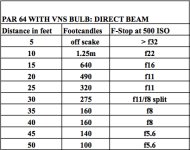
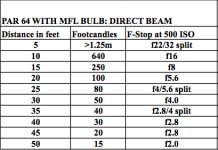
Yeah, I picked up 4 par 64 cans from eBay for I think it was $89.00, of course I need bulbs, TVMP and stands, but I don't know of anything available so reasonably for the pure punch. Here are two charts I made showing the photometrics of a 1k very narrow spot (VNS) bulb and a 1K medium flood (MFL) bulb.

Par 64 VNS Photometrics.jpg

Par 64 MFL photometrics.jpg

The VNS bulb is much sharper of a beam and does have a hotspot The MFL is much smoother of a beam.
 
Good Charts David!
Another thing that newbies need to keep in mind....
1) Know your electronics power sources. Incans are HUGE Amperage hogs . I always scout my locations and test each circuit or have someone do it long distance. It's pointless to show up on a location with 4 2K's or more and discover that the room you're shooting in has two outlets with 15A each. You also need to discover the total available amperage per circuit.... unless you want to see the breakers close your shoot down ;)
2) The BIG advantage of florescent, HID and LED is the very low draw with LED's and florescent being the least taxing on wall AC.
I'm running my HID's & LED's off of Tekkeon MP batteries and some legacy Lead Acid packs.
Nothing beats untethered.
 
Do you mean 1.25k not m?
Just when I was thinking I was getting a handle on things, I just realized some folk talk in foot candles and others in lumens at 1 meter. An then there is luminous flux/lumens http://www.bulbamerica.com/osram-sylvania-1000w-120v-par64-q-mfl.htmlI am seeing these lamps at 19400 LM. I've been mostly comparing lights by their lumens.

The footcandle readings are from direct measurement with my incident light meter; a Sekonic L-398. I leaned exposure with this light meter and it is my basic point of reference when thinking about light. I started shooting film and I trust my L-398. I am in no way saying that this is the only, or best. way to judge lighting, but it is the way that I do it. To me, the photometrics of a light, in footcandles, is basic information that I need when evaluating any light. The charts that I posted were put together over several nights where I set up everything in my light kit and took light meter readings over a measured distance. I also set up the lights in several soft light configurations and measured the photometrics for that. I now have a pretty detailed understanding of what my light kit can give, exposure wise, over known distances and have this info in printed charts like above that I carry around with me on location scouts. Doing the measurements also gave me an opportunity to study the quality of the light that my kit can provide. Herein is the rub; soft light over any kind of distance takes a lot of light. As a general statement, you would be very lucky to get an f1.4 at 20 feet (At 500 ISO) from a 1k tungsten Fresnel at full spot off of a bounce source. To me, understanding this basic performance of the lights I am using is the basics of cinematography. Now if you are doing this with lumens of light, more power to ya, but my reference is footcandles. There is no right way with this, for sure. What ever works for you is just as valid.
 
I've been wanting to make an LED lighting kit ever since I discovered Litepanels. During my time at film school (undergrad and grad school) I've used pretty much the same kit of Mole tungsten lights with 2Ks being used only once or twice. I understand the worry about lights being hot but it's normally a non-issue if you don't go crazy with them and blow circuits and stuff lighting the heck out of a scene. In most cases you will only ever need two 650w at one time for indoors and maybe a little one for added effect. A better setup is actually combining fluorescents and making up for any lighting deficiencies that way. Higher ISO cameras make things a lot easier these days but it all depends on the look you're ultimately going for and the lights you choose greatly affect that. For me, I light simply and go for more natural looking images but I've been on productions that have gone for the same thing and lit up the night (and day) and others that have gone for more stylized stuff and used nothing more than Kinoflos.

One of my greatest experiments were my two films "The Christmas Valentine" and "Sparks of Pink & Blue". With "The Christmas Valentine", I wanted to get a classic Christmas feeling by trying to emulate the look of warm Christmas paintings that you normally see on holiday cards and storybooks. To get that with my, then new, Nikon D90, I primarily used Christmas lights rather than normal lighting solutions and used practicals sparingly. For "Sparks of Pink & Blue" I knew that the story took place at night in a house so I needed to light with the moon essentially. Needless to say, there weren't enough lights available at my film school to make this possible and I wasn't sure that gelled Tungsten lights would give me the same moonlight feeling I was after. So, I knew that I'd need a bunch of lights and that I'd need them to be soft and that meant fluorescents. For this I actually resorted to the simple DIY route and used a bunch of hardware store clamp lights with 100w 5500K balanced daylight CFLs that were available at the time. These really helped sell the moonlight feel after adding some 1/2 blue gels and I was able to use enough of them around the house to make a 360-degree lighting setup as well.

Returning to LEDs, they combine the best of both worlds, cool, powerful, and highly flexible but they can be very expensive! LED lights can do the job for many occasions but the problem I hear about most is the color bias various different LED fixtures can have. Some are green, some are blue, and others can be a little yellow depending on the brand. Thankfully there are workarounds with custom white balancing but some can be tricky, particularly with some of the lower quality panels. The light spread of LEDs can also be an issue as 90% of them are pretty much flat circuit boards with a bunch of LEDs stuck in them and they may or may not have barn doors to control the light spread. The best thing that has come out for LEDs, in my opinion, are the new Litepanels Sola fresnels, nearly perfect fixtures for everything but the price is through the roof. Now one option could be to do like I did with "Sparks of Pink & Blue" and use the DIY route but I recently looked at the bulb options at the usual big stores and the only daylight bulb I could find was a larger LED flood bulb which could possibly be too heavy for clamp light use with those big metal heatsink fins wrapped around the bulb. Plus, again, the price is a little risky for simple testing as that one was about $60. The only other option would be lower powered 3400K tungsten-like LED bulbs but that may not be worth the expense in the end due to the loss in power and slightly off color balance. Still, if you know that LEDs are your main light of choice then it may be wiser to buy a competent amount of lights to cover your bases, like maybe one small tungsten kit and a CFL solution and then adding one multi-purpose LED fixture as your specialty light. Then you can gradually add or replace as prices go down or new innovations pop up, like the Solas.
 
The footcandle readings are from direct measurement with my incident light meter; a Sekonic L-398. I leaned exposure with this light meter and it is my basic point of reference when thinking about light. I started shooting film and I trust my L-398. I am in no way saying that this is the only, or best. way to judge lighting, but it is the way that I do it. To me, the photometrics of a light, in footcandles, is basic information that I need when evaluating any light. The charts that I posted were put together over several nights where I set up everything in my light kit and took light meter readings over a measured distance. I also set up the lights in several soft light configurations and measured the photometrics for that. I now have a pretty detailed understanding of what my light kit can give, exposure wise, over known distances and have this info in printed charts like above that I carry around with me on location scouts. Doing the measurements also gave me an opportunity to study the quality of the light that my kit can provide. Herein is the rub; soft light over any kind of distance takes a lot of light. As a general statement, you would be very lucky to get an f1.4 at 20 feet (At 500 ISO) from a 1k tungsten Fresnel at full spot off of a bounce source. To me, understanding this basic performance of the lights I am using is the basics of cinematography. Now if you are doing this with lumens of light, more power to ya, but my reference is footcandles. There is no right way with this, for sure. What ever works for you is just as valid.
I am still trying to understand that >1.25m reading. What does the "m" stand for? I think you misunderstood me about the lumens, I am just comparing light sources (published data) and most of them are in lumens. You have gone much deeper into the use of a particular source. The problem I have is I am not confident in the published data (which makes choosing a light that much more difficult). Yes your charts are awesome, but I was more at the starting line. Also, curious why are you using VNS and MFL and not WFL's? From your chart I am guessing with diff/bounce you would be 15' away and around f5.6. I am trying to get lights with a light diff at around 10' away and f5.6, but it looks like going this route I am going to rely on a Harbor Frieght dimmer to be that close.
 
Returning to LEDs, they combine the best of both worlds, cool, powerful, and highly flexible but they can be very expensive! LED lights can do the job for many occasions but the problem I hear about most is the color bias various different LED fixtures can have. Some are green, some are blue, and others can be a little yellow depending on the brand. Thankfully there are workarounds with custom white balancing but some can be tricky, particularly with some of the lower quality panels. The light spread of LEDs can also be an issue as 90% of them are pretty much flat circuit boards with a bunch of LEDs stuck in them and they may or may not have barn doors to control the light spread. The best thing that has come out for LEDs, in my opinion, are the new Litepanels Sola fresnels, nearly perfect fixtures for everything but the price is through the roof. Now one option could be to do like I did with "Sparks of Pink & Blue" and use the DIY route but I recently looked at the bulb options at the usual big stores and the only daylight bulb I could find was a larger LED flood bulb which could possibly be too heavy for clamp light use with those big metal heatsink fins wrapped around the bulb. Plus, again, the price is a little risky for simple testing as that one was about $60. The only other option would be lower powered 3400K tungsten-like LED bulbs but that may not be worth the expense in the end due to the loss in power and slightly off color balance. Still, if you know that LEDs are your main light of choice then it may be wiser to buy a competent amount of lights to cover your bases, like maybe one small tungsten kit and a CFL solution and then adding one multi-purpose LED fixture as your specialty light. Then you can gradually add or replace as prices go down or new innovations pop up, like the Solas.
I am not the OP but I was also leaning towards LEDs for what I am doing (mostly run and gun), but all the problems you mention are true, and especially the pricing. From the little experience I have, they are simply not very bright unless very close to light a small group of people (and if you are doing 2 camera probably in the way) unless you get the bigger ones like 1ks. Then you are looking at $700 a pair for the cheapest ones which is a gamble. More like $1000 and up for 2. That's without battery packs, so realistically I would be looking at $1500 for what rental places charge around $100/day. The 1k par64s I am looking at are just about $140 to buy a pair with dimmers, (I already have c-stands). Huge difference in quality of light and flexibility and bottom line price. I've checked the used route btw and just not finding anything that entices me as much. I was looking for something which would be around f5.6 at 8-10' distance either bounced or diffed. Also, in the flo's and CLFs I am concerned about light bulb breakage, they just seem so delicate! I would like to go with a 2-4 85w to 150w (actual not equivalent) CFLS in a flat 18x18x8 can, but no one makes one (yet) for a good price. I would just pack/use padding in to keep the bulbs safe while traveling locally. I may end up making my own cans so I can get the 5600k color temps too. Maybe someone will make 3200k 85w+ CFL bulbs soon too.
 
Back
Top