LED Lighting

gbadgley

Active member
Howdy,

I just finished watching Barry Green's DVD, and was particularly interested in his discussion on the CMOS sensor and Led lights. There is an issue with banding in that they have to be run at full power and can't be dimmed. I'm just curious as to what others have experienced using these lights with our type sensors. They seem to have a long, long list of advantages, and this seems to be about the only disadvantage, and even with this issue, there seems to be a workaround.

I will be doing some outdoor interviews soon, and was thinking this might be a great way of getting some fill.

Any input on the choice of a led panel for fill would be great also.

Cheers.
 
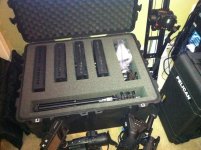
Not sure about the banding issue but we use the ePhoto 600 and 900 LED panels. Fantastic price, surprisingly well built and bright and you can power them with V-mount batteries if filming in a remote location. For traveling, we comformtably fit all 4 lights, cables and 3 lightstands all inside of a Pelican 1630 case. the entire package was around $2k.

lights.jpg
 
Last edited:
Interesting. I'm running an on camera LED that has a dimmer. I run it about 1/4 power all the time and haven't noticed anything strange at all.
 
I've been using several Cool Lights units - 256, 600 & 1200 bi-colour - as well as litepanel minis, haven't noticed any banding issues across the range of frame rates. If you push the shutter to the extreme there is something going on but I'm not too sure if that can be blamed on the LEDs or the look of 1/2000.

I haven't been thrilled by the skin tones of a lot of the LEDs but the ease of use and battery power overcame that small quibble. The 1200 bi-colour has fixed the skin tone problem (at full daylight the Cool lights still have the redder LEDs on producing a much more pleasing look - not all bi-colours lights do this) but you do sacrifice the easy use of batteries - they run on 18volts.
I have a garage full of lighting units but LEDs have become my day to day choice (with a couple of Dedolights added to the mix)
 
I've been using several Cool Lights units - 256, 600 & 1200 bi-colour - as well as litepanel minis, haven't noticed any banding issues across the range of frame rates. If you push the shutter to the extreme there is something going on but I'm not too sure if that can be blamed on the LEDs or the look of 1/2000.

I haven't been thrilled by the skin tones of a lot of the LEDs but the ease of use and battery power overcame that small quibble. The 1200 bi-colour has fixed the skin tone problem (at full daylight the Cool lights still have the redder LEDs on producing a much more pleasing look - not all bi-colours lights do this) but you do sacrifice the easy use of batteries - they run on 18volts.
I have a garage full of lighting units but LEDs have become my day to day choice (with a couple of Dedolights added to the mix)
I love my Cool Lights LED's. Haven't had any issues with banding ever. Something I guess I will look out for.
 
No problems with flicker/banding for me either. I'm using Datavision 600/900, Microbeam 128 camera toplights (often one on camera for catchlights, dimmed right down) and a Bebob LUX LED40.

The main issues I have are with colour. The Bebob is a very good match for daylight. The Datavisions are pretty close, if a teeny bit green. The Microbeam is actually very magenta by comparison with daylight, weirdly. Skin tone rendition is not as nice as it was with tungsten, I am forced to admit, although a little subtle grading usually fixes that up.

But... compared with tungsten, how FABULOUS are the joys of running cool lights (safe, easy to rig, can use in enclosed space) that ALL run off battery for a good two hours at full power, built in dimming, no trailing wires, moving a light just means picking up the stand and moving it, all lights pretty close to daylight balance (no losing 2 stops with a blue filter, thus requiring yet more power and yet more heat and danger), naturally softer light sources which is what I need for 95% of my shots...

The LED lights are amazing. I'll never go back to tungsten. Funds permitting I might change some of the datavision panels for high end Litepanels ones with the red LED's at some stage to try to improve skin tone rendition, but I've sold almost all my tungsten (kept a couple of small and medium Arri fresnels on general principle, in case I need very hard light or tungsten balance). Shooting with the LEDs is an absolute joy by comparison.

Cheers, Hywel.
 
Roscoe's LitPad's will band if dimmed too much, but I haven't noticed the issue with LitePanels' 1x1, or bricks.

I use LEDs when necessary, but they're my last choice due to poor reproduction of skin.
 
Led's

Led's

I took another look at Barry's DVD on the banding issue. It is a rolling banding to be more precise. My impression is that it is not an issue with most led panels just the more inexpensive ones, and in some cases it is very subtle. But it is an issue, and good to be aware.

It seems from the main issue is with skin tones. Just how difficult is it to adjust using gels? It is all that difficult to get what you want?
 
*shivver* rolling banding is evil. If we notice it is there anything we can do to correct during filming? Like changing the shutter speed?
 
*shivver* rolling banding is evil. If we notice it is there anything we can do to correct during filming? Like changing the shutter speed?
Depends on what's causing it. If you're encountering it because of fluorescents or HMI's then yes, changing the shutter speed to 1/60th (in NTSC) or 1/50th) in PAL will usually make it go away.

With LED's, not so much. You *may* be able to chase it with the shutter speed, but not likely. It becomes a tricky dance of adjusting the dimming level of the LED vs. chasing it with the shutter speed. What I've found is that LED's are MUCH less likely to cause banding if you run them at 100% brightness. It's the dimmers in LED's that usually causes the banding.
 
Yikes! I was considering an ARRI Hybrid kit (with the Locaster dimmable/temp-tunable LED) - and didn't know about this issue.

Does anyone know if the Locaster suffers from this issue?
 
I've encountered it on cheap panels, but I've actually found a cheap panel that doesn't do it too, so ... it's possible to make a non-banding dimming panel. And I would expect that Arri would make it properly, especially because they make CMOS cameras. But until you test it, it's all assuming...

If you want to know whether a particular light is going to have the issue, just try a hyper-short shutter speed, like 1/250 or 1/500 or something. That should definitely cause banding, if the light is going to cause banding at all. If you see no bands at 1/250, 1/500 or 1/1000, then it's not likely that you'll see banding at all. But you have to try it at various dimming levels; like I said before, even lights that have nasty banding might be perfectly okay when at 100% brightness.
 
As an alternative to dimming, don't most of theses LED lights allow you turn off some of the lights in banks?
 
Yes, it's a GREAT explanation of what happens when you start using discontinuous-emission spectrum lights.

The worst thing is that it introduces a dependence between the lighting and the camera sensor, which can make matching different cameras pointed at the same scene impossible, because it depends on exactly where the peaks of the light's emission lie with respect to the peaks of the filter pass bands on the RGB bayer array on the camera sensor. For the lower-end white light panels, there's a whopping peak in the blue, a broad peak in the green, and a bit of a fall-off across the red. Since skin tones are mostly red (with a bit of green) this can make their reproduction particularly tricky, especially if you are trying to emulate tungsten (which has a lot of emission down in the reds) rather than daylight (which is more or less flat across the visible spectrum).

I wish I'd realised how individual the match might be between light and camera- what one should do if humanly possible is try the lights under studio conditions with the camera or cameras you are actually going to use. You may find that they are a good match- as my Datavision and Bebo lights seem to be for my AF100. Or it may be that despite appearing the same colour temperature to the eye, they register colours very differently (like my toplight).

After a bit of work with a Macbeth colour chart when I first got the lights, I now have a fairly good feeling for how the lights register and how to make them look attractive on skin tones under various lighting conditions, including mixing with daylight (for which the basic rule I've evolved is "don't mix the toplight with real daylight as it turns into a magenta spotlight"- it mixes much better with the other LEDs than with actual sunlight).

You also need to play around with white balance settings as one usually would. I've found that white card WB doesn't usually produce the most attractive results, I prefer to use daylight preset or (most often) tweak a variable colour temperature a bit to get nice skin.

Is it ideal? No. Is it better than fluorescents? In my experience, absolutely. I sold my fluorescent units without hesitation (I liked their dimming and cool running, but HATED the way they reproduced skin, and they wouldn't run off battery which is a killer feature of LED for me). Is it better than tungsten for matching daylight? In my opinion it is as good as. The match is not quite as flattering to skin tones as tungsten with a CT gel over it, but you get a hell of a lot more light and a hell of lot less heat from the LEDs, and it isn't too hard to tweak for good effect.

What I can't do with my units is emulate tungsten at 3200 K. CT Gel just doesn't cut it, you don't really get a comparable result. But I deliberately bought white light/daylight balanced panels because most of my footage wants/needs daylight rather than tungsten balance anyway. If I want the warmed-up look to match practical tungsten the best way I've found to do it is to gel the panels and cheat the variable white balance until it looks at its best. That gives a result which is acceptable to me, but maybe wouldn't be if 90% of your footage needs to match practical tungsten.

Cheers, Hywel
 
Back
Top