LARGE FORMAT LOOK TEST: ALEXA 65 vs. ALEXA MINI

Teddy_Dem

Well-known member
Not sure that I have seen this posted on this forum yet, but I came across this really well done test of the ALEXA 65 vs ALEXA Mini. It does help to clear up some theories and misconceptions about the effects of sensor size and lens focal lengths, while also proving some of them.

https://vimeo.com/444951736

There is a good write-up on the website of the DP that performed the tests:

https://manuel-luebbers.de/large-format-look-alexa-65-vs-alexa-mini/

"Both cameras are mounted into a stereoscopic rig, so the cameras are recording the same scene and action with the same perspective center simultaneously. The cameras are recalibrated after every lens change so the nodal points of both systems match perfectly."
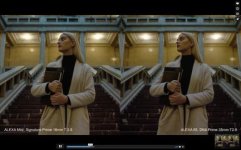
 
I was just looking at different format lenses and cameras last night.

Now, I am more so a fan of the Alev3 than anything RED makes, but in controlled situations, I liked the Dragon w/ Master Prime combo more than the way they handled their Mini LF and Signature primes looks. More so in the tonal and contrast aspects. The colors on the Mini LF were handled to cater to more current tastes of slightly saturated or vibrant, and a hint more more cyan in the blues, which also looks lovely. It is just the contrast in the midtones doesn't seem to translate as well for me, in this particular instance. Could just be old web compression. I am not making any final judgments, just that I don't always see the need to fuss too too much between RED, Venice, and Arri, when in controlled lighting. As the whole workflow chain effects the overall look.

Zeiss Master Prime 50mm @ T1.3
https://www.youtube.com/watch?v=9BNj4Qf_uaE

Arri Signature Prime 75mm @ T1.8
https://www.youtube.com/watch?v=K5eN9voJjj8


LF Arri Signature 47mm @ T1.9
https://www.youtube.com/watch?v=nhcV0St9ebI


s35 Zeiss Super Speed 50mm @ T1.3
https://www.youtube.com/watch?v=HkLnKssaPXY

"full frame" Canon K35 55mm
https://www.youtube.com/watch?v=JzGTD3KKtAk

^^^Those K-35's though! @v@!!!
 
Last edited:
I am watching the Arri comparison on a 2K monitor, and it is interesting how much more detailed the Alexa 65 looks over the Mini 2.7K.

The detail of the Alexa 65 on a 2K monitor reminds me a little of the detail coming off the Sony F35. Insanely organic and detailed for HD, with its RGB 2x's stripe sensor.


These shots are the kinds of shots I appreciate having the extra DR. As parts of the subject are already underexposed, and the lights of the building are clipping. Every half stop less DR in these situations just creates a more video look. Surely, as in the Old Fast Glass examples above, good controlled lighting can make a difference, but shooting dogma 95 or cinema verite often stumbles upon tricky wide DR situations that might have to be avoided depending on the camera used. Limitations can lead to creativity, but I'll take the DR.


Screen Shot 2020-11-19 at 4.48.40 PM.jpg
 
I am watching the Arri comparison on a 2K monitor, and it is interesting how much more detailed the Alexa 65 looks over the Mini 2.7K.

Agreed. Also notice how much cleaner the noise is on the ALEXA 65. There is also some very subtle differences in the color of the ALEXA 65 vs the Mini.
 
Not sure that I have seen this posted on this forum yet, but I came across this really well done test of the ALEXA 65 vs ALEXA Mini. It does help to clear up some theories and misconceptions about the effects of sensor size and lens focal lengths, while also proving some of them.

The 6:20 matched DOF portrait shot in particular helps debunk the "full frame look" as an overall technical myth. Whereas the out doors scene with matching T-stops reinforces the shallow DOF advantages of larger formats.
 
Agreed. Also notice how much cleaner the noise is on the ALEXA 65. There is also some very subtle differences in the color of the ALEXA 65 vs the Mini.

Yes, looks like the 65 is a hint more contrasty, with richer shadows, and more cyan bias in the blues and shadows than the Mini 2.7K.

Although, these cameras are shooting with different lenses and through a split beam setup, so I won't comment too much on the skin tone or anything like that.
 
Agreed. Also notice how much cleaner the noise is on the ALEXA 65. There is also some very subtle differences in the color of the ALEXA 65 vs the Mini.

I absolutely love the look of Alexa 65 and LF.

Looks like iso3200 is finally usable in an Arri now too. Really excited for the Arri s35 4K camera next year.
 
OK so I used to own a MF hasselblad. But nothing here suprises me.

ONe chip is 2X the other, which means twice the FOV for a given lens length

One chip is 2x the other which means half the noise for a given viewing size

One chip is 2x the other which means open up 2 stops to get matching DOF

If you have the money and the lenses and the light and the ability to move the mass, the bigger sensor is going to 'win' until your requirement is lots of DOF (like a macro shot)
 
I know they were using a 3D rig/beam splitter, which I'm sure affected things(which way?), but I was surprised at just how different the cameras looked(especially color wise. that grass could not have been anymore different if they had been using an old Fs7 and B&W film). The mini, to me, seemed to have a little warmer image and the 65 had a much darker image(dramatically so)(edges/corners probably due to falloff of "using more of the lens/image circle) and a little cooler. The 65 also seemed to deal with mixed lighting a little better(a light in the upper right of the interior scene looking up is very noticeably different in the mini shot, but with the 65, while still different, appears much closer to the look of the rest).
 
I know they were using a 3D rig/beam splitter, which I'm sure affected things(which way?), but I was surprised at just how different the cameras looked(especially color wise. that grass could not have been anymore different if they had been using an old Fs7 and B&W film). The mini, to me, seemed to have a little warmer image and the 65 had a much darker image(dramatically so)(edges/corners probably due to falloff of "using more of the lens/image circle) and a little cooler. The 65 also seemed to deal with mixed lighting a little better(a light in the upper right of the interior scene looking up is very noticeably different in the mini shot, but with the 65, while still different, appears much closer to the look of the rest).

The Alexa's are film emulating cameras, so perhaps the Alexa 65 is just attempting to look more similar to the way 70mm film stocks render. Look at Nolans analog process in "Dunkirk" and those rich blacks, hype cyan's and greens... etc. It may actually be a slightly different colour recipe based on film maker preferences.


https://www.youtube.com/watch?v=F-eMt3SrfFU


https://www.youtube.com/watch?v=qp967YAAdNk

70mm and max films always look a bit more saturated. Even 'Dunkirk' being all muted has some brilliant colours. Now I now so much happens along the process, but these are two large format films that retain a bit of the analog process and original look of the film... do a degree. ...Basically, I have no idea what I am talking about.
 
ONe chip is 2X the other, which means twice the FOV for a given lens length

One chip is 2x the other which means half the noise for a given viewing size

One chip is 2x the other which means open up 2 stops to get matching DOF ...

Actually, 65 has three ALEV sensors. The LF has two.

65 is still rental only. And ARRI can't make enough LF's.
 
Actually, 65 has three ALEV sensors. The LF has two.

65 is still rental only. And ARRI can't make enough LF's.

Yeah, the Alexa 65 is absolutely gorgeous with all that resolution, DR, and proper colour science. And those large format lenses don't hurt either.

I've only shot on the Mini LF, and it leaves something to be desired in resolution sometimes. Not that it is a slouch. However, resolution without adequate DR is rather annoying, unless you live in the Pacific North West and can shoot in soft light 300days of the year.
 
Interesting video and comparison. Unless I'm missing something, this is basically more real-world confirmation of what DP's like Steve Yedlin have said for a while now: http://www.yedlin.net/NerdyFilmTechStuff/MatchLensBlur.html

Basically, the "large format look" is mostly just marketing, designed to sell cameras/lenses, and there is no more a thing as a "large format look" than there is a single "film look". Again, this is based on what this video and Yedlin and others have suggested.
 
Interesting video and comparison. Unless I'm missing something, this is basically more real-world confirmation of what DP's like Steve Yedlin have said for a while now: http://www.yedlin.net/NerdyFilmTechStuff/MatchLensBlur.html

Basically, the "large format look" is mostly just marketing, designed to sell cameras/lenses, and there is no more a thing as a "large format look" than there is a single "film look". Again, this is based on what this video and Yedlin and others have suggested.
I'm so triggered. Tom, hold my drink. haha.
 
I'm so triggered. Tom, hold my drink. haha.

I'm certainly open to (and interested in) other views, but from all I've seen the empirical evidence and theoretical underpinnings suggest Yedlin is correct. Clearly there are practical limitations than make it difficult (if not impossible) to recreate certain full frame aesthetics on, e.g., 1/2" sensor cameras, but once you get to S35-sized sensors those limitations seem to be gone.
 
S35 can keep up to a certain point...even MFT can if you're allowed to stop down the other lenses.

But once fast FF lenses start being used wide open (not that many want to or will use them like that) with the best AF - especially the wider ones - S35 won't be able to.

You can see in some of the shots the 65 is slightly milkier. I don't know if they are shooting wide open, but if they aren't then it's even easier (as mentioned) for the S35 sensor to match.
 
S35 can keep up to a certain point...even MFT can if you're allowed to stop down the other lenses.

But once fast FF lenses start being used wide open (not that many want to or will use them like that) with the best AF - especially the wider ones - S35 won't be able to.

You can see in some of the shots the 65 is slightly milkier. I don't know if they are shooting wide open, but if they aren't then it's even easier (as mentioned) for the S35 sensor to match.

Are you suggesting this because there simply aren't S35 lenses with the corresponding aperture? I.e., finding a S35 lens that opens to T1 to match a FF lens opening to T1.5 simply isn't realistic? Or is there some other quality?

I certainly buy the former argument.
 
Back
Top