
Navigation
Install the app
How to install the app on iOS
Follow along with the video below to see how to install our site as a web app on your home screen.
Note: This feature may not be available in some browsers.
More options
You are using an out of date browser. It may not display this or other websites correctly.
You should upgrade or use an alternative browser.
You should upgrade or use an alternative browser.
Kinefinity MAVO LF
- Thread starter KrocanX
- Start date

nutmegger
Well-known member
Here is the Google Translate version of the Kinefinity/Mavo web page.
CHARACTERISTIC
MAVO INDICATOR
TERRA VS. MAVO
FIRMWARE FEATURES
VIDEO INTRODUCTION
IMAGE
FOOTAGE AND VIDEO
MAVO and MAVO LF are based on the same computing platform, using advanced color processing architecture and new CMOS image sensors to achieve low-noise, high-latitude dynamic images. Whether it is the S35 format version of MAVO or the large-format version of MAVO LF, up to 6K images can bring extraordinary details, sharp images and rich levels. MAVO uses the S35 6K CMOS image sensor for all S35 lenses and large format lenses. MAVO LF large-format cameras provide large-scale aesthetics such as cleaner images, wider viewing angles, shallower depth of field, and more presence.
MAVO and MAVO LF provide 6K wide 66fps slow motion, 4K wide 100fps high speed shooting, these high-speed images and the normal frame rate of the shooting picture are exactly the same, more than 14 degrees of latitude, natural highlights and delicate dark parts are Get perfect reservations. Using 6K 3:2 aspect ratio CMOS sensor, in addition to the conventional 16:9, 17:9 standard aspect ratio, can also be very flexible to provide a variety of format recording methods, such as 4:3, 6:5 S35 Deformation width screen, even the full-open door 6016 × 4016, up to 24 million pixels of dynamic images!
MAVO and MAVO LF provide three kinds of intermediate encoding formats suitable for editing and color grading to simplify the workflow and provide the maximum color space. Record the raw RAW format KRW for ProRes and Kinefinity up to ProRes444XQ, as well as the full support of the DaVinci Resolve compressed RAW format cinema DNG. The compression ratio can be set to 3:1, 5:1, and 7:1.
Both the MAVO and MAVO LF are extremely compact and compatible with most TERRA accessories. This will benefit from MAVO's advanced computing architecture and low-power design to be able to encapsulate such robust performance in such a small and reliable body. With the new quickly installable KineBACK-W back, the wireless card can be inserted into a wireless camera : zero-delay wireless graphics and support for the Movcam lens wireless control system , which greatly simplifies the connection between the camera and the accessories, dramatically improving the Reliability and durability.
MAVO
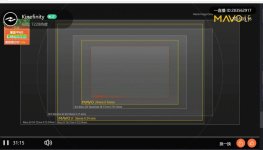
S35 format MAVO uses S35 format 3:2 aspect ratio CMOS image sensor, physical size is 24x16mm, resolution up to 6016x4016, perfect match S35 film lens, or half, full-width camera lens. The S35's anamorphic widescreen lens can also be perfectly adapted to MAVO's 6:5 or 4:3 modes. In the S35 format, 6K 50fps can be captured, and at 6K Wide, 66fps can be achieved. In crop mode, 4K Wide 100fps!
MAVO LF
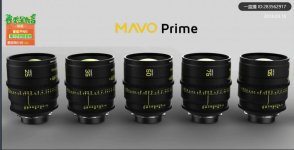
The large-format MAVO LF uses a full-width CMOS image sensor with a physical size of 36x24mm and a resolution of 6K+ and 6016x4016. Large format opens a new chapter in the field of film and television. Compared with the S35 format sensor, the area of the large format CMOS sensor is increased by 2.25 times, the photosensitive area is increased, the single pixel area is larger, the signal to noise ratio is higher, and the picture is clearer. In addition, large format offers a wider perspective, shallower depth of field and more presence. You can use not only movie lenses designed for large format like MAVO Prime, CP3, Cooke S7i, Arri Signature Prime, but also a large number of existing full-frame camera lenses.
Sensitivity MAVO, S35 CMOS sensor using advanced CMOS image sensor process, making the picture noise is very low, roughly equivalent to half of the TERRA 6K noise, in order to obtain higher sensitivity. Although the benchmark ISO is 800, at 1600, 2560, and 3200, noise is still relatively low. If the output is 4K or 2K resolution, the ISO can rise even higher, and the output screen is still delicate and clean.
Better Sensitivity MAVO LF uses a new full-frame CMOS image sensor, making full use of the photosensitivity of each large pixel point, coupled with advanced process technology, making MAVO LF's low-light performance very prominent, the reference ISO at 1600. In ISO 2560, 3200, 5120, the noise is low, and the usability of the direct use picture is very high. If the output picture is an overshoot output of 4K or 2K, the ISO can rise even higher.
Frame Rate and Format MAVO uses a high-speed, low-noise S35 CMOS image sensor (equivalent to a full-frame cropping factor of 1.5), and has a latitude of over 14 stages at 6K resolution and various cutting modes. S35 format, the frame rate up to 6K Wide 66fps and M43 format, the frame rate up to 4K Wide 100fps, RAW format are 12 bits. Under the ProRes encoding format, it also supports in-camera mining, which directly outputs S35 4K/3K/2K resolution. Since the basic frame rate is also much higher than TERRA 6K, the "jelly" effect is also much lower than TERRA 6K.
More Flexible Formats The MAVO LF uses a high-speed, low-noise, full-frame CMOS image sensor with over 14 levels of latitude in 6K resolution and various trim modes. In full-frame, the frame rate can also reach 6K Wide 66fps. Under the S35 format, the frame rate can reach 4K Wide 100fps. This is also an advantage of the large-format CMOS image sensor, that is, the ability to upgrade under the S35 format is stronger. Similarly, the RAW format is 12 bits deep, and the ProRes format supports in-camera overclocking, which allows direct output of 4K/3K/2K resolution over full-format. The "jelly" effect is also much lower than TERRA 6K.
Mavo_res_comp
The 4K 100 grid, either MAVO or MAVO LF, has a strong promotion ability. Both can output 66fps in 6K Wide full-frame output, can be directly recorded to 100fps in 4K Wide, and can achieve 120fps in 3K Wide for cropped format, and 2K Wide can reach 192fps. It also has degraded ability, the lowest frame rate is 2fps. The frame rate can be arbitrarily set between the lowest frame rate 2fps and the highest frame rate supported by the Sensor's frame rate, the accuracy of 0.001fps. When recorded, it is recorded at the project frame rate (for example, 25 fps). This way you can easily achieve fast motion and slow motion, providing you with more technical means to achieve the lens language you want.
CinemaDNG
Compressed RAW cDNG returns in the form of adjustable compression! MAVO is different from TERRA an important place, MAVO can directly record compressed RAW material CinemaDNG, and the compression ratio is adjustable, the current firmware supports 3:1, 5:1 and 7:1. Da Vinci Resolve natively supports cDNG, so that in the Leonardo da Vinci Resolve, you can directly edit and colorize cDNG material shot by MAVO! 3:1, 5:1, and 7:1 provide three different compression ratios, no matter which one is able to achieve super high picture quality and large post-adjustment space.
Apple ProRes MAVO can choose RAW encoding, or you can directly record ProRes in the machine! Not only can you output regular 2K/4K ProRes, MAVO can also support ProRes with full-resolution and full-frame-rate recording , such as 6K ProRes and 4K Wide 100fps ProRes. MAVO supports ProRes' highest ProRes444XQ, 444, and 422HQ/422/LT/Proxy. As the most popular intermediate code ProRes, undoubtedly the industry standard, all editing and color correction software support ProRes. Thanks to the efficiency of ProRes, 4K ProRes can even play back smoothly on the entry-level Macbook notebook. Note: Depending on resolution and frame rate, not all resolutions and frame rates can record 444XQ and 444 .
KRW
KineRAW encodes the KineRAW original RAW encoding to retain the maximum image information. KineRAW is Zhuo Yu's exclusive intra-frame compression encoding for oversized streams. From KRW 2.0, KRW is an RAW encoding with adjustable compression ratio, compression ratio from 2:1 to 10:1, resulting in ultra-high resolution At the rate and high frame rate, the RAW encoding format can still be recorded. If the compression ratio is set to about 2:1, the 500GB KineMAG can record 4K RAW footage for about 90 minutes, which is only slightly larger than the ProRes 422HQ stream. ProRes or uncompressed or compressed cDNG can be used for the post-production work using the ProRes or cDNG process.
The wireless camera uses a brand new quick-mount KineBACK-W back, KineBACK-W has a wireless slot, inserts a dedicated wireless card, and MAVO can be turned into a wireless camera: zero-delay 600m/1000m wireless video and support for Movcam Lens wireless control system. Integrated wireless graphics and lens control require no additional power, no additional connection to HDMI or SDI cables, and no additional fixing. This greatly simplifies the connection between the camera and the accessories, significantly increasing reliability and durability.
2.5-inch SSD storage media Although the MAVO body is so small, in order to maintain the best compatibility with third-party SSDs (solid-state drives), it still uses the standard 2.5-inch SSD SATA 3.0 interface, so you can try a large number of 7 mm on the market Thickness SSD as a storage medium. Of course, as a recording storage medium, only the latest 7mm KineMAG SSD is recommended toensure the best performance when paired with MAVO.
Machine-loaded custom LUTs 3D LUTs that your favorite, director-like, and post-worker-approved 3D LUTs generated by the post-production software, different scenes, different LUTs can be loaded into MAVO, and the scene can be seen loaded You like the LUT's picture, so that your workflow will be optimized, saving valuable time, but also help with the site lighting, art director work. While on-site monitoring can be arbitrarily switched LUT in real time, which is very quick and convenient.
4.3
4:3 deformation width screen MAVO has 5.3K 4:3 format 5376×4016@40fps, supports 4.8K 6:5 format 4864×4016@40fps, due to the vertical height of 16mm, so these deformation widescreen recording format, Can be regarded as S35 widening recording. If you use a anamorphic lens with a lens ratio of 2 to shoot, set a normal screen monitor in the camera, and when it returns to a normal screen at a later time, the resolution will be 10752×4016! MAVO can also support full-screen opening, output 3:2 format 6016 × 4016 @ 40fps, to bring enough space for the later tailoring.
Multi-Framing Multi-frame Intra-machine Oversampling + Crop + KineEnhancer = Infinite Resolution possible. With the help of on-board supersampling/down-conversion (DownScale), the ProRes output of 6K/4K/3K/2K under the S35 format can be realized. With the KineEnhancer, the S35 format can be equated to the full format, and the M4/3 format can be equivalent to S35 format, of course, MAVO LF does not need KineEnhancer to add light to reduce the focus; with crop mode (Crop) can be native 6K S35 format CMOS output 4K M4/3, 3K S16. The MAVO supports all three methods, so that it is possible to obtain multiple resolutions and frame rates from full format to 16mm format.
The universal mount KineMOUNT MAVO is equipped with a universal KineMOUNT mount with contacts. According to your lens resources,you can support all kinds of bayonetby purchasing the corresponding second-generation adapters: PL bayonet , Canon EF bayonet , Nikon F bayonet , SONY FE/E bayonet and the latest EF / PL mount with electronic ND (e-ND) . Regardless of whether it is a native EF bayonet or a relay EF/Nikon F/SONY E bayonet, it is a film-level locking fixed lens.
Many of the accessories that are compatible with MAVO are mostly TERRA-designed accessories. KineBACK-W is specially matched with MAVO and immediately obtains numerous professional interfaces. Even with a wireless slot, inserting a wireless transmitter card can achieve zero-delay wireless transmission. The KineMON dedicated monitor is a 5-inch full HD monitor that requires only one cable to perfectly display the MAVO monitor screen without additional power supply. Side Grip multi-function battery handle , powered by GripBAT 45Wh (BP-U30 compatible battery), can last for more than one hour. The ultra-small V-port battery KineBAT 120Wh is specially matched to the MAVO small body universal V-port battery, but its small size is up to 120Wh. It can be used by MAVO for real-time monitoring and shooting, and lasts for four hours. The newly designed KineKIT-TERRA by Movcamis MAVO provides stronger support, protection and expansion of more fixed hole positions, and is also more suitable for shoulder pads.
As the flagship product of the Kine camera line, MAVO is not only equipped with new high-speed, low-noise CMOS image sensors, but also equipped with full-format CMOS, and the era of large-format production with other top wide-format cameras. In the aspect of in-camera encoding, the compressed cDNG format is even more added, so that the recorded RAW format can be directly edited and toned in DaVinci Resolve, greatly improving the RAW-based workflow; in ProRes support, up to ProRes444XQ and 444, thus covering all the encoding formats of Apple ProRes. At the same time, MAVO still has a well-received Kine color space, and it also has an ultra-small body and sufficient reliability.
Explanation: All the trademarks mentioned on this website are affiliated with their respective trademark owners or attribution companies.
Enjoy
Last edited:

NorBro
Major Contributor
Something a bit more concise as well:
https://www.cinema5d.com/kinefinity-mavo-6k-cinema-camera-lens-family/
https://www.cinema5d.com/kinefinity-mavo-6k-cinema-camera-lens-family/

puredrifting
Major Contributor
Okay, whose feeling brave and crazy? They'll get there but I agree with Norbro, I'm not paying thousands for a camera that has no support building and or campus in Southern California (just for me, of course, YMMV, depending on where you live and where there is support)

nyvz
Veteran
Okay, whose feeling brave and crazy? They'll get there but I agree with Norbro, I'm not paying thousands for a camera that has no support building and or campus in Southern California (just for me, of course, YMMV, depending on where you live and where there is support)
Converted my 2 year old terra 5k preorder to mavo LF... Will likely cancel it if they haven't fixed the monitor lag and quality issues.
But yeah it's so hard to get hands on these cameras it's a major hurdle for actually finding b-cams, backup bodies, getting support, aks etc... And that's a big problem. Maybe if they can really make the new camera amazing it will change if adoption increases but seems unlikely given their history. This is their 4th generation camera I believe and it hasn't gotten any better for buyers outside of china it seems.
NorBro
Major Contributor
Someone on BMCuser said this today:
"Last I talked to them they weren't really interested in the expense of trying to expand and market to the US. They are quite happy with their current market and don't see it being easily adopted in the US."
---
They probably have the capital to do whatever they want. Someone once mentioned they specialized in high-end astronomy gear before creating cinema cameras.
This is what it says on their 'About us' page:
"Kinefinity™ is the brand of professional digital cinema products including KineRAW cameras, KineMAG SSD, KineKIT accessories, KineStation transcoding software, KineGrip sidegrip, and more. The KineRAW cameras and related products are designed, developed, assembled in China by a team with passion, concentration, vision and technical background from high performance astronomy camera design."
---
Even though I still think they should have at least one HQ in the United States, I can understand them not wanting to bother with it.
NorBro
Major Contributor
Also wanted to add (as we all know) that businesses change as the world changes.
RED - for the longest time - didn't sell cameras anywhere besides from their own online store. Then they trickled down to smaller suppliers and eventually after 10 years to B&H and Adorama along with a curious relationship with Apple and the RAVEN camera kit.
Now they are planning on making 8K cameras with Foxconn.
Maybe one day we'll see Kinefinity sold at Best Buy!

JPNola
Veteran
For anyone who is curious about the Mavo primes, someone on another forum speculated that they are re-worked Cine Altas, another forum user chimed in that they could not be Cine Altas because Cine Altas are not FF, and yet another user joined the conversation to say that the lenses are made by Nisi. The person did not say from where they got that information.
I am more interested in the lenses than I am in the camera. Whomever is behind that set of primes, I give them that they came out with a complete set all at once. They won't unseat Sigma as the hot-hand in "budget" cinema primes ( sorry, CP3's, but it's true ). But they could find space in the Xeen market at the stated $12k price for the 5-lens Mavo prime set.
I am more interested in the lenses than I am in the camera. Whomever is behind that set of primes, I give them that they came out with a complete set all at once. They won't unseat Sigma as the hot-hand in "budget" cinema primes ( sorry, CP3's, but it's true ). But they could find space in the Xeen market at the stated $12k price for the 5-lens Mavo prime set.
NorBro
Major Contributor
Actually they are $1695 right now, lol (but not for the Nikon mount or MFT...and some E-mount focal lengths are more than others).
The cheapest EF bundle with 5 lenses is $8,295:
https://www.bhphotovideo.com/c/product/1226579-REG/rokinon_xeen_14_24_35.html
(The same PL kit is somehow cheaper.)
The cheapest EF bundle with 5 lenses is $8,295:
https://www.bhphotovideo.com/c/product/1226579-REG/rokinon_xeen_14_24_35.html
(The same PL kit is somehow cheaper.)
I wonder if it is a porblem with copyright or patent on some form of encoding, these codec patents can be crazy throughout the world and maybe in China they are all legal. Possible explaination of why they don't care about selling outside of China. Otherwise it would seem that some business in the USA would import these cameras.

Samuel H
Major Contributor
If they already have their hands full with whatever they sell in China, I completely understand them avoiding the effort to sell stuff abroad. Red tape is not easy, they may just think it's not worth their time.
This used to be extremely common in the opposite direction: many US companies wouldn't bother to sell stuff there. Whether they're just special or it's an early sign of times changing, we'll see, at some point.
This used to be extremely common in the opposite direction: many US companies wouldn't bother to sell stuff there. Whether they're just special or it's an early sign of times changing, we'll see, at some point.
nutmegger
Well-known member
I wonder if it is a porblem with copyright or patent on some form of encoding, these codec patents can be crazy throughout the world and maybe in China they are all legal. Possible explaination of why they don't care about selling outside of China. Otherwise it would seem that some business in the USA would import these cameras.
Interesting that all of the labeling on the camera is in English. Also, in the lower right hand corner of the LCD, it appears that the Mavo may have built in ND filtering, something RED does not.

Enjoy
Last edited:
I wonder if it is a porblem with copyright or patent on some form of encoding, these codec patents can be crazy throughout the world and maybe in China they are all legal. Possible explaination of why they don't care about selling outside of China. Otherwise it would seem that some business in the USA would import these cameras.
They have official resellers in quite a few places now including the US and I think they even do repairs in Berlin.

bgundu
Veteran
I wonder what RED thinks about them...can't deny the resemblance to their ecosystem.
Maybe that's why they aren't coming here. lol, j/k
We've talked about them since 2014 on Reduser. Besides Jarred Land owns this DVXUser site as well. He knows very well who they are.
http://www.reduser.net/forum/showthread.php?115077-KINEFINITY-KineMINI-4K-amp-KineMAX-6K-cameras
NorBro
Major Contributor
Thank you for the link, but I mean more what Jarred and Jim (and their inner circle) think...not RED camera operators.
I'm thinking more like on a Jinnimag level:
http://www.reduser.net/forum/showthread.php?155462-Jinnimag
I'm thinking more like on a Jinnimag level:
http://www.reduser.net/forum/showthread.php?155462-Jinnimag
bgundu
Veteran
Thank you for the link, but I mean more what Jarred and Jim (and their inner circle) think...not RED camera operators.
I'm thinking more like on a Jinnimag level:
http://www.reduser.net/forum/showthread.php?155462-Jinnimag
In that case, they have never commented on the camera.