James Webb Space Telescope launching tomorrow (Christmas)!

ahalpert

Major Contributor
This has virtually nothing to do with filmmaking, although it is an amazing feat of optics and telescope technology!

The $10B James Webb Space Telescope, a successor to the Hubble telescope, has been a work in progress for 25 years and is set to launch on Christmas day. This is what it looks like:
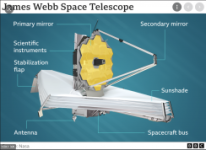
Screen Shot 2021-12-24 at 5.51.39 PM.png - Click image for larger version  Name:	Screen Shot 2021-12-24 at 5.51.39 PM.png Views:	0 Size:	55.0 KB ID:	5683037

The telescope will be able to collect light from the earliest galaxies in the universe (ie super old light that has been traveling for billions of years) and may also be able to detect the signatures of life in the atmospheres of distant planets, if there is any. So cool!

The telescope will launch in a compact form and then unfold itself over a period of a month as it travels out to its final resting orbit 1 million miles from Earth.

  • Once the JWST gets to space, it will spend about a month in transit to a point about 1 million miles from Earth. (Unlike the Hubble Space Telescope, this observatory won't be close enough to our planet for an astronaut servicing mission if something were to go wrong.)
  • During that transit, the telescope's large sunshield, its instruments and mirrors will all deploy over the course of weeks.
  • NASA calls it "the most complex sequence of deployments ever attempted in a single space mission," noting there are more than 300 single points of failure items that could go wrong.
The bottom line: "No one has ever before unfolded a telescope in space," JWST scientist Jane Rigby told Axios. "What we're doing is necessary — astronomy simply cannot advance in some key areas until we build bigger telescopes, and that means telescopes that have to unfold."
  • "I'm confident because we have the best engineering team in the world, we've practiced this on the ground over and over, we've tested all the hardware, and now it's time."
https://www.axios.com/nasa-james-web...169711883.html
 
Last edited:
Interesting to see what the first photographs will be. Also, 1 million miles from earth so the pull of the sun and the earth are nearly equal.
 
The first photo from James Webb is dropping today at 5PM EST!!!

Milestones in space exploration remind me of the corny but effective credits montage from the underappreciated Star Trek: Enterprise series

 
And the size of that patch of sky is the equivalent of holding a grain of sand at arm's length. I think the Hubble image was a 23 day exposure, while the Webb captured it in 12 hours. Amazing. I'm really looking forward to seeing what Webb can show us over the next decades.
 
I never expected they'd be able to see that much detail in an exoplanet. I'll bet it takes a lot of manipulation in post to bring it out.
The weird thing is that the article says the planet is 7-12 times the size of Jupiter, but I thought Jupiter was just a little below the mass threshold for becoming a star. The new planet must be made of different stuff or it wouldn't still be a planet at that size.
 
I never expected they'd be able to see that much detail in an exoplanet. I'll bet it takes a lot of manipulation in post to bring it out.
The weird thing is that the article says the planet is 7-12 times the size of Jupiter, but I thought Jupiter was just a little below the mass threshold for becoming a star. The new planet must be made of different stuff or it wouldn't still be a planet at that size.

I'm not sure. From what I'm reading, it seems that the core density matters as well as the mass. Of course, maybe the mass is just a smidgen too low to initiate fusion.

Modelling suggests that the upper limit for a planet mass, forming via core accretion, is less than 10 times the mass of Jupiter - just a few Jupiter masses shy of deuterium fusion.
https://www.google.com/amp/s/www.sci...ter-a-star/amp

I think that the process of star formation produces a denser object than the process of planet formation. From the same arricle:

Stars and planets, you see, are born through two very different mechanisms. Stars are born when a dense knot of material in an interstellar molecular cloud collapses under its own gravity - pouf! flomph! - spinning as it goes in a process called cloud collapse. As it spins, it spools in more material from the cloud around it into a stellar accretion disc.

As the mass - and therefore the gravity - grows, the core of the baby star is squeezed tighter and tighter, which causes it to grow hotter and hotter. Eventually it becomes so compressed and hot, the core ignites and thermonuclear fusion kicks off.

According to our understanding of star formation, once the star has finished accreting material, a whole lot of accretion disc is left over. This is what the planets are made of.

Astronomers think that, for gas giants like Jupiter, this process (called pebble accretion) starts with tiny chunks of icy rock and dust in the disc. As they orbit the baby star, these bits of material start to collide, sticking together with static electricity. Eventually, these growing clumps reach a large-enough size - around 10 Earth masses - that they can gravitationally attract more and more gas from the surrounding disc.

From that point, Jupiter gradually grew to its current mass - about 318 times the mass of Earth, and 0.001 times the mass of the Sun. Once it had slurped up all the material that was available to it - at quite a remove from the mass required for hydrogen fusion - it stopped growing.

So, Jupiter was never even close to growing massive enough to become a star. Jupiter has a similar composition to the Sun not because it was a 'failed star' but because it was born from the same cloud of molecular gas that gave birth to the Sun.

The sun is a bit denser than Jupiter despite the outward pressure caused by fusion which reduces its density. So, without fusion, I think it would be a lot denser than jupiter.

Jupiter’s average density is about 1.326 g/cc, while the Sun’s average density is 1.408 g/cc…so the Sun has a higher average density.

Both bodies have very similar composition, and since the Sun is much larger, the increase in gravitational compression should increase the Sun’s density far more than Jupiter’s, however, the Sun is generating a great deal of energy from nuclear fusion, so the radiative pressure reduces the Sun’s density, making them very close in density.
Answer to Is Jupiter more dense than the Sun? by David Goodman https://www.quora.com/Is-Jupiter-mor...et_type=answer

But I'm not positive about why this exoplanet isn't undergoing fusion, I'm just making inferences based on articles about Jupiter.

Another interesting note which I never learned or just forgot is that Jupiter is so massive that the sun orbits around a point between itself and Jupiter.

Jupiter is so big that the center of gravity of the sun and Jupiter is outside of sun. Although extremely close to the surface of the sun.

So the sun and Jupiter both orbit around their center of gravity which is also known as barycenter.

Barycenter is the center of mass of two or more bodies that orbit one another and is the point about which the bodies orbit.
Answer to Is it true that Jupiter is so large that it does not orbit around the sun? by Prerak Sharma https://www.quora.com/Is-it-true-tha...et_type=answer

It seems like the James Webb telescope has a tool for masking out the light from the star so that the planet can be seen, called a coronagraph (presumably because these tools were first used for imaging the sun's corona) but I can't find a picture of what its coronagraph actually looks like.
 
Back
Top