Is January going to save us?

With all streaming companies, except Netflix, still losing money, budgets will likely get tighter.

One network I know asked for a 20% budget reduction for most shows this year. According to some of the EPs I’ve spoken with, the rumor is that the network is going to be asking for a further 20% budget cut for 2025.

Warner/Discovery announced a $10 billion dollar loss in October
Warner/Discovery will split into two companies next year. That will cause plenty of organizational chaos and slow things down.

Zaslav has managed to become both the most hated man AND the worst CEO in Hollywood.

Discovery acquired Scripps Networks Interactive in 2018, and Scripps was still a powerhouse with pretty good numbers overall. Almost immediately, the layoffs began. And then Zaslav got his sights on what he’d really wanted all along: to own a motion picture company. In 2020, Discovery, Inc. acquired Warner Brothers. Discovery was still in decent shape, but WB was carrying considerable debt. It wasn’t enough to offset or to recover. Zaslav was more concerned about earnings calls and CEO salary, and his focus was (and is) being able to claim cash liquidity. Selling off properties, laying off staff… everything he does is to free up some cash. Meanwhile, the company he assembled was way too big to be sustainable. So, it’s kind of amusing to see that it has to be split to try and salvage either side.
 
In all the conversations I have had with showrunners, EPs, and production company owners, interest rates have never entered the conversation. Yes, it’s a factor… a smaller factor that affects spending in every industry, not just this one. Is it going to have an effect? Sure, inasmuch as it will affect any other business in how much it costs them to carry debt. But this is not the driving factor.

The key issue on the TV/streaming side is this: linear (cable) has been on a marked decline for some time now, with more and more people “cutting the cord”. When Netflix was the only game in town, they were doing quite well, but then everyone else started hopping on the streaming bandwagon and trying to compete for subscribers. Over the last few years, those companies (streaming platforms like Netflix, Amazon, and AppleTV+; and cable networks with their own streaming apps) poured gobs of money into programming for their streaming libraries to try and attract higher shares of the customer base.

The result of all this is that the market was flooded with programming. The supply side was saturated, but the demand side barely budged. Suddenly, all the streaming platforms realized they weren’t making any money. That’s when they stopped buying most programming, so they could reassess and see how they could monetize the industry in the new ecosystem.

For commercial production, well… ad spending is down on linear, and streaming isn’t seeing the ad sales that linear used to.


On the narrative side, there’s been the anticipation of productions waylaid by this year’s strikes being able to kick back into gear with the strikes resolved. The reason folks said “January” around that was that those projects had to go back to square one on pre-production. Any work they’d done on casting, locations, production design… that all had to be re-evaluated. So, the ends of the strikes meant getting back into pre-pro, not straight into production, so there’s a delay of a few months.

And that’s for the films that don’t up and move overseas.

Time will tell.
I think the people who worry about interest rates are probably way above their pay grade. The money people.

From Bloomberg, July 2022:

"If Netflix started the fire, the macroeconomic situation has poured on some lighter fluid. Rising interest rates have made it harder to borrow, and made companies less eager to be in debt. It’s also limited financing for major deals, which forces everyone to be more cautious.

The market for new projects has slowed. Netflix, once the biggest spender of them all, has broadcast that it isn’t going to spend like it once did. Amazon has grown more budget-conscious since it hired Mike Hopkins, though it will spare no expense for certain series (like “Lord of the Rings”).

The biggest contraction of all is underway at Warner Bros. Discovery, which is scrutinizing costs after a debt-fueled merger."

They're all deleveraging. At Netflix:

"in 2023, the total debt has been reduced to $16.97 billion from $18.5 billion in 2020—a decrease of 8.28%."

When you say, "Suddenly, all the streaming platforms realized they weren’t making any money." -- the thing is, that's not such a problem if you can borrow money for free. You're investing in the future of your business very inexpensively. But when you're losing money every year (ie borrowing money) and the cost to borrow skyrockets, it completely changes the equation.

More from that last article:

"But, why did Netflix accumulate such significant debt initially?
Single word answer: growth.

The content industry is capital-intensive. For example, a series like “Stranger Things”, which is fully financed and owned by Netflix, has a production cost of up to $8 million for each episode. Considering the hundreds of hours of original content that Netflix creates every year, the cost starts to add up significantly.

This led to a situation known as “negative Free Cash Flow” up until 2019, where the company was spending more than it was earning. Netflix bridged this gap by increasing its borrowing...

In 2019, Netflix’s Free Cash Flow was in the red at -$3.14 billion. By 2023, it had made a dramatic turnaround to $6.93 billion."
 
And from the New York Times in October:

"In 2014, the year Netflix bought “Richie Rich,” it issued $400 million in debt — on top of the $500 million of debt it issued the year before — to vastly expand its foray into original programming. This is how it went from being a mass mailer of DVDs to the world’s most important content platform: by borrowing mountains of money. In 2015, the company raised another $1.5 billion, aiming to triple its content offerings from the year before. The next year it raised another billion. In 2017 it raised more than $3 billion, with a plan to release 80 movies the following year. (The platform was already releasing an average of one a week at that point.) Over the next two years, the company borrowed another $8 billion.

What Netflix was doing was creating a sort of flywheel, where new debt helped create new shows, and new shows brought in new subscribers, and new subscribers brought in more cash — but it needed to continue selling bonds over and over to oil the content-subscriber treadmill, to such an extent that by 2019, it had about $15 billion in long-term debt. It earned the nickname Debtflix in the business press, which wondered if all this borrowing was sustainable. If you applied the logic of the media business to Netflix, it looked uncertain, but Netflix was operating by tech-sector rules — spending boatloads of cash to acquire customers, changing their habits and overwhelming competitors until, at the other end, an entire industry was transformed."
 
Crazy about Netflix. It's stock went way down but has totally recovered. Even with interest rates remaining quite elevated compared to zero.
 
Howdy all,

First of all, I just want to say how happy I am that this forum is still alive. I appreciate the mods and everyone behind the scenes keeping it going!

And I'm really thrilled that so many of you are still around. I'm literally rewatching Key & Peele again and love that Charles Papert is on here (I think we have a real-life acquaintance in common). I've bought a course from Doug Jensen, and get so much from him. I used to read DV Magazine religiously and it's amazing Jim Feeley is on here. Norbro is my spirit brother with his endless fascination with tech. I'm always learning from Chris Young's endless experience. I dig Alex H's calm, illuminating explanations whenever he posts something about audio or his industry experience.

And of course, I love the rigorous mental exercise from SMM's cryptographic posts that I have to decipher as if my life depended on it... ;)

And many more of you!

I'm mainly an editor, and I've been a member of this forum since 2006 (I just changed my old user name, hoju, over to my real name). Crazy! Back when BMCuser was a thing too. I film / write for my own projects as well. I only have 200 post or so on here, and mainly a reader. Doubt any of you know my profile, but I feel like I know a bunch of y'all.

Like many in our industry, it's been a really rough time for me. Basically, I've been out of work for nearly 10 months now.

I've heard from many, for several months now, that things are going to turn around in January.

Okay, but why? Do any of you have an explanation for this? [Please keep politics out of it if you can.]

I'm at the point where I have to make some big decisions, none of which I want to deal with, frankly. But things are so different now. I suppose it's the classic dilemma of getting older and finding yourself in unfamiliar waters.

I'd love to hear from you, and what you're sensing. Get out now? Hold on a bit longer? Do a dance to appease the angry media gods?

For those that haven't been as affected, if you have any advice, I'm definitely all ears! Or eyes, I guess.

Lastly, if any of you want to connect, whether you find yourselves in the same boat or not, you can either dm me or reach out via my website. [Mods, I hope this is allowed.]

Best,

Arash
www.cataclysmoinc.com
This is why I still love this forum. I get a lot out of reading other people's perspectives, problems and solutions.

In response to the "things are going to turn around in January." - There are certainly a variety of factors that are going to be affecting this country come January. I think it depends on the niche that you are in on whether or not those things affect you and your work personally.

I do feel like I've heard that "things will turn around next year" for the last 3 years. Or that we'd just have to get past XYZ and then things would get better.

I don't really believe any of that to be honest. You can't rely on external, uncontrollable factors to make an impact on what you do and how your 2025 is going to go.

Pep talk over, now on to some personal anecdotes that may or may note be helpful.

While I know a lot of people had it rough, I had my best year as a freelancer in 2024. For context, I don't work in narrative, news, Hollywood or super high end, million dollar projects. I'm primarily a corporate shooter.

Things that moved the needle for me from a business perspective:
  • I shoot both stills and video. - This allowed my to diversify the projects I can do and make more money that way.
  • I also edit. - This means I could maintain the pipeline from capture to completion and simplify things for my clients. They don't need to go find a separate editor once we've wrapped the shoot and I have a third skill to bill for.
  • I own most of my kit. - I did rent things occasionally this year, but for the most part I'm bringing my own gear on shoots and the rental revenue from that had helped to both purchase new, needed gear and put money in my pocket.
  • I've been lucky with my clients. - I primarily do work direct to ad agencies, who need to hire small crews to execute their shoots. The agencies that I do work for have clients in government and healthcare primarily. And I really can't think of two industries that have more consistent revenue streams than government and healthcare.
After saying all of that, I'm still hedging my bets, saving money and preparing for a 2025 that could be rough. If a few big clients decide to go a different direction then I'd be scrambling.

Things I'd personally do if stuff started to turn south.

  • Get on your state's government vendor list, per my previous bullet points. - While it may "sound" boring to do work for state government, every state has a wide variety of departments that are doing fun, exciting projects. And, again, they have money to burn every year.
  • Network. Ugh... I'm not a huge fan of pressing the flesh, but I'd do it to feed my family and pay my mortgage. I'd be attending every single local ad club meeting, local business professionals meeting, etc. and advertising my services. No one has time to come find you, you have to get on their radar.
  • Sign up for all of the online marketplaces for photo/video/editing. - Most of these are horrible, lowball forums for people to get stuff cheap. But if I needed to make a few quick bucks I'd do what I could to spin up quick business here.

Not sure if any of this is helpful, but thought I'd share my two cents.
 
@ Dustin - Really appreciate this! And I really connect with much of it, including the distaste for networking... ha!

I had actually planned on going down a similar route, getting behind the camera more, which I love to do, including taking stills. A good friend had been nudging me into taking photography more seriously, as he does quite well with it. My intuition had been wrong, I guess. I thought that photography had become way too commoditized, given everyone with a phone is now a "photographer," saturating every social channel with endless images.

Very happy that you've found a path that keeps you afloat! And to be clear, I am generally someone who does his own thing, and believes in forging his own destiny. This past year, though, just really knocked me on my derrière. Didn't see it coming, but lesson learned.
 
@ Dustin - Really appreciate this! And I really connect with much of it, including the distaste for networking... ha!

I had actually planned on going down a similar route, getting behind the camera more, which I love to do, including taking stills. A good friend had been nudging me into taking photography more seriously, as he does quite well with it. My intuition had been wrong, I guess. I thought that photography had become way too commoditized, given everyone with a phone is now a "photographer," saturating every social channel with endless images.

Very happy that you've found a path that keeps you afloat! And to be clear, I am generally someone who does his own thing, and believes in forging his own destiny. This past year, though, just really knocked me on my derrière. Didn't see it coming, but lesson learned.
@Arash Ayrom I hope things pick up in 2025 for you!

I certainly didn't mean to imply you, or anyone else, haven't been running your own show and taking care of what you can control. I know a lot of super talented people that struggled this past year.

It's always been more helpful for me personally to believe I can make my own "luck" by making small, incremental moves every day that will hopefully pay off down the line.

I'm also aware that you can do everything right, and things can still go wrong. 🤷‍♂️
 
@ Dustin - Oh, absolutely. I didn't mean to come across as insulted or anything. What I was trying to say was that I don't generally blame anyone else for my lot in life. If I came across as anything different, it wasn't my intention. I didn't take a single issue with your reply whatsoever. In fact, last night, I made a list of some new avenues to explore.

That said, it is easy to fall prey to the demons wreaking havoc in one's head...
 
Here's a fun [related] question...if not this, what would have some of you done in your lives if you could rewind?

Which other path(s)? 🤓
 
Here's an article in the LA Times about this very subject - https://www.latimes.com/entertainme...od-jobs-outlook-crew-members-survive-until-25

It sounds like the industry (at least in LA) is making an uneven recovery. The article quotes cameraman Keith Dunkerley - i worked under him as a 2nd AC on a feature he DP'd ("Pawn".)

I had assumed that Arash was referring to crewed productions for film/TV/commercials. I think when we start talking about corporate or industrial or single-person production or whatever then each area will be a different situation.

2024 was a good year for me, revenue up about 7% from 2023. But I'm well aware of the precariousness of my situation. About 75% of my income comes from one client. That client had a pretty bad 2 years and had a number of layoffs in 2024 as well as converting some staff to freelance. But I happened to be well positioned with what I do for them and my reasonable fee schedule. And so I seem to be more needed than ever. For now.

My general strategy has always been diversification. And I think you hear that same idea from Dustin and Alex H. Diversify from production into post, from video to photo, from camera to sound. Work in different industries and types of production.

I shoot and I edit. I try to maintain ties with as many clients and types of clients as I can even if I can't service them all simultaneously. So hopefully if my main client fires me, I can try to rekindle relationships with other clients.
 
Here's a fun [related] question...if not this, what would have some of you done in your lives if you could rewind?

Which other path(s)? 🤓
I don't think that's a fun question. :)

But sometimes I think back to my computer science professor in college telling us about how machine learning was a lucrative subject to study. But then I remember how boring it would be to do that work and why I never had any real interest in it.

I always found psychology fascinating.

Sometimes I think about how my parents thought I would become a banker because I used to wear 4 watches at the same time when I was a kid. But again-- boring.

I just watched Napoleon and I think history is really exciting.

But I think we've all ended up where we were supposed to be and it's only a question of luck if the industry and economy can support us at this moment in time.
 
And from the New York Times in October:

"In 2014, the year Netflix bought “Richie Rich,” it issued $400 million in debt — on top of the $500 million of debt it issued the year before — to vastly expand its foray into original programming. This is how it went from being a mass mailer of DVDs to the world’s most important content platform: by borrowing mountains of money. In 2015, the company raised another $1.5 billion, aiming to triple its content offerings from the year before. The next year it raised another billion. In 2017 it raised more than $3 billion, with a plan to release 80 movies the following year. (The platform was already releasing an average of one a week at that point.) Over the next two years, the company borrowed another $8 billion.

What Netflix was doing was creating a sort of flywheel, where new debt helped create new shows, and new shows brought in new subscribers, and new subscribers brought in more cash — but it needed to continue selling bonds over and over to oil the content-subscriber treadmill, to such an extent that by 2019, it had about $15 billion in long-term debt. It earned the nickname Debtflix in the business press, which wondered if all this borrowing was sustainable. If you applied the logic of the media business to Netflix, it looked uncertain, but Netflix was operating by tech-sector rules — spending boatloads of cash to acquire customers, changing their habits and overwhelming competitors until, at the other end, an entire industry was transformed."

Yes. That’s business, of course. And Bloomberg (and to some extent the NYT) are going to look at it in terms of finance, as that’s the language they speak the best. Ask the creative side, though, and you’ll see the rest of the situation.

It’s worth noting that the drop in programming preceded the rise in interest rates. It began after Netflix announced that, for the first time, they made a quarter without seeing a rise in subscriber base.

Look, there’s a lot at play. I’m not saying that you’re wrong in the fact that interest rates are impacting production. What I’m saying is that it’s not the principle issue, and wasn’t the catalyst for production falling off so drastically.
 
I don't think that's a fun question. :)

But sometimes I think back to my computer science professor in college telling us about how machine learning was a lucrative subject to study. But then I remember how boring it would be to do that work and why I never had any real interest in it.

I always found psychology fascinating.

Sometimes I think about how my parents thought I would become a banker because I used to wear 4 watches at the same time when I was a kid. But again-- boring.

I just watched Napoleon and I think history is really exciting.

But I think we've all ended up where we were supposed to be and it's only a question of luck if the industry and economy can support us at this moment in time.
Going where you're needed, as opposed to your passion, still isn't that bad of an idea though.
 
Yes. That’s business, of course. And Bloomberg (and to some extent the NYT) are going to look at it in terms of finance, as that’s the language they speak the best. Ask the creative side, though, and you’ll see the rest of the situation.

It’s worth noting that the drop in programming preceded the rise in interest rates. It began after Netflix announced that, for the first time, they made a quarter without seeing a rise in subscriber base.

Look, there’s a lot at play. I’m not saying that you’re wrong in the fact that interest rates are impacting production. What I’m saying is that it’s not the principle issue, and wasn’t the catalyst for production falling off so drastically.
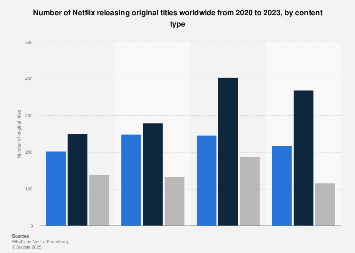
The number of original Netflix releases did not decline until 2023. The Fed started hiking rates in March 2022.

"In 2022, Netflix's original series substantially increased, going from 280 to 404 titles. However, in 2023, there was a decline in new series offerings, dropping back down to 370 titles."

Likewise, the number of total original US scripted series produced did not decline until 2023: https://www.emarketer.com/content/us-scripted-series-declined-14-2023

I agree with you that stalling subscriber growth was the proximate cause of Netflix cutting back production but I think that interest rates added fuel to the fire. And i think that interest rates were probably the main reason that Netflix competitors decided to stop chasing their lead.

Then the strikes offered studios an opportunity to reset and to rethink their strategies.

You can talk to the creative side, but none of them has a job until the money people green light their project.

I agree that the sharp decline in linear TV and the attendant change in advertising modes may be the biggest problem of all. But if programming simply changed distribution from broadcast/cable to streaming and the number of productions stayed the same overall, it would be no problem at all.
 
Going where you're needed, as opposed to your passion, still isn't that bad of an idea though.
I have no regrets about selling out on account of the lifestyle/family benefits. (What i really wanted to do was write/direct.) But ideally I'd like to compromise as little as possible
 
Drifting off topic - have you done any passion projects?
Not in a long time. I wanted to make a feature film and was developing a few different ideas, including a fantasy horror concept that intentionally would have been very low budget to produce (basically one location and 3 actors, little to no effects). but I stopped actively writing about 5 years ago. Making no-budget indies isn't that easy when you have small mouths to feed. And then let's say you're wildly successful and people want to pay for your next project. There's going to be lots of meetings and travel and uncertainty and upheaval. If you don't even want to win the prize, you shouldn't play the game. Right now I never have to travel for work, I work mostly from home, and I spend a lot of time with my kids. Maybe I'll make movies later in life...
 
With all streaming companies, except Netflix, still losing money, budgets will likely get tighter.
I think there was a Streaming Bubble, as companies threw oodles of money at the wall to see whatever would stick, in a belief there would be "a winner takes all" result to The Streaming Wars, so losing money in the short term didn't matter if in the long run they win.

Many of us got to benefit from this frothy bubble environment, and rode that wave.

But reality had to sink in eventually, and the bubble has popped.

Am doubtful it will ever return to that, unless there is something else major like the streaming revolution which causes another bubble to happen (which I can't see happening, and anyway, bubbles are not a good thing in the long run anyway for the economy! https://www.investopedia.com/terms/b/bubble.asp )
 
Back
Top