
Navigation
Install the app
How to install the app on iOS
Follow along with the video below to see how to install our site as a web app on your home screen.
Note: This feature may not be available in some browsers.
More options
You are using an out of date browser. It may not display this or other websites correctly.
You should upgrade or use an alternative browser.
You should upgrade or use an alternative browser.
Is it possible to get rifle scope cross hairs in camera?
- Thread starter JimS2
- Start date
- Status
- Not open for further replies.

paulears
Veteran
But you do everything wrong even when you ask? What you lack is the courage to try things, get them wrong and learn from the experience. Most of us ask the world when we are genuinely stuck, or have made a decision, or about to and just have that tiny feeling there is a better way. We ask things like is there a trick to doing X on Y. You always complicate it by asking I've heard that some people do X, but wonder if I should consider Z or maybe Y, but only if Z has done Q because I've been told this is how Zephram Cochrane did it back in the Old days?
Life is not a sequence of preprogrammed steps, it's building up your knowledge so progressively more of your own decisions become right. Asking others removes that section of the learning curve, so your questions constantly get harder because they are built on shaky foundations. You have been making your movies for ten years, and you have made zero progression. Ask yourself why after so many years you still struggle? Have you not noticed many of your questions in your new super identity are being answered by people who were at school when you had finished your education? They've overtaken you and are now giving you guidance. You have wasted so much time thinking and talking, and stagnating. One day reality MUST make you see this Ryan. You will of course ignore this totally as you always do. Helping you has become a quest for many of us, but constantly repeating the same information is pointless if you never listen. If you want to make your movie get up and do some work on it, for real. Stop the planning loop. Move on and up. Come back and tell us younhaveshot it, edited it, and people are enjoying it.
Life is not a sequence of preprogrammed steps, it's building up your knowledge so progressively more of your own decisions become right. Asking others removes that section of the learning curve, so your questions constantly get harder because they are built on shaky foundations. You have been making your movies for ten years, and you have made zero progression. Ask yourself why after so many years you still struggle? Have you not noticed many of your questions in your new super identity are being answered by people who were at school when you had finished your education? They've overtaken you and are now giving you guidance. You have wasted so much time thinking and talking, and stagnating. One day reality MUST make you see this Ryan. You will of course ignore this totally as you always do. Helping you has become a quest for many of us, but constantly repeating the same information is pointless if you never listen. If you want to make your movie get up and do some work on it, for real. Stop the planning loop. Move on and up. Come back and tell us younhaveshot it, edited it, and people are enjoying it.
Oh well, it's just I feel I have learned a lot but there are always new things I am not sure about. What do other directors do when it comes to learning what will work and what will not, when it comes to trying new things?
Have successful directors tried everything and therefore they know what works and what does not, and therefore there is nothing new to try? Or is there always room to venture into unknown territory, but perhaps they choose not to, cause they do not know if it will work or not?
How do other directors know that the movie they are about to make is going to work, without trying to cover all their bases and cross all their Ts? Or do they not know, and they just get lucky?

ahalpert
Major Contributor
this is how Zephram Cochrane did it back in the Old days?
Jesus, this forum's lousy with Trekkies

Paul's right - don't be afraid to do the wrong thing. There's no right or wrong anyway. Putting vaseline on your lens used to be the right thing, and now nobody does that anymore.
You asked how people have the self-confidence to make their movies? They were too crazy or stupid to doubt themselves.
Don't be afraid of doing it wrong. Be afraid of never trying in the first place.
Kubrick did lots of stuff wrong on his first 2 movies, especially with the sound recording. Making them was part of his learning process.
Oh okay sure. I guess I am just wanting to be careful and do as many things right as possible. Otherwise several things are done wrong and it could hurt the movie as a result, especially when there is money on the line. But I can just try to do the best I can, and hope it turns out well. But when other people tell you that you've been doing everything wrong so far, how do you make yourself go in blind without wanting to seek more advice, and hope that you will make an entire feature right? Doesn't the opinions of everyone saying you have done everything wrong so far, give you some doubt that you want some further advice before making a feature?
ahalpert
Major Contributor
Doesn't the opinions of everyone saying you have done everything wrong so far, give you some doubt that you want some further advice before making a feature?
You have to trust your gut. If you make a movie that YOU like, there will be someone else who likes it, too.
Don't believe everything people tell you, either. Everyone's got an opinion and they're not necessarily correct.
Now, if you want technical advice such as "how do I light a green screen properly?" they can answer that.
But most of the questions you ask are subjective. There's no right or wrong way to show a rifle scope POV. A lot of people do it in a similar fashion but you have to decide what you like.
If you cannot decide what you like and dislike, you should not be directing. That is the only thing a director really needs to do is decide "yes" or "no" to a series of decisions.
ahalpert
Major Contributor
Spend as little money as possible to communicate the ideas you want to communicate and go all in with your effort.
A no-budget movie is usually just a proof-of-concept to show other people that you can manage a feature-size project, you can tell a story, you can direct actors and cameras, etc. Make it as good as you possibly can. And be ready with your next movie treatment so you have a project for people to fund once they see how well you can direct.
A no-budget movie is usually just a proof-of-concept to show other people that you can manage a feature-size project, you can tell a story, you can direct actors and cameras, etc. Make it as good as you possibly can. And be ready with your next movie treatment so you have a project for people to fund once they see how well you can direct.
ahalpert
Major Contributor
Whoever told you that gave you bad advice.
Get the best performance out of the actors and the cinematographer you have. Coaxing out their best through insight and collaboration is your job.
But the basic skills of a director can be evaluated even in a movie with bad shooting and acting.
The viewer can evaluate your story structure and writing. Your dialogue writing. Your pacing and your editorial decisions. Your concept.
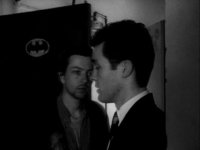
Christopher Nolan DP'd his first movie, "Following", which he made for $6,000. I don't think it looks particularly good, and later he would hire skilled DPs. But the movie showcases the sensibilities and storytelling skills that make him a good director.
"As Christopher Nolan's debut feature, it was designed to be as inexpensive as possible to make. Scenes were heavily rehearsed so that just one or two takes were needed to economise on 16mm film stock, the production's greatest expense, and for which Nolan was paying from his salary. Unable to afford expensive professional lighting equipment, Nolan mostly used available light. Along with writing, directing, and photographing the film, Nolan also helped in editing and production."
A still:
Get the best performance out of the actors and the cinematographer you have. Coaxing out their best through insight and collaboration is your job.
But the basic skills of a director can be evaluated even in a movie with bad shooting and acting.
The viewer can evaluate your story structure and writing. Your dialogue writing. Your pacing and your editorial decisions. Your concept.
Christopher Nolan DP'd his first movie, "Following", which he made for $6,000. I don't think it looks particularly good, and later he would hire skilled DPs. But the movie showcases the sensibilities and storytelling skills that make him a good director.
"As Christopher Nolan's debut feature, it was designed to be as inexpensive as possible to make. Scenes were heavily rehearsed so that just one or two takes were needed to economise on 16mm film stock, the production's greatest expense, and for which Nolan was paying from his salary. Unable to afford expensive professional lighting equipment, Nolan mostly used available light. Along with writing, directing, and photographing the film, Nolan also helped in editing and production."
A still:
Yeah that's true. One movie that gets a lot of praise is El Mariachi for example, and I didn't find the acting to be that good to be honest, nor the sound, but it got a lot of praise. I still like the movie though, but maybe like that, a movie can be successful, but not have the best acting or production value?
ahalpert
Major Contributor
Right. Did you see the movie Primer? I don't remember the acting. I think it was okay-ish.
But it had a great story. Really cool take on time travel. And it was made very cheaply. I saw it on Netflix a few years back.
A lot of times people throw money into a production thinking that viewers will like it more if it has expensive effects or something. But it's like putting lipstick on a pig. Underneath the effects, the story is not moving.
But also - a producer or investor can look at your movie and tell - ok, this actor isn't doing a great job and the lighting is cheap, but I really like the IDEA that the director put together here.
Yeah that's true. I did see Primer. Actually, I had to put the subtitles on with that movie because the sound was poor, but I did enjoy that one too.
There are things I want to do for my script, but not sure if they can be down. For example, I wanted a car to explode to kill someone in part of the story, but didn't think I could pull off a car explosion on a microbudget. So I thought maybe he should just be shot to death and forget about the car explosion, but instincts tell me to go for the explosion if possible. But how do I know it can be done?
Another section of my script, there is a protest in the streets happening, which of course can be pricey to shoot. However, what's the minimum amount of actors, I can use to sell the idea? Will ten actors holding protesting signs be enough, or will audiences see it for what it is, and that it's obviously not enough people they are seeing to be sold on the idea...
How does a director know if things like that will work?
ahalpert
Major Contributor
A few things:
1. Most of the "good" debut films that people make are stories that can be told with a low budget. I don't think there are any explosions in Primer or Following, you know? And there are limited characters and commonplace locations. I wouldn't try to make Titanic for $6,000. Finding a story you can shoot cheaply may be wise.
2. There are ways to get around showing an explosion. The character can be in the car and then you cut away when he turns the key in the ignition to someplace in the distance hearing the explosion. Or someone just gets a phone call telling them about the explosion.
But you will not be able to feature the explosion visually as a beautiful effect. You don't have the money to do it.
If you really want to show the explosion, you should practice how you will achieve the effect beforehand. Here's a tutorial, for example: https://youtu.be/wQHwO4U7AiM
If you fake a car explosion effect in post, it will probably look fake. But that may not matter as long as the story is good. I will understand that the car exploded and keep following along.
I thought that the house burning flames and smoke from the end of Get Out looked a little fake. But it didn't take me out of the story.
If you think the explosion is best for the story, I would research how to do it in post. To pull it off, you will need to shoot the scene already knowing how the effect will be done later.
3. To determine how many people you need to indicate that there's a protest, I recommend:
A) Doing a test shot with that number of people and just seeing how they look in the frame
B) check out some low-budget indy movies that show protests and see how they staged it.
You will NEVER be able to show a sea of people marching in the streets. (Unless you go film at an actual protest. I think there was a scene in Eternal Sunshine of the Spotless Mind where they go to a parade and it was an actual parade that happened in NYC.)
The cheapest way to indicate that there's a protest is just to have audio of people chanting in the distance.
You can also show protestors walking past the camera in the foreground while the camera is focused on your actors in the background.
No matter what, I will probably watch it and think to myself, "he couldn't afford a real crowd of extras." But as long as I'm emotionally invested in your characters and story, that won't matter and it won't take me out of the story.
Oh okay thanks. I mean I can show the guy shot instead, I just thought the explosion would be better. I thought about shooting a real protest as well it's just I would have to organize the protest, which would be another can of worms of course.
But as for the explostion, I have tried post tests before and yes, it did look fake. I don't have to show the whole thing, as long as the audience doesn't feel that it's awkward that I chose to cut away at a key moment. I mean I never saw a movie cut a way at an explosion before, so I wonder, would that even be work, since I've never seen it done before? I saw Get Out back when it came out but do not remember how the burning house looked.
But as for the explostion, I have tried post tests before and yes, it did look fake. I don't have to show the whole thing, as long as the audience doesn't feel that it's awkward that I chose to cut away at a key moment. I mean I never saw a movie cut a way at an explosion before, so I wonder, would that even be work, since I've never seen it done before? I saw Get Out back when it came out but do not remember how the burning house looked.
Last edited:
ahalpert
Major Contributor
A) you can do things that haven't been done before. In fact, that's generally better than doing things that have already been done. And sometimes constraints like "I have to cut away when the car explodes" lead to creative solutions
B) in Repo Man, there's a weird x-ray effect but then basically just a flash of light when the cop gets blown away, although it's supposed to be sort of supernatural: https://youtu.be/HZjZbJuhPAo
C) it's free and easy to make a mock-up that will give you the sense of how it will play out. Just take your iphone or whatever and shoot some shots of your wife/girlfriend/friend starting the car. The same sequence of shots you're considering using in the movie. Plus a shot that you will cut to after the explosion.
Take it into your editing program and edit it together with an explosion sound effect or whatever and see how it feels to you. Even though it's the wrong actor/camera/car/everything, you'll get a sense of how the sequence feels and if it might work or if it totally doesn't
Oh okay thanks. In your honest opinion, does this car explosion, looking convincing or no?
https://www.youtube.com/watch?v=0bhDOROOph4&feature=youtu.be
https://www.youtube.com/watch?v=0bhDOROOph4&feature=youtu.be
ahalpert
Major Contributor
...almost. when the screen went white I was on board. Then flames seemed to come out of...somewhere - the dashboard? Might have been better just to have flames filling the screen? Then the flames clear and what am I looking at? The car behind?
BUT I totally got the picture. She was in a car and then it blew up. Good enough! Anything more convincing than that is just a bonus
BUT I totally got the picture. She was in a car and then it blew up. Good enough! Anything more convincing than that is just a bonus
- Status
- Not open for further replies.