Is Canon getting ready to release new cinema camera/s? Big C200 Price reduction

Well, that's just a thing. The original Alexa had an in-body upscaling from 2.8K to 4K but that was mostly a PR replacement for post. Most cameras have an in-body lens correction, which can also be done in post but saves time if it's in-body. Presumably a high end "consumer" camera will have a slew of similar options that s shooter can activate or leave alone. The basic idea is that, if a smartphone has it, so should a hybrid.

I think it would make a lot of sense for arri to have aberration/distortion/vignetting corrections available in-body or by using metadata in post. One can't argue against having it as an option. But the way they make their lenses, they're not in dire need of it.

But to be sure, it's easy for me to imagine arri coming out with a "lightweight" series of lenses that are poorly-corrected and rely on digital corrections and then see an article with some big-name DP talking about how he couldn't have shot his latest movie without the compact design
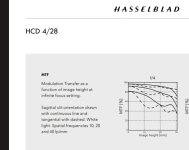
 
Image correction was pioneer by hasselblad.

probably when developing the 28mm 645 lens which is very wide fov

they determined rhat a simple “fisheye” design with a digital correction out performed a physically corrected rectilinear lens.

the lens caused some outrage as despite the price it was rubbish when used with film (the roll stuff) and marked a step change to digital at the top end
—-

ivthink knowing the Hasselblad/phase one history in stills is useful.

very wonderful high resolution images (16 bit in 2003) but too slow for 80% of work


which is exactly how i feel about arri

I'm not seeing a lot of info on the history and reaction to that release. Although I see info on the lens itself. Mtf chart doesn't look amazing

Screenshot_20230308_201205_Drive.jpg

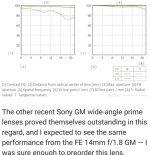
vs sony gm 14

Screenshot_20230308_200126_Chrome.jpg
Anyway, my understanding from pixel peeping lens reviewers is that detail and microcontrast suffer from these machinations but I could be wrong. Any type of distortion I apply in my NLE degrades detail, but they could be doing something more sophisticated

it seems like the only real difference you're referring to between arri and canon/sony in terms of speed/ease of operation is autofocus
 
S35 is also a shallow DOF experience. We're talking a difference of about 1 stop

But, C200 aside, the cartel keeps its APS-C without decent video features and MFT without decent auto focus. Yes, from a purely physics perspective, the networks can go smaller than full frame but the camera selection isn't there yet (OK, Fuji's aren't bad but the big boys aren't going to waste time on these "off" mounts).

As to the lower tier glass, Sony's 20-70 F4 is ~ 300 grams lighter and an inch shorter than the G-master 28-70 F2.8 and is getting excellent reviews. Hypothetically, one can make an F6 too but they're not gonna. Now, if they have a 5.6-7.1 or something like that, an in-camera correction and auto exposure might be helpful. But F4 seems to work just fine.

Of course, the sports guys shoot almost point blank, so they can easily get by with a prime (I think 50mm is what is often used) and, considering the out-of-focus areas, some aberration is barely noticed.
 
it seems like the only real difference you're referring to between arri and canon/sony in terms of speed/ease of operation is autofocus

that hassy lens is 20 years old - doubtless well superceded - just like the 20mp camera it was made for - when dslrs were 1.2 mp and phones 480px stills.

——

Yes af is a whole big deal - if you want to gimbal up to a statue you are stuck without it. A statue! Let alone a living moving sports star.

have you ever worked with an arri with wireless fiz setup ? Its no surprise there is a first a second and a trainee to keep it alive
 
But, C200 aside, the cartel keeps its APS-C without decent video features

what about the fx30? anyway, you're talking about camera availability not theoretical practicality

As to the lower tier glass, Sony's 20-70 F4 is ~ 300 grams lighter and an inch shorter than the G-master 28-70 F2.8 and is getting excellent reviews.

do you mean it's getting excellent reviews from real reviewers or from "influencers?"

cue diglloyd

Sony FE 20-70mm f/4G: Fun-House-Mirror Distortion, as Expected

As I expected, and confirming my intense dislike of wide-range kit-style zooms, the Sony FE 20-70mm f/4G lives up to its design decisions. Its 3.5X zoom range spanning that 20mm to 70mm range inherently defies rational expectations with regards to distortion. Software distortion correction is mandatory, either by shooting JPEGs (enforced, no choice) or in RAW (Adobe Camera Raw as yet has no profile available so cannot be corrected easily).

I’ll be showing how the 20-70mm compares to the Sony FE 12-24mm f/2.8 GM and also various reference lenses. Readers can decide for themselves how much sharpness they are willing to give up in exchange for convenience.

Clearly this is a “vlogger” lens and with distortion correction it will be well loved for its extremely convenient zoom range, and for JPEG snapshots and similar. But the 20-70mm is wholly unsuitable for landscape photography unless your quality standards for sharpness are low. At least over a good part of the zoom range, where distortion correction must be used.

Correcting this level of barrel distortion will result is major loss of sharpness in the outer zones.

At the long end, pincushion distortion is similarly unappealing, and correcting it will damage sharpness everywhere in the frame, making high micro contrast impossible.

In this example, distortion correction at the edges involves a pixel-stretch factor up to 1.27X linearly. Which means you are reducing the potential sharpness from 60 to 37 megapixels in those outer zones.
https://diglloyd.com/blog/2023/20230307_1504-SonyFE20_70f4G-distortion.html

on the point of lens correction in general, he says in response to a reader question:

DIGLLOYD: I’m OK with software correction for things like lateral chromatic aberration, though it is not ideal; the effects are not equally good as a well corrected lens and can never be. Especially since longitudinal chromatic aberration has a substantial perceptual effect.

Distortion and the negative effects of distortion correction are a radically different case because of degraded sharpness and micro contrast—together with grossly misleading MTF charts that account neither for diffraction nor distortion correction, a defiance of how such designs MUST be used. It’s flat-out dishonest IMO. Simple math is all that’s required to understand the losses (no pictures required!). Though I’ve also shown directly (many times) how much sharpness is lost with/without correction.

These points have clearly been evaded by the Amazon-owned folks of the dpreview crew, but whether it is incompetence along with conflating unrelated types of optical design compromises, or intentional misrepresentation using inappropriate examples for “air cover” for advertising sponsors in reviews to come (the article hints as much), I don’t know. But I do know that rationalizations are more profitable than criticisms.
https://diglloyd.com/blog/2023/20230307_2040-SonyFE20_70f4G-distortion-assessed.html
 
That bashing of that lens sounds loopy.

sure for landscape or architecture it might not be right

for being in a car filming the driver getting a few wides a cu of the hands on the wheel and gear knob it sounds amazing

also on a gimbal
 
what about the fx30? anyway, you're talking about camera availability not theoretical practicality

FX-30 is an anomaly under the current market conditions but, as the technology advances, one hopes that it becomes a norm. There are rumors floating around about a "high end" APS-C from Sony, as A6600 is going to be four years old in August.

As to the lens testers/influencers visavis 20-70 F4, they concede that it's not a $10,000 Leica prime but that it's good enough for video and general use. Once the correction software arrives, it may be even better, It should be.
 
I think the 20-70 will sit in a nice place.

Making lenses for 'shooting sequnces' is extremely tricky and there is alwys a catch.

2/3 lenses inconveniently cost $20k as does the 17-120 canon

Stills lenses are usually fairly hamplered with non parfocality, slow iris at the tele end and others.

Anyone expecting that $2 20-150 f2 is lving a dream
 
That bashing of that lens sounds loopy.

sure for landscape or architecture it might not be right

for being in a car filming the driver getting a few wides a cu of the hands on the wheel and gear knob it sounds amazing

also on a gimbal

he's a landscape photographer.

look, I'm a guy using all the in-body corrections available running around with mirrorless cameras on pistol-grip gimbals. but there's a difference between "good enough" and "as good as" and I like to be clear about what's going on

relying on these corrections is good enough for what I do (which is usually delivered in HD and probably streamed in 720p max) but it's not as good as a properly-corrected lens and no amount of wishful thinking will make it so

you may be right about good autofocus being more important than pixel-level color quality or dynamic range or good codecs. but it's not a one to one correspondence with the photo AF evolution because photos only need to be in focus for the split-second you're shooting. on a film, you need to worry about focus behavior from moment to moment. not just keeping focus on the subject but how you transition to other subjects, which can vary in numerous ways within the same shot. it's a wrinkle
 
Making lenses for 'shooting sequnces' is extremely tricky and there is alwys a catch.

2/3 lenses inconveniently cost $20k as does the 17-120 canon

the catch is $24k but if you're going to use it for 20 years and/or get proper kit fees for it, it's all gravy. I think the cabrio is what Papert and others were touting in the other thread. 19-90 t2.9 and 8.8" long. not as good as some lenses maybe, but not in need of "in-body corrections"

https://www.bhphotovideo.com/c/product/895225-REG/fujinon_19_90mm_t2_9_cabrio_pl.html/specs

and the canon lenses have AF available as well, right? on the canon bodies, not arri of course
 
Yep - so here we are seeing a hole for a C500iv

AF dingled for motion use, proper connectors proper 'sequence AF lens

more work ready than a mirroless but not a hard core cinematography tool for narrative features.
 
I think this is new on lens distortion

COmmenters talk about bad. I dont see bad, engineers are usually not bad. they make trade offs, for example a lense that needs correcting may save 25% of mass and 30% of cost. A thing worth offering to the market and a thing that some will feel free to pass by.

https://m.dpreview.com/articles/2128193923/a-distortion-of-the-truth-here-s-why-we-re-not-against-software-lens-corrections?utm_content=bufferf996b&utm_medium=soc ial&utm_source=twitter.com&utm_campaign=buffer

"Lenses that include mathematical elements"

Sheer propaganda. But the underlying point is sound. The tradeoffs may well be worth it in terms of size, cost, and preventing other aberrations caused by correcting distortion.

But let's acknowledge the tradeoffs: for example, if you're going to use "vignette compensation" then obviously hours going to end up with more noise in the corners than in the center

Anyway, concerning shooting sports with AF and alternatives to ARRI, I think we're just speculating and we ought to ask run&gun what he would do if arri launched a camera with autofocus only compatible with arri lenses. Or if red launched a high-end camera with autofocus that was compatible with his Canon autofocus zooms
 
Yep I dont know how 2/3 boys keep a golf ball sharp - its serious talent AFAIK - input please

My only sports experience is. well most saturdays for a decade doing stills for the local press and jumping to AF as soon as It became a thing with the nikon F4 - I love a sharp 300 or 400 2.8 look.
I now ride on the lauels of my old trainee.. who is now uk sports photographer of the year in the uk.

aren't we talking specifically about shooting s35 and larger format video of sporting events? which neither of us do?
 
INdeed but we are chatting about 'is there a hole' for a new generation of canons and where they should point.

Some seem to think the alexa exists so canon should just go home

I beleive Canon should forget formal drama and become the kings of 'court and sport' being in theory able to deliver a cinematic look and the practicality that is need to capture live one time events.

I guess 70% of stills sport at a pro level is canon right now.

If sport is done well with 2/3 (and it is!) then that poo poos my thinking.

Sounds sort of like what the C300 accomplished. Not features, but everything else.

"Alexa exists so canon should just go home"

Well, canon probably isn't going to beat the color and dynamic range of Alexa, nor the reliability, brand recognition, and design (I'm guessing?)

But I agree with you that once you taste high-quality autofocus, it's easy to get hooked

Personally, i dont even watch sports. I would think that shallow DOF is not that desirable when you're trying to follow the action in a game. And also that when you zoom way in on a 2/3 camera, your DOF is relatively shallow anyway (if you're wide open).

I also think the market for them is tough in the sense that customers like run&gun will spend $50k+ on a camera. So, to be truly competitive, Canon should offer a $50k camera with $50k worth of reliability, quality control, and features. But they're not going to do that because they've positioned themselves at the bottom of the market.

Will awesome autofocus bring high-end customers into the fold? I mean, wouldnt it have already? The c300mk3 is out there
 
I dont think AF is really game ready as a professional tool.

Yes the latest gen (not on the C cameras) works very well, amazing algorithm, but there is still no setting that makes one feel in control.. like the 'tickle' mode I mentioned before.

The manual focus heads love to 'aha shoot through a bush and AF fails'. ( 80% true) rather than noting that an interview at 2 becomes a no stress activity - even with a crappy monitor covered in reflections.

My minimal knowledge of the alexa design (menu et al) is that it is just simple and doent bum you by disabling luts a 60fps or other inexplainable rubbish. just 1-200fps, everything works. It doesnt have flower mode or birthday party mode (which to my are a hazard as you might engage them by a mistake). I guess a lack of auto iso could be a drawback, not that ive ever used auto anything (apart from focus)

I still dont know how to keep a golf ball sharp at 1000mm!
 
I
Yes the latest gen (not on the C cameras) works very well, amazing algorithm, but there is still no setting that makes one feel in control.. like the 'tickle' mode I mentioned before.

according to Doug Jensen, the FX6 can comfortably switch between AF and MF without taking your hands from their normal operating positions. (I don't have one, so I wouldn't know). What's tickle mode?

I still dont know how to keep a golf ball sharp at 1000mm!

Are we talking about it flying through the air? Wouldn't it be at the hyperfocal distance by that point? Or you mean on the ground? I'm guessing they just use peaking and have enough DOF to spare
 
First, does anybody actually argue that Arri is more reliable than Canon? That just seems to be an assumption based on price more than experience. From a design standpoint, Canon always seems to be very conservative in features in order to make sure that cameras don't fail. I guess some of the cabling and plastic parts can break easier on a Canon can break easier, but it is a lot cheaper to have backups.

As far as AF, I feel like it is more of a tool than a crutch if used correctly. Canon has slowly added a number of different AF tools, but you have to practice with them to figure out what works best. I think the "manual focus" assist is the best tool if you are shooting at a moderately fast aperture and want to keep it in continuous AF mode. In manual focus assist, the DPAF just corrects for the last few inches required to hit critical focus. That way you can shoot through bushes or not be worried that the AF will suddenly snap to the trees behind somebodies head. It would probably also help with tracking golf balls since it would hunt trying to find a focus spot, especially if you turn down the response rate. But it doesn't work well with extremely wide or shallow depth of field. In that case, the DPAF focus guides and peaking using manual focus work better. Luckily, the peaking is vastly improved on the C500 MKII and R5c, probably due to the better sensor resolution. Canon really needs to get their quad pixel focus out to fix most of their problems with their tracking.
 
Back
Top