
Navigation
Install the app
How to install the app on iOS
Follow along with the video below to see how to install our site as a web app on your home screen.
Note: This feature may not be available in some browsers.
More options
You are using an out of date browser. It may not display this or other websites correctly.
You should upgrade or use an alternative browser.
You should upgrade or use an alternative browser.
is AI gonna take our jobs?
- Thread starter DBP
- Start date

ahalpert
Major Contributor
It's helpful to understand how it works to plan on how to to use it and to predict where it's going.
The artists I quoted are basically formulating an argument that it amounts to copyright violation. I don't think it would under current law, but laws can change. The point of copyright is to protect the goose that lays the golden egg, which in this case is human artists. That's all the machine does is make things like it has seen before. It works from statistical predictions of what is the most likely next pixel or word.
Already, machine learning experts are worried about the stagnating quality of future iterations of things like ChatGPT because it's used up all the high quality text available and can't expand its database. And, as with imagery, the future pool of additional material is likely to be increasingly AI-generated, so it will be feeding on its own output which doesn't help its development.
Here's a tweet compiling AI-generated portraits that contain the mangled remains of an artist's signature from original works of art, because the machine didn't understand that that wasn't part of the art itself, which highlights the semi-plagiaristic aspect of what's happening here: https://twitter.com/LaurynIpsum/stat...QW_GhjBJpOqPog
there's another article I can't find now about one of the most popular digital artists working today. Apparently now when he searches for his work online, he finds more AI works that were asked to be made in his style than his own actual work. But I think that a subsequent version of Midjourney incorporated his request not to copy the style of living artists.
If the only issue at stake here were how to incorporate AI into our workflow, you wouldn't see a thread asking if AI is gonna take our jobs. You've bluntly predicted that it will but now you're being cute and pretending that it isn't an existential concern for artists.
I think the reality is that some of us will be pushed out of the industry. Even when you look at Charles' example about the cooler noise in the background -- that might have been an expensive fix-it project for a sound mixer in the past. Not the type of thing most of us enjoy doing, but fixing technical problems of one sort or another in post has made me a lot of money over the years.
Some types of work or projects will broadly come under the purview of a producer or a low-paid assistant shooter/editor working with an AI.
AI could benefit large corporate outfits (kind of like the one I linked to above, Synthesia) because there are natural advantages to big business (brand recognition, economies of scale). And if you can eliminate the need for local specialists with diverse knowledge bases, you can more likely succeed as a large centralized corporation with low-paid staffers doing what we used to do for good money.
Realistically, I think we should evaluate the type of work we do and if there will be a place for us in it alongside AI. In reaction, you should try to broaden and deepen your clientele, possibly move to an adjacent role or sector in the industry with better prospects, and/or prepare an exit strategy if your skills are particularly ripe for displacement.

NorBro
Major Contributor
Pretending it's not a concern? Why would I think videographers or editors will lose their jobs but not artists as well? I said art is special and beautiful, but of course it's a concern; many will not have work within a decade, much sooner than the other two aforementioned positions.
Evaluating work, skills, clients is good...that's what needs to be done, not feel-good reasoning why AI is wrong.
I know sometimes it feels like I'm ruthless against the man & woman, but you have to toughen people up and they need to keep a very open mind that AI's existence isn't anything personal against the creatives; it's just the way the world is going to naturally change - naturally - by going to more machines, more automation, more networks and devices connected to each other, more work in less time, less communication with people for more work, everything seems like it will be a blur.
NorBro
Major Contributor
Like, seriously...who by 2100 sees a world where someone is going to pay someone else to sit there and draw something? Like besides as a novelty.
For day-to-day work, it's out of the question. Machines are making everything and people pick and choose and it's on to the next, and next, and next, and next, and next, and next.
For day-to-day work, it's out of the question. Machines are making everything and people pick and choose and it's on to the next, and next, and next, and next, and next, and next.
NorBro
Major Contributor
Here's the big picture...the critical-thinking on the matter.
Almost all of the jobs in this industry are for marketing purposes. Anything else is for memories (something rare like weddings) or just for fun.
For the most part, people want visuals to sell something. Art - logos - graphics - video - audio - photos - whatever. It's all edited to sell something, directly and indirectly.
A creative creation that will either be purchased through a subscription or hosted in places for free where there is access to people's minds and/or their data, a product, an idea, etc.
If computers can create visuals, marketing campaigns will go from 6 months to 6 hours.
The content turnover will be unimaginable for any of us alive right now to comprehend.
Companies will try new things on an HOURLY basis and will have the data to see what's working. New work will constantly be created by computers in an effort to attract and sell. To make as much money as possible for the businesses, the countries using it.
At some point, everything is not going to matter if it's real or not (filmed by a camera). It's going to look real enough, it's going to be accepted.
It goes without saying that money always wins and this is why AI will win.
ahalpert
Major Contributor
Like, seriously...who by 2100 sees a world where someone is going to pay someone else to sit there and draw something? Like besides as a novelty.
]
We'll all be dead by 2100. I'm not personally worried about what happens in our industry after 2050. Medium-term projections are all that matter in this context.
Also, fine art won't be impacted. Hand-painted canvases will probably become more valuable. But we're not fine artists.
It goes without saying that money always wins and this is why AI will win.
There are sectors where more money can be made by doing actual photography. Quality-over-quantity arms-race type sectors, like high-end advertising or prestige TV. They'll keep employing people, probably for even greater pay.
It's really the budget-conscious sectors that arent going head to head with competing media where i expect AI to take the biggest bite.
And then, of course, there are things that AI can't do (documentary). Everything else is a question mark. Editing will probably generally leverage AI for a much faster workflow or to eliminate a dedicated editor altogether (but not on the high end).

CharlesPapert
Director of Photography
Wow, those results are great. There certainly are welcome benefits to AI, and not having to wrestle as much with noise on set is a huge, huge plus. I've been experiment with Resolve 18's voice isolation setting, and it provides impressive results as well.
I did a test with some particularly difficult clips (where the S/N ratio was really challenged) and Audo did slightly better than the voice isolation feature in Resolve, so i'm sticking with it for now.
NorBro
Major Contributor
We'll all be dead by 2100. I'm not personally worried about what happens in our industry after 2050. Medium-term projections are all that matter in this context.
Also, fine art won't be impacted. Hand-painted canvases will probably become more valuable. But we're not fine artists.
There are sectors where more money can be made by doing actual photography. Quality-over-quantity arms-race type sectors, like high-end advertising or prestige TV. They'll keep employing people, probably for even greater pay.
It's really the budget-conscious sectors that arent going head to head with competing media where i expect AI to take the biggest bite.
And then, of course, there are things that AI can't do (documentary). Everything else is a question mark. Editing will probably generally leverage AI for a much faster workflow or to eliminate a dedicated editor altogether (but not on the high end).
Art...yeah, novelty, as noted.
Sectors...some, def, because people will still shoot. Human camera operation will never go away, it shouldn't.
Documentary...AI can do documentary but it depends what and how. It can't see our brains (yet) and make that, which is what I assume you're mostly referring to - making complex documentaries based on those visions - but it can document something by making something and that might be "good enough".
___
Although I personally don't care what happens, and it's all good either way, I think that a larger-than-life company making an AI video/editing product will change everything much sooner.
If Apple ever makes a new AI editing application and it's one of the highly commercialized features in the iPhone, it's going to be a nightmare for freelancers, IMO.
This is how people are trained, changed, brainwashed, enlightened...by someone with control over so many minds with their products.
"Jonny, we love your work...but what do you think about this new iAI?"
"Hate it."
ahalpert
Major Contributor
I did a test with some particularly difficult clips (where the S/N ratio was really challenged) and Audo did slightly better than the voice isolation feature in Resolve, so i'm sticking with it for now.
I've been using the Crumblepop AI audio editing plugin recently with good results. But I haven't tested the Denoise feature yet, I've just used Level Audio and Remove Echo.
Comparing it to Audo, it seems like it might be more fully-featured but Audo is rolling out new features soon? It's interesting that Audo charges per minute of procesed audio and you can get 20 min/month for free. Crumblepop works as a plug in and you pay per month or $600 for a perpetual license.

Liam Hall
Veteran
Which workflows?
Speech to text. Neural filters and smart selection tools. Speech enhancement. Machine learning tools to aid tagging etc to name a few.
ahalpert
Major Contributor
Speech to text. Neural filters and smart selection tools. Speech enhancement. Machine learning tools to aid tagging etc to name a few.
Neural filters and smart selection in photoshop, you mean? Speech to text for transcribing interviews?
There's a columnist at Bloomberg who likes to say that dystopia is when robots take over half your jobs. Utopia is when robots take over half your job.
There's a columnist at Bloomberg who likes to say that dystopia is when robots take over half your jobs. Utopia is when robots take over half your job.
That's a good one Abe! I like that!
Liam Hall
Veteran
Neural filters and smart selection in photoshop, you mean? Speech to text for transcribing interviews?
.
Yes, but lots of other options too like sky replacement, content aware fill, plus audio features like audio track repair, clean up tools, voice isolation etc. And yes speech to text for both transcribing and translating have saved me an enormous amount of pain lately. They're popping-up all over the place - I notice Neural filters are in the new Da Vinci too.
There's a columnist at Bloomberg who likes to say that dystopia is when robots take over half your jobs. Utopia is when robots take over half your job.
If AI can do more of the boring monotonous things leaving me to do the fun stuff, that will be just dandy!
ahalpert
Major Contributor
. They're popping-up all over the place - I notice Neural filters are in the new Da Vinci too.
What are the neural filters for video and are they any good?
Liam Hall
Veteran
What are the neural filters for video and are they any good?
Sorry Abe, I missed your reply. There is "Face Refinement" which cleans up skin blemishes and unkind shadows. "Magic masking" which seems to work like LightRoom for identifying and masking subjects. Object removal is another one. There are a few others and some that work for audio.
ahalpert
Major Contributor
Sorry Abe, I missed your reply. There is "Face Refinement" which cleans up skin blemishes and unkind shadows. "Magic masking" which seems to work like LightRoom for identifying and masking subjects. Object removal is another one. There are a few others and some that work for audio.
Are they usable? Hit-or-miss? Ungodly good? What's your impression so far?
ahalpert
Major Contributor
I used my first AI-generated image on an edit this weekend. I was asked to include this portrait of the painter Basquiat:
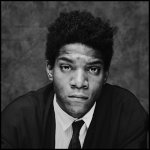
which would look like this cropped to 16x9:
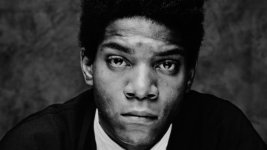
so I outpainted it in dalle2 and got this (albeit at 1024x1024 resolution):
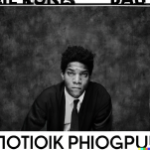
I overlaid the original image on the center to maintain higher resolution on the important part of the photograph. and now cropped to 16x9, it looks like this in the edit:
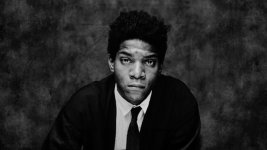
imperfect, but good enough for this project, plus very fast to do. oddly, the AI put the background in focus even though it's out of focus in the original shot
which would look like this cropped to 16x9:
so I outpainted it in dalle2 and got this (albeit at 1024x1024 resolution):
I overlaid the original image on the center to maintain higher resolution on the important part of the photograph. and now cropped to 16x9, it looks like this in the edit:
imperfect, but good enough for this project, plus very fast to do. oddly, the AI put the background in focus even though it's out of focus in the original shot
Liam Hall
Veteran
Are they usable? Hit-or-miss? Ungodly good? What's your impression so far?
Hit and miss. Some things are great and save time, speech to text for example, other things are a little rudimentary, but they will improve - content aware fill, for example. I've used it successfully for extending the canvas as you've done on the portrait above.