indie go-goer raising $30,000 to build 100w LED light?

I have recently completed my prototype 1000W filament led equivalent doing 16K lumens, 3 color temperature choice on the same unit. Battery powered.
 
A friend of mine raised $700k for a bike product that few months later i discover already existed on the market. Yes, people ARE that stupid.
 
I have designed, sourced out parts, elbow greased, prototyped, evaluated, and field tested my first led on-camera led light in 1997 which takes much more in terms of calculations on the confined minimal interior space for components and thermal management than a large fixture does, especially being fanless and with all electronic components except the on/off switch being made in USA. With die extrusion design and tooling on T-6061 aluminum as well as CNC and anodizing, it still came well below the $10K mark before the first unit was available for sale. That also included packaging design with bar coding and printed matter stuff like instruction booklet, guarantee card etc.) Sheet metal stamping and bending is less expensive than having aluminum die process where just the die itself is upwards of 6K dollars and minimum extrusion runs ( to be cost effective) are in the 1/2 ton (1000lbs) territory. Now if we're talking about the marketing and advertising stuff, then that is a different add-on. Perhaps I saved a lot because I was a one-man-band doing everything myself without paying out salaries. I am not saying that it is cheap to do , as I know any new concept from initial design to the 1st working prototype is very expensive, especially when later you find out that a small important detail just isn't right and you have to re-tool the entire thing over again. Minor flaws in design, fitting, performance, and " Oh, damn this screw is in the way of that" issues only become apparent just at the final stages of prototype completion.
 
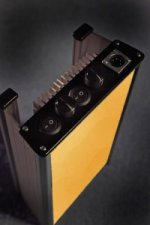
Test videos ? not yet on my 4 newest models. They are a 6 X 6 X 3 inch "small model" with a very silent fan and 9K lumens ( 550W equivalent) drawing only 80 watts from the battery.
An 8 X 6 X 3 inch "medium size model" with a very silent fan and 12K lumens ( 750W equivalent) drawing only 92 watts.
A 12 X 6 X 3 inch model without a fan and 12K lumens (750W)
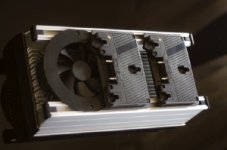
A 12 X 6 X 3 inch model with a fan and 16K lumens ( 1000W equivalent) drawing 156 watts from batteries ( 2 batteries needed 14.4V types)
I will be doing some videos showing the results around the end of Feb. Photometrics will be done at the same time.
They all use the very latest power class led's on copper bases, custom drivers, mil. spec components, teflon wiring, hard soldering.
Each unit has external DC powering via a 4 pin XLR, Dimming 0-100%
Available in different color temp and beam angles from 10 to 70 degrees or a mix( custom), surface finish in silver, black or grey mil. spec powdercoat.
I have little amount of photos as it is an ongoing process with completion date for end of Feb/13.
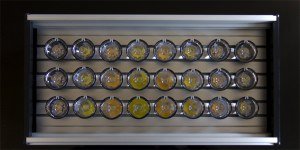
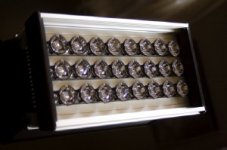
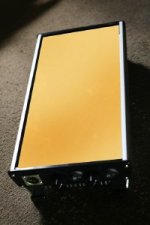
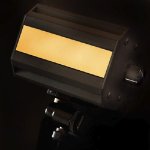
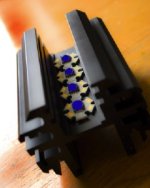
Also includes an on-camera remote phosphor model (not completed proto. yet) showing the 4 455nm blue dies, 8 will be eventually used. Here is a sneak look.Bi-color 1K, 2K with fan, 1K narrow beam, RP concept, RP concept, on-cam RP, 450nm layout.
1K18MC.JPG2K5500Flr.JPG2K5500FVlr.JPGEXP.JPGEXP2.JPGRPC 1.JPGRPC 2.JPG
 
Not yet, but I have to see where I can cut costs without cutting down on quality and reliability. It will be a while before I can get them to be produced even in small quantities as that all depends on the demand and pricing to be as affordable as possible and that can only happen if the components can be discounted considerably by quantity purchases. Even if I make a small quantity run, they may be sitting on the shelves collecting dust as the newer LED emitters are constantly being improved upon and I want to always offer the latest available. You would be surprised how many units are being sold out there with older led emitters in them that were made over 5 perhaps 10 years ago. Manufacturers will not implement changes and improvements to their products overnight as soon as the newest, latest leds are commercially available. Change takes time. I, on the other hand can take, for example a new led that came out today, order 48 pieces, get them in within 3- 4 days, mount them on 20mm copper stars, cement it in a fixture by the end of the week and have 2 units ready for the following Monday. For example. I have proved that a 1000w (16K lumen) unit can be done as a battery powered unit with only 2 brick type 14.4V ENG type batteries. That has only been possible just recently as the latest led's I used produced well over 100 lumens per watt WHEN DRIVEN AT THEIR FULL OUTPUT POTENTIAL and not at the theoretical low power input measured at 1 watt. If my leds were measured at 1 watt, they would produce over 160 lumens per watt. I just wanted to see just what kind of kick a#% light I can muster within a very small enclosure and a fan. The enclosure measures 12 X 6 X 3 inches, I really would like to see any out there that is smaller for the same 16K lumens and battery powered.
 
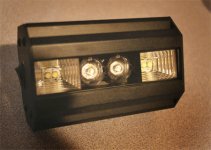
Darren, here is one I finished yesterday as a one-off for a friend of mine who is a wedding videographer and just needed something a little special for next week. He needed brightness, and lots of it, he needed a wide even beam to cover his 24mm on the full frame 5D3 without using diffusion, he needed a very narrow spot ( 12 degrees) to illuminate at 80 ft. distance, a dimmer, a 3200K , and a high CRI along with using one L series 7.2 V Sony battery. Also the ability to power tap it on his 14.4v ENG cam. Switchable between narrow, wide, both. Power draw to be less than 40 watts. No fan. Water resistant.
This is a custom build with 3600 lumens,using 6 leds, wide field rectangular beam projection of 75 degrees. TIR optics for narrow. Unit measures only 4.75 inches wide.
EXP 4000.jpg
 
Well, Norman99, it's a bit of a puzzle. How come you - just one individual - can do better than lighting equipment manufacturing companies that have million+ dollar budgets? I mean, I'm sure you have a very good understanding of the film world demands, but it's not a stretch to say that those companies can hire people equally qualified. So what gives?

Now, I'm not questioning your cred at all - I'm just amazed and a little puzzled.

Having said all that. If you can come up with physics defying lighting solutions at a reasonable price (so that anyone other than top studios can afford) your product will be in much demand.

For me, it really comes down to these requirements - and yes, I know it's shooting for the moon, but hey, as long as we're dreaming-sky-is-the-limit:

1)Good color spectrum - no crazy dropouts or weird spikes

2)Brightness - the more the better, within the limits of the laws of physics of course - I mean, if we can start rivaling HMI levels of power without the heat, that would be heaven

3)No weird multipointed pinprick shadows - strong hard light you can actually shape with snoots like a leko

4)Can be battery operated - even if it's a pretty beefy battery - so power efficient

5)Doesn't get crazy hot

6)Quiet

This is probably asking too much, but maybe in 10 years?
 
The manufacturing companies ( not every one of them) are there to do 2 things. 1- To make a healthy profit and 2- To design lights that are to be mass produced for what is needed for the industry as efficiently and cost effective as possible so that it can satisfy #1. Let us take a little closer look at #1. The healthy profit bit. From the start, a light ( not mentioning names now) that material cost per unit at time of mass production is $33 dollars US and a per unit labor and packaging and designing and patent and conformity standards certification, blah, blah, blah.... is an additional $27 dollars US. That light costs $60 to produce BUT the producer ( manufacturer) wants to make a buck, and why not ? say it wants a profit of $30 per unit, fine. The Distributor buys it at $90 and wholesales it out to retail for $160 making a nice cut at that. Now the retailer also wants to sell it for a profit so that the unit will go for say, $239 to the public. That rough estimate is not too far from reality. That's the business end of things. We can see that a light that initially started at $60 gets sold to the consumer for $239. The magic 4X cost to retail figure. Now, let's just say a really good light is needed, using quality parts, 99% made in USA, with mil spec components, latest leds, custom drivers, hand assembled, conservative specs ( not overrated as usually are), extruded aluminum, powdercoat anodizing, Lexan scratch resistant panel, etc. And just let's say the same manufacturer wanted a similar light done this way. Now the material costs are much higher, how about 800% higher on parts alone ? That new light with same labor may well sell to the wholesaler for roughly ( $264 parts+$27 labor inc. misc. mentioned) + 50% manufacturer's profit ( $145.50) = $436.50. The retailer has to pay roughly $650 for it and the end user about $850.
Thus overpricing it out of the market and nowhere being competitive. The hard sell is now up to the retailer to get them off the shelves before they are soon replaced by a newer design/technology.
Now about the manufacturers hiring equally qualified people. They do, and most, are even smarter than me. The problem is that they have to follow an agenda of designing, outsourcing parts and making them profit ready and out the door. Profit is the key word. They also look at other factors as trends, shooting habits, preferences, markets, competition etc.
They have their work cut out for them. Big companies also have big salaries and big expenses to pay.

Out of the 6 requirements suggested:
#1 is determined by the led choices that are commercially available. They are really good but getting better like in every 6 months, as an average.
#2 Many power leds ( large die types) already exist to rival and exceed HMI's in terms of lumens per watt, especially when used in multiples. Leds do produce plenty heat, and is a major consideration in the design.
#3 There are, the large single die in conjunction with a reflector or fresnel.
#4 That is not even a problem as I have already made a 2K battery powered.
#5 It DOES get crazy hot. All depends what crazy is in degrees C. But #6 will answer that.
#6 Active cooling is needed when heat becomes an issue.
Asking for too much ? not really. Give it a little time.
 
Well, Norman99, thank you for that informative post. I don't know if you've filled me with optimism or depressed me. I guess I'll split it - I'm amazed and optimistic about the technological challenge, and depressed about economic reality of affordability. So, yes, I'll give it more time - not that there is any choice. I just wish my body gave me more time too... nobody is getting any younger, myself included. But then again, I'm already grateful and amazed at what is available on the market today - it would seem like magic even just 10 years ago.
 
Norma, you are a bad man. I remember stumbling across a thread you were on prototyping the light in your avatar. Inspiring, hope you bring some of those to market.
 
The light at the end of the tunnel may soon be in the form of the LEP ( light emitting plasma) and/or the Remote Phosphor approach. Both of which have their ups and downs. The LEP needs a ballast and the RP is on the rather expensive side, at least for now. Top end led's are expensive , Creamsource, Zylight, etc. I am just making a few models to do just what is not available out there. Custom made to measure suits kind of thing. Trying at the same time to be as affordable as possible by eliminating a few "middle men" so to speak. Unique features on some of my designs call for a rectangular beam projection ( in video one shoots a rectangle 16:9 field in a round spot ) like putting a square peg in a round hole. There is light spill and waste at all four corners, as an example. I hand pick the leds from the same bin and batch for consistency etc. I do not forsee my units being mass produced any time soon. But regardless, leds are here to stay and their few advantages are such that just for those advantages will make them the tool of choice. No tool is perfect but we tend to choose the one best suited for the job at hand.
 
Well, Norman99, thank you for that informative post. I don't know if you've filled me with optimism or depressed me. I guess I'll split it - I'm amazed and optimistic about the technological challenge, and depressed about economic reality of affordability. So, yes, I'll give it more time - not that there is any choice. I just wish my body gave me more time too... nobody is getting any younger, myself included. But then again, I'm already grateful and amazed at what is available on the market today - it would seem like magic even just 10 years ago.

I use to build my own computers... that's because for a much cheaper price, I could build a 'better' system. To be sure I didn't go out to the sunny San Diego beaches, shovel sand, fire it up... produce wafers, etc... but bought at the sub system level for 'cheaper'.

I don't know that LED lighting has gotten to that 'cheaper' subsystem to build 'better', or perhaps more 'tailored' systems for lighting.

But I for one don't believe that large corporations really do much in the way of 'innovation'... even Apple is not really all that 'innovative' when it comes to the internals. They have of course developed 1) a certain 'look'... my Frankensteinian PC (running FreeBSD) would not be seen in the same aesthetic light as any Apple design... 2) Manufacturing process. The latter is their big 'innovation' which of course people never realize... The 'micro kernel' running Mac OS was developed at Carnegie-Mellon about 30 years ago, the FreeBSD upperlayer kernel was conceptually developed at Bell Labs 40 years ago, with a 'rewrite' via Berkeley in the form of BSD (as in Free-BSD...)). The user interface is built and costomized by Apple, but conceptually the Mac OS 3-9 was somewhat based on Xerox Smalltalk, again a 40 year old system, and Mac OS X abuser interface pretty much a 'windows' system with fancifications, such as X11 from MIT... a 30 year old system...

The same is true for Microsoft... At one time they hired one of the Carnegie-Mellon people to develop their 'New Technology' kernel aka NT... etc.

Very often in a large corporation the 'development' team is very small... 20-30 perhaps, and perhaps for some projects... 5 or so. The large corporation can of course put money into more 'risky' projects, but as often as not, even with demonstrating capability, those small projects are canned, and the corporate boat's inertia carries on with the same-old-same-old.
 
Back
Top