I'm confused, can some audio guru please enlighten me?

Postmaster

Dark Side of the Camera
Okay, here is the thing.

Rule of thumb for dialog: Shotgun outdoor, super cardioid indoor - right?

When I bought my NTG1, I thought it's a shotgun (at least the Rode site says so) that I can use for outdoor.
Now I'm looking for a better mic, my eyes are on a Senheiser.

Now I found the MKH 60, which Senheiser calls a Shotgun/lobar/super cardioid (WTF?) - which confuses the hell out of me.
Than they also have the ME 67, which seems to be only a lobar and the MKH 416, which is a "short gun interference tube lobar"

I think I missed something and got it all mixed up.
Can someone please chime in and help me?
 
First, the "shotgun outside, hypercardioid inside" rule isn't a rule... it's a suggestion for the inexperienced as the hypercardioid is more forgiving in the hands of an inexperienced boom op for interior scenes. There are times when the hyper is the best choice indoors (highly-reflective environments), but a shotgun can work just fine indoors,

Second, "shotgun" does not refer to the response pattern of the mic capsule. It's actually about the interference tube that is mounted around the mic capsule. At its heart, a shotgun is most often a supercardioid.

I hope that clears it up a little. The best mic kits out there have a wide selection of mics, so that the right tool for the job is available (which may vary greatly by application and environment).
 
The issue is not the precise pattern per se; it's how the mic achieves its pattern. "Super-cardiod" refers to the shape of the pattern itself. The classic shotgun achieves its directivity through the use of a ported interference tube in front of the capsule. That's where the problem lies - the tube does not work well when there is a high proportion of reflected to direct sound. Hypercardioids use a different physical principle altogether to make them directive and indirect sound doesn't affect them as much. If the 'super-' gets its pattern from an interference tube it is likely to have problems in a reflective environment such as most location interiors. If it uses the 'hyper-' principle it will be much better behaved in the presence of reflections. Note that the dstinction between indoors and outdoors is only a rule of thumb and only applies to "standard" situations. An outdoor shot next to a brick wall beside a paved basketball court is likely to be very reflective and might present problems for a shotgun. An indoor shot on a controlled sound stage is likely to be very dead and present no issues to the 'gun'
 
The term "shotgun" is a colloquial name for a "form-factor", i.e. a microphone in the shape of a long tube.
There are SEVERAL different ways of making long, above-average directional microphones.
People casually refer to ALL of them as "shotgun". But that is misleading as you have excellently demonstrated.

Because of the way most (but not all) "shotgun" microphones develop their super-directionality, using them in a space with near reflections confuses the heck out of them (*) and renders them almost worse than an ordinary cardioid.
In 99%+ amateur location shooting, "near reflections" = "indoors" and that is why you see the statement about not using shotgun mics indoors.

(*) Most types of "shotgun mics" (the "interference tube" kind, not as much the multiple-element kind like the Sanken CS3) depend on the DIRECTION/AXIS of the undesired noise to know what to accept and what to reject. If the DESIRED SIGNAL gets reflected from nearby surfaces, then some of the DESIRED SIGNAL gets REJECTED along with the UNDESIRED NOISE. That is why conventional "shotgun mics" are have compromised directionality in the presence of nearby reflections (i.e. "indoors").
 
Thanks a lot gentlemen, the fog in my brain is disappearing a bit now.

So the MKH 60 and my NTG1 are both hypercaroid capsules with interference tubes attached, which makes them more directional whereby my Oktava, that has no tube is just a supercardoid which is more forgiving, especially in reflective environments - right?

So where comes the "lobar" into play and what exactly does it mean?
 
So the MKH 60 and my NTG1 are both hypercaroid capsules with interference tubes attached, which makes them more directional whereby my Oktava, that has no tube is just a supercardoid which is more forgiving, especially in reflective environments - right?
Exactly correct. You got it!

So where comes the "lobar" into play and what exactly does it mean?
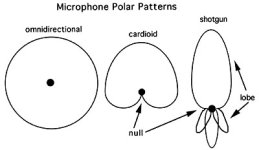
The "lobes" are those things that hang out the "backside" of the polar-pattern. Ideally, a directional microphone would have no lobes except the primary one pointing forward. But the best technology we have today creates that exceptional directivity by playing some tricks with acoustic physics, and those tricks have the side-effect of those extra "lobes" off the sides and the end. Some microphones have bigger lobes than others. It is good to know the patterns of your microphones to use them to your advantage. For example, there might be some noise source at a particular angle that you could reduce by simply moving the microphone to the other side so that noise source comes in at a different angle, etc.


polar.jpg
 
So the MKH 60 and my NTG1 are both hypercaroid capsules with interference tubes attached, which makes them more directional whereby my Oktava, that has no tube is just a supercardoid which is more forgiving, especially in reflective environments - right?

Basically, with one important correction:

The MKH60 and NTG-1 are both built on supercardioid, whereas your Oktave (I'm assuming MK012?) is a hypercardioid.
 
Okay, here is the thing.

Rule of thumb for dialog: Shotgun outdoor, super cardioid indoor - right?

When I bought my NTG1, I thought it's a shotgun (at least the Rode site says so) that I can use for outdoor.
Now I'm looking for a better mic, my eyes are on a Senheiser.

Now I found the MKH 60, which Senheiser calls a Shotgun/lobar/super cardioid (WTF?) - which confuses the hell out of me.
Than they also have the ME 67, which seems to be only a lobar and the MKH 416, which is a "short gun interference tube lobar"

I think I missed something and got it all mixed up.
Can someone please chime in and help me?
An interference tube microphone is often called a "gun", "shotgun" or "rifle" - the shorter guns tend to be called a "shotgun" and the long ones a "rifle" to differentiate the patterns.

The Sennheiser MKH 416, MKH 60 and the new MKH 8060, as well as the pre-polarised K6+ME66 and new MKE 600 are all short gun interference tube microphones. "Lobar" is used by Sennheiser to indicate a gun mic. and the "super-cardioid" bit indicates that the capsule itself is a super-cardioid.

The interference tube works only at higher frequencies, so the low frequencies will be the capsule response - in this case super-cardioid.

The longer the interference tube, the lower the frequency that it starts to work and the more directional is becomes at higher frequencies.

The long gun "rifle" microphones are the MKH 816 and MKH 8070.

The MKH 70 is somewhere between the 416 and 816 as it has a pattern more directional than a 416, but less directional than an 816 or 8070.

I hope this helps.
 
Basically, with one important correction:

The MKH60 and NTG-1 are both built on supercardioid, whereas your Oktave (I'm assuming MK012?) is a hypercardioid.

Oktava may call the MK012 capsule a "hyper-cardioid", but the published response is "super-cardioid", a true "hyper-cardioid" would have a larger rear lobe.
 
Oktava may call the MK012 capsule a "hyper-cardioid", but the published response is "super-cardioid", a true "hyper-cardioid" would have a larger rear lobe.

Out of curiosity where are there guidlines for the names? I've heard the "super" VS "Hyper" discussion before and basically came to the conclusion that the real difference is what the manufacturer decides to call it. Nobody seemed to have a definitive reference to set definitions. I have read a number of articles that should have had the "real" info but they tend to contradict each other.

So if such a document exists I would love to see it. I get asked this periodically and would love to have an answer I could back up.
 
Back
Top