Ikonoskop has temporarily stopped the production of the A-Cam

Are there any other cameras which produce a similarly lovely image to the A-Cam 2, which perhaps also use CCDs?

No other CCD based cameras that I know of in the under $10k market. The Digital Bolex uses the next step up in the same KODAK KAI series CCD's. Should look very similar to the Ikonoskop but we haven't seen it yet and they are still working on sensor tuning and color science for the release firmware.

3-chip high end broadcast cameras from Sony still use CCD's, but they are $40k and up.
 
Are there any other cameras which produce a similarly lovely image to the A-Cam 2, which perhaps also use CCDs?

If it ever comes to market, the Digital Bolex D16 will probably have a very similar image to the Ikonoskop. It also has a Super16-sized Kodak CCD and records to Cinema DNG. The Blackmagic Pocket Cinema camera is roughly comparable. It's sensor is also S16 sized and it will eventually record to compressed raw. The Pocket has a CMOS sensor, though, with all that entails.
 
If it ever comes to market, the Digital Bolex D16 will probably have a very similar image to the Ikonoskop. It also has a Super16-sized Kodak CCD and records to Cinema DNG. The Blackmagic Pocket Cinema camera is roughly comparable. It's sensor is also S16 sized and it will eventually record to compressed raw. The Pocket has a CMOS sensor, though, with all that entails.

It was just announced yesterday that the BMPC will be shipping with raw.
 
Its quite cynical to put it in these terms but I must admit that this development comes as absolutely no surprise. Expressing how much you love the idea of the Ikonoskop only reveals how entirely arcane and out-of-touch one is with the current world of filmmaking. Onward to BM pocket-cams!
 
Its quite cynical to put it in these terms but I must admit that this development comes as absolutely no surprise. Expressing how much you love the idea of the Ikonoskop only reveals how entirely arcane and out-of-touch one is with the current world of filmmaking. Onward to BM pocket-cams!

If by arcane and out of touch you mean not resigned to accepting rolling shutter, aliasing artifacts, and for most under $10k cameras low end codec mush, as well as the inability to produce an accurate 100% or better ITU709 color gamut... guilty.

The pocket cam from my brief hands on at a trade show has abysmal rolling shutter performance and due to the lower resolution worse aliasing artifacts than the BMCC. It does produce pleasing color easily, especially skin tones, but the BM cameras do not do deep saturated reds or yellows well at all. OK for $995 camera but certainly not that exceptional and not functionally in a class with any $5k-$10k pro level camera, including the Ikonoskop.
 
Last edited:
CCD have their issues as well. For one is a vertical streaking of light sources. It turns pretty much most of the shots with bright lights into a pile of garbage, that includes sun. Even film has it's set of issues. Same for of superiority of CCD over CMOS is outdated 10 year old argument, proven wrong multiple times. Even the argument about critical applications goes out of the window with new Canon sensor for astronomy, which happens to be CMOS. 99% of viewers don't give a crap about color science, rolling shutter or aliasing. What people care about is story: dialogue, acting, lighting and the real criteria for judging any film. Nobody really gives rats ass what camera was used, besides 100 people having nothing better to do, but to sit on forums and continue to spew the same crap over and over.
DB started making a nice product, but the development is turning it into a joke. And I predict it will follow Ikonoskop, because it can't deliver the goods on time. The moment Pocket Cinema hits the market, DB will be just a footnote and ancient past.
 
Last edited:
It seems the Blackmagic crowd are taking glee in the demise of Ikonoskop and the struggles of DB. I own an Ikonoskop but if I found a better looking image for what I paid I would jump on it. Haven't seen it yet. Saying that image quality doesn't matter makes sense in the world of DSLRs and prosumer cameras since there is only subtle differences between them. People endlessly trying to create ways to get their camera looking a little more filmic for their youtube video; in those instances most people can't see any real difference. I am never looking for some secret trick to make my Ikonoskop more filmic.

I was actually going to pick up a BMPC but stripped down with a Zeiss 9.5 my Ikonoskop is super discrete, portable and works as a travel/doc camera in fact I just used this setup in West Africa. My sunsets flares look amazing defintely not garbage.

As a creative community we should encourage these niche companies since they are the inspiration for what can exist outside the big companies. Diversity promotes ingenuity. I would never hope that DB or Blackmagic fail because they offer some of the specs of my Ikonoskop at a lower pricepoint, and I'm not screaming that Canon is conspiring to rip me off because their DSLRs didn't include CinemaDNG even though its possible.

Snowblinds prediction that once the BMPC hits the market the DB will be a footnote may actually be true, the Chicago Sun-Times just fired all their professional photographers since they can post pictures people take with iphones for a fraction of the cost.
 
CCD have their issues as well. For one is a vertical streaking of light sources. It turns pretty much most of the shots with bright lights into a pile of garbage, that includes sun. Even film has it's set of issues. Same for of superiority of CCD over CMOS is outdated 10 year old argument, proven wrong multiple times. Even the argument about critical applications goes out of the window with new Canon sensor for astronomy, which happens to be CMOS. 99% of viewers don't give a crap about color science, rolling shutter or aliasing. What people care about is story: dialogue, acting, lighting and the real criteria for judging any film. Nobody really gives rats ass what camera was used, besides 100 people having nothing better to do, but to sit on forums and continue to spew the same crap over and over.
DB started making a nice product, but the development is turning it into a joke. And I predict it will follow Ikonoskop, because it can't deliver the goods on time. The moment Pocket Cinema hits the market, DB will be just a footnote and ancient past.

Vertical streaking is so well controlled with modern CCD designs that it isn't a significant issue, even shooting the sun. The full well white clip point for the KAI4050 is 20,000ev. Vertical streaking doesn't occur below 6,000,000 ev or 300x overexposure.

Some of us do care very much about the quality of our images. We are the visual artists creating them, not an ignorant audience. I would submit that how critical the image quality and color accuracy are very much depends on what the subject matter is and the critical aesthetics of both cinematographer and viewer. I have shot educational videos for art exhibitions and you would not believe how critical a painter can be about accurate reproduction of their color palette. There are pigment colors in pastels and oil paints that most digital cameras can't capture and most TV monitors can't reproduce.

It is nice to have alternatives that emphasize different features and qualities from the run of the mill mass market retreads the big companies release year after year. The BMC line is certainly a step up in IQ and creative image control compared to all the low end AVCHD cameras out there. But they are not the only possible solution and have their own serious design compromises to meet a low price point for mass market retail distribution.

Ikonoskop and Digital Bolex don't need mass market acceptance. Just a couple of thousand artisan filmmakers a year that see and appreciate the real difference in creative potential they offer in a sea of cheap me too jello ridden washed out aliased CMOS mushcams. Could I shoot decent video with a pocket cam? Sure. Is it what I want to see for my own personal creative work? Definitely not.

I hope serious debate about the actual pros and cons of different cameras and technologies will help bring more attention to interesting high quality alternatives like the Ikonoskop. Both it and the Digital Bolex are developed by people who would still prefer to shoot film over video but realize that is not the future. The next best thing is a simple raw digital camera designed around a sensor line that really can closely match the broad gamut color reproduction and motion aesthetics of film because it was critically developed to do just that first and foremost.

Try this simple test with your own camera. Set it to whatever LUT you prefer, go out to a street intersection somewhere, white balance on a good reference like an 18% gray card or a calibrated white balance card. Then shoot a stop light for a full cycle. See if your camera can produce a red red, yellow yellow and green green that matches the way you see the colors of that stoplight with your own eyes. Most cameras won't even come close. Many aren't even easy to correct in post short of actually masking and painting the lights the correct color.
 
Last edited:
And what does it matter to a viewer from general public? Like I pointed out, you guys spend way too much time on bb like this, where self indulging crowd of a hundred or so people endlessly rehash the same topics. Same goes for film and television. "Deadliest Catch"- the most watched show on discovery was shot on HDV for 5 seasons, while people would discuss ad nauseam this camera is better than that camera. I am just pointing out the stupidity of these arguments. I am camera company agnostic. But looks like Ikonoskop underestimated the issue, which is that most people don't really care about camera they use as much.
 
Not all of us are engaged in lowest common denominator commercial TV work. TV, Internet streaming, and theatrical entertainment are not the only venues and not the ones for which quality is most critical. By your argument there is little point in shooting on anything more than an iPhone, no point in huge finely photographed and artfully produced feature films. Blair Witch and 28 days quality is good enough for anything.

In a world filled with mediocrity, Ikonoskop's mistake was their "If you build it they will come" marketing philosophy. You have to seek out and communicate with your intended market.
 
Last edited:
Not all of us are engaged in lowest common denominator commercial TV work. TV, Internet streaming, and theatrical entertainment are not the only venues and not the ones for which quality is most critical. By your argument there is little point in shooting on anything more than an iPhone, no point in huge finely photographed and artfully produced feature films. Blair Witch and 28 days quality is good enough for anything.

In a world filled with mediocrity, Ikonoskop's mistake was their "If you build it they will come" marketing philosophy. You have to seek out and communicate with your intended market.

Even if you watch on an Iphone you see purple skies, jello whatever looks created by cheapo cams.

"If you build it they will come"

I think that is actually true. I didn't buy their product not because I didn't know about it - I didn't buy it because it did not line up for me.

Ive also not bought a Scarlet (too heavy, too insensitive), and not bought an F3 (codec too thin) , or a BMC_EF (wrong chip for the mount) or a BMC_MFT (why bother when the S35 is round the corner) - the other cameras that Ive hovered with my finger on the buy button

The market is there but the product is not..


S

All good points. There is not one monolithic market, but multiple niche markets. It all depends on what best fits the individual shooter's profile and budget. In the under $10k prosumer market range all available cameras have significant compromises in one way or another.
 
I have yet to see a CMOS camera of any kind at any price, with the possible exception of the Alexa, touch the color accuracy and gamut the Kodak KAI series CCD's are capable of. This is one major reason that seriously color critical industrial applications, like monitoring fabric die processes for color match, and scientific missions like the mars rovers use Kodak CCD's. Leica used Kodak full frame sensors in their M8 and M9 series. They changed to a CMOS sensor for the newest model so they could add a video feature, but IMO their image quality suffered for it.

If by arcane and out of touch you mean not resigned to accepting rolling shutter, aliasing artifacts, and for most under $10k cameras low end codec mush, as well as the inability to produce an accurate 100% or better ITU709 color gamut... guilty.

Apologies in advance if I am misunderstanding something, but I am curious about this on a basic technical level. All other factors being equal, why would a CCD have better color reproduction than a CMOS sensor, or vice-versa? They are both inheriently monochrome sensors. It seems like color characteristics of the image would be more of a factor of the quality of the Bayer filter (or prism in a 3-chip system), ADC, image processing, etc than of whether the underlying imager is CCD or CMOS.
 
Apologies in advance if I am misunderstanding something, but I am curious about this on a basic technical level. All other factors being equal, why would a CCD have better color reproduction than a CMOS sensor, or vice-versa? They are both inheriently monochrome sensors. It seems like color characteristics of the image would be more of a factor of the quality of the Bayer filter (or prism in a 3-chip system), ADC, image processing, etc than of whether the underlying imager is CCD or CMOS.

Where is my Foveon camera?
 
And what does it matter to a viewer from general public? Like I pointed out, you guys spend way too much time on bb like this, where self indulging crowd of a hundred or so people endlessly rehash the same topics. Same goes for film and television. "Deadliest Catch"- the most watched show on discovery was shot on HDV for 5 seasons, while people would discuss ad nauseam this camera is better than that camera. I am just pointing out the stupidity of these arguments. I am camera company agnostic. But looks like Ikonoskop underestimated the issue, which is that most people don't really care about camera they use as much.


I would love to see you pitch this line of thought to your next potential client...

Hilarity ensues.
 
I would love to see you pitch this line of thought to your next potential client...

Hilarity ensues.
Yes, I am sure, you tell your dentist what drill to use or a cab driver how fast they need to go and which route to take. With your logic anything below Alexa would miss the quality mark, particularly DSLR. No, people hire me because I know what needs to be done, not because I use this camera or that camera.
 
I like both kinds of sensors for different reasons. just like I like vanilla ice cream and chocolate. I own both kinds of cameras too. I will shoot with whatever suits my mood for the piece. I really dont ever feel the need to go and take huge dump on red camera thread just because I do not love their images or think CCD is better. I am an artist, I like the paint brush Ikonoskop makes and I am sad to see them go.
 
Where is my Foveon camera?

Good point, I'm waiting for this since donkeys years (actually since I got my first Sigma and fell in love with the Kodachrome look).

You would think it's the next logical step after CMOS and all the debayer fuzz and problems that come with it.
As far as I understand, you can't read out the Foveons quick enough for video, but they overcome so much barriers in sensor tech, I wonder, why they don't do more R&D here - would sure be a killer sensor, even if it does only 24p at the beginning.
 
All good points. .. In the under $10k prosumer market range all available cameras have significant compromises in one way or another.

Im not sure Id call the Ikon or Scarlet 'prosumer' or even the BMC

The thing with all the cameras is it seems that they are ruined by schoolboy errors in design, not the core technology

Even the earphone plug on the F55 is a total schoolboy error. The Scarlet is IMO not flawed - its quite good - its just not 'my camera'

S
 
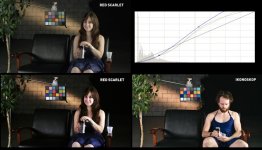
all.jpg

Edited in the GIMP from 8-bit screenshots of the Vimeo video by someone who doesn't completely know what he's doing. A professional colorist working from the original, higher-bit-depth files might attain closer proximity.
 
Last edited:
Back
Top