While shooting last concerts I had couple of moments when I couldn't do 3 things simultaneously - manual focusing, panning/tilting and zooming. And the only idea I have for now is to use this www.digipin13.hr/de/video/pare-panasonic-remote-detail remote controller (thank you for the link in this forum!). But still, how do people do it without it? Am I doing something wrong?

Navigation
Install the app
How to install the app on iOS
Follow along with the video below to see how to install our site as a web app on your home screen.
Note: This feature may not be available in some browsers.
More options
You are using an out of date browser. It may not display this or other websites correctly.
You should upgrade or use an alternative browser.
You should upgrade or use an alternative browser.
I need a third hand when using manual focusing and zoom
- Thread starter AlexLF
- Start date

NorBro
Major Contributor
They don't to all three...or it's very uncommon.
If there is a single camera operator who has no assistance then usually remotes like that are used with cameras that have parfocal lenses. You zoom in - focus - and then you're able to push out and push back in without worrying about manually focusing (if you of course stay in the same spot). And then that only leaves panning/tilting while zooming which comes with experience...you get better with time.
Sometimes there might be another person helping the camera operator by pulling focus depending on the camera/lens/production while the camera guy/gal just works on the movements and zooming. Rarely, you might find someone also controlling the zoom, but usually one person can zoom and pan/tilt (i.e. coverage of all sporting events in the world).
And now as AF advances and keeps getting better there may be a time in the future where it's completely relied on.
P.S. Some also work with cameras on their shoulder and use their fingers to control each ring independently if possible.
Last edited:
deltoidjohn
Veteran
Sounds like you need Lanc remote.
It attaches to your tripod pan handle and gives you a zoom rocker on the handle. Depending on the model you often also get controls for record start/stop, iris, & focus.
It attaches to your tripod pan handle and gives you a zoom rocker on the handle. Depending on the model you often also get controls for record start/stop, iris, & focus.

Larry Chapman
Well-known member
Thank you for the replies! Now I know what I wish for DVX300 - parfocal lens
So my options for now are remote or using auto focus. Thanks again!
Although the lens is not spec'ed as parfocal, in my experience, as long as you don't zoom too quickly it absolutely holds focus throughout the zoom range. I shoot many theater events and have success grabbing focus at full zoom (not i-zoom) then pulling back to a wide shot of the stage. During the performance, I do zoom in when appropriate (solo dancer, for example). Never had an issue. When you do grab focus, note the focus distance so you can reset, if needed, via the ring instead of using auto-focus.
"cameras that have parfocal lenses. You zoom in - focus - and then you're able to push out and push back in without worrying about manually focusing " Norbro's method described above is the norm. But some events such as sports requires pan/tilt/zoom/focus all at the same time, such as sports. Cameras needing this have two pan handles with zoom on the right handle and focus on the left handle. The big box lenses you see on TV cameras also have their own auto-focus that runs independent of the camera. It costs an f-stop to engage, but it's worth it.
Well, as we all know Panasonic do not use LANC. With the PaRe remote you can program 3 different focusplanes. Ie. foreground, mid, back. And with a press of the button the Cam exactly goes to the programmed focusplane. I do many dancing videos and with autofocus I run always into troubles because the Cam can not hold a dancer, suddenly it focus another dancer in the background (there are sometimes 16 dancers on the floor). So the programmable focusplanes help a lot. And the PaRe can be mounted either on one handle or on two handles (I use it in that way). So it easy to man focus lefthand and zoom righthand...

JPNola
Veteran
They don't to all three...or it's very uncommon.
P.S. Some also work with cameras on their shoulder and use their fingers to control each ring independently if possible.
That is what I do- use different fingers, on the same hand, to control each ring independently...
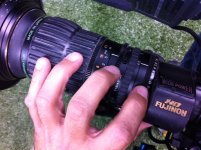
A parfocal lens makes things easier, no doubt, but the technique is also possible on lenses ( zooms ) that are not parfocal. With practice and experience it becomes relatively easy to master despite at times having to perform finger movements in opposite direction, simultaneously. Even with a parfocal zoom you end up "hunting" for focus since you cannot always pre-set the focus for an in-camera zoom or simple re-framing tighter / wider. Particularly if working at a fast pace as one would when shooting a concert.
I don't see why one needs any special add-ons to perform simultaneous zooming / focusing / iris-riding. Granted, the nature of the zoom you are using will either facilitate the technique or hinder the technique. It is easier with B4-type broadcast zooms than it is with EF zooms- the EF zooms and all still-photography originated lenses generally having a more stiff zoom ring and more stiff focus ring than the B4 zooms and thus being more difficult to manually zoom in and out using only one finger. On EF zooms my technique is to grip the zoom ring with forefinger and thumb ( forefinger on top of the lens, thumb underneath the lens ) and then ride focus with some combination of middle-finger, ring-finger, pinky finger. I ride the iris with the iris wheel on the RH grip of my Fs7.
The positioning pictured above is for performing manual focus. When on a servo zoom and needing the smooth control of the servo zoom motor, there is a technique where you operate the servo with two fingers, reaching over the lens to the servo rocker and at the same time riding iris with the thumb, riding focus with the pinky-finger...
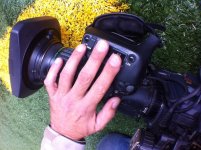
The common practice for ENG shooting is to control the zoom servo with the right hand, right-hand on the servo-grip of the lens, and then ride focus and iris with the left hand. 4 fingers on the zoom ring...thumb on the iris ring. In ENG shooting you are often- near always - riding the iris in-shot according to the need dictated by the scene you are shooting. Many dislike using zebra for exposure, but having the exposure indicator on your subject is advantageous. Your eye does not have to leave the subject to look at a histogram or other exposure indicator. The exposure tool is on your subject and when riding critical focus on a moving subject you do not have to momentarily take your eye off the subject to check exposure. You ride focus and exposure simultaneously, looking at the same thing on the screen: looking at your subject. Your subject is the exposure tool, so to speak.
One thing about use of a focus-puller Camera Assistant: If the scene is not blocked out in advance and there are no focus marks procured in advance, the focus-pulling assistant is pulling by eye and 'hunting' for focus same as a camera operator does sans any focus-pulling AC. There really isn't much advantage in such situations to having a person other than the operator pull focus. It can even be disadvantageous in that the the focus-pulling AC often does not know where the Camera Op is going next and as a result cannot anticipate the needed focus pull. But the Camera Op who is pulling focus themselves knows where they are going next and as a result can anticipate the focus pull that will be needed. Often, when nothing is blocked in advance, the focus-pulling AC is having to 'chase' the Camera Op and play catch-up to the moves performed by the Op. Better in such situations to just have the person performing the framing ( the Camera Operator ) also perform the focusing. An AC has the advantage of being able to see the distance marks on the lens, but distance marks on a lens are only of limited use. The AC is most times still going to perform critical focus by looking at a display. Lens markings don't get you to critical focus. Ever. Not even when perfectly calibrated. Lens markings are a general "in the ballpark" reference only. Focus marks- either on the lens or on a focus wheel- are different from lens markings and focus-marks can get you to critical focus. Although, in modern times, focus-puller AC's will still use a monitor for critical focus confidence checks. Prior to video-taps only the Camera Operator could know that critical focus had been achieved and it was for that reason that Camera Ops often pulled their own focus. Or, as I have witnessed myself in the past, the Camera Op would reach down and take over control of the focus from the 1st AC in order to achieve critical focus.
This is likely way more on the subject than anyone wanted...and as to the "how do they do it?" question, two things:
* a lens that is conducive to single-handed operation of multiple functions
* time in the saddle. ( experience ).
Use a zoom controller and that reduces the other hand to only focus and iris. With time in the saddle riding focus and iris simultaneously will become second-nature to you. Your experience shooting a concert caused you frustration. But keep in mind that concerts are one of the most difficult situations for riding exposure. You often have extreme exposure changes between a performer in a spot-light to audience in reflected light or to another performer who is comparatively in the shadows. A rhythm guitarist or drummer. The multi-camera productions of music concerts typically have an Engineer doing the exposure-riding or "shading" of the cameras. The Cam Ops are only framing, focusing, & zooming.
Last edited:
@JPNola
its great that you can do this with your fingers... I'm not, I'm not so scilled. I work with my remote and that's fine... But please, we talk about the DVX200...
@AlexLF
If you receive your PaRe, you will see it's the best remote availabe at the moment! Good Luck!
its great that you can do this with your fingers... I'm not, I'm not so scilled. I work with my remote and that's fine... But please, we talk about the DVX200...
@AlexLF
If you receive your PaRe, you will see it's the best remote availabe at the moment! Good Luck!