Other: I am no longer a Sony fanboi

The Alexa Mini does NOT have good audio because it has a lemo and line-level only input. You need a lot more than a custom cable to deal with that. It really kicked itself out of some possibilities because of that. It's WAY expensive as well.

A lemo based line input does not imply that the audio is not good. To save space, they used a small connector and left out the pre-amps. With external audio, line level is the way to go because the signal to noise ratio is FAR better. If you need an on-board mic use an external pre-amp. I would rather deal with that setup than have the camera be bigger (less mini) and have XLR, pre-amp, and 48v power. It gives the user the option of being as small as possible and you can always make the camera bigger by adding audio.
 
Not practical for pro shoots, not to mention something like the Amira has 4 tracks and full audio controls. To get that on the mini would require SLR-like franken rigging, more batteries, wires everywhere and so on.
 
Not practical for pro shoots.

Really? If the camera is aimed at a market in which a separate sound recordist will always be employed, then a simple high quality line-in sounds like a reasonable and calculated compromise to me - one would just need mixer tails with a compact and robust Lemo, rather than 2 or 4 x XLR and return.
 
Really? If the camera is aimed at a market in which a separate sound recordist will always be employed, then a simple high quality line-in sounds like a reasonable and calculated compromise to me - one would just need mixer tails with a compact and robust Lemo, rather than 2 or 4 x XLR and return.

Yeah, I kinda agree with this.

Most of the guys I know shooting C100's and C300's even use separate audio guys.

And as much as I hate my own Franken-Rig, I almost never see the big-guy cameras rigged-up any less. A friend of mine in Chicago shoots Dragon and I usually can't even find the camera under all the rigging.

I think time is going to bear out that the URSA Mini is a killer design configuration for even TWICE the price and that it will be Blackmagic's real blockbuster camera.
I think of every shoot I've ever done and with the exception of tiny stealth cameras the URSA Mini would have been a better tool in almost every case.
 
Not practical for pro shoots, not to mention something like the Amira has 4 tracks and full audio controls. To get that on the mini would require SLR-like franken rigging, more batteries, wires everywhere and so on.

Every film and TV show I have ever worked on for nearly 20 years never needed ENG features. I promise, they were all 'pro' shoots with many $millions at stake. if you are talking about 1 and 2 man band, run-and-gun work - the Alexa mini would be an odd choice.
 
Odd is king

It seems that Alexa family is the only camera that is 'right' IMHO. It works out of the box without needing accessories from 8 different manufactures. It is still heavy, big, and expensive but it is laid out more intelligently than other options. The 'Gackification' of modern cinema cameras is appalling. The goal is to interface with a creative human to capture images of our world. Many manufacturers have learned to capture the images, but have failed miserably interfacing with the people doing the work. I see so many owner/operators spend more time gacking the fiddly bits of the "rig" than actually honing their craft.

I honestly have not paid much attention to the BM cameras. The first few releases were so remarkably dismal from an industrial design perspective, I did not even care about the image coming out of it. I simply do not want to wrestle the camera on a daily basis. The Ursa mini is a huge improvement in industrial design and ergonomics. I still don't know if I would trust a company that has a foundation building the cheapest possible solutions. I am more than willing to pay for solid experience that you get with Sony, Panasonic, and ARRI. Since no camera is perfect, I will lean toward the most proven reliable system. After travelling the world shooting everything big and small - I don't want an experiment.

I will shoot with ARRI, Sony, and Panasonic with confidence there will not likely be surprises.

RED, Black Magic, and AJA are children in the camera world and I prefer not experience their learning curve.
 
RED, Black Magic, and AJA are children in the camera world and I prefer not experience their learning curve.

Kind of interesting side note: your nickname implies you trust a car company who started building cars about 80 years later than other companies and who's learning curve included believing in the success of the Wankel rotary engine...:beer:
 
Kind of interesting side note: your nickname implies you trust a car company who started building cars about 80 years later than other companies and who's learning curve included believing in the success of the Wankel rotary engine...:beer:

I never trusted Mazda much, my rotary powered cars had all sorts of quirks. They (RX-7's) were race cars and always needed diaper changes and bedtime stories. I enjoyed the the experiment because they were a hobby and I had other cars as daily drivers. Tons of fun, but would not want to travel far. The RX-8 was way better, but after 37 years Mazda learned a few things. The Wankel is super interesting, but ultimately too quirky to get very far commercially.

The other half of my nickname is because I am a pilot. That is an endeavor that requires life supporting reliability of man and machine. I would not want a rotary engine in my airplane. ;-)

So, I don't shy away from experiments. I just approach them safely to manage risk when life and career are at stake.
 
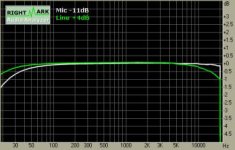
The graph shown here is the frequency response of my Sony EX1's mic preamp.

fr.jpg

I consider this acceptable audio for my usage. It is far superior to the audio preamps on the Atomos Shogun and just about every other camcorder I have tested.

If a camera goes to the expense of having full sized XLR connectors, the audio BETTER be good.

If the FS7 is as good as this, I'll buy it.
 
If a camera goes to the expense of having full sized XLR connectors, the audio BETTER be good.

If the FS7 is as good as this, I'll buy it.

By the time you finally talk yourself into trying it, it'll be an FS8 :kiss:

Why not take up that FS7 trial you were offered the other day by the New England dealer?

I'd be interested to know your findings, if you've got an RTA to assess the pre-amps.
 
I have a shop full of test equipment, but the graph I posted was generated with freeware, RMAA. I compared my shop tests with its results and both agree with half a dB, so the RMAA is accurate with a good sound card, or a CD player as the source.


Another good reason to have good on-camera audio.. you never know when you get to experience a Jazz cafe for audiophiles in Japan!
 
For your demanding audio requirements, I'd suggest you run sound separately. I do quite a lot of work with "Audio people" and I count myself as one of them. We've just got back from a 3 day job for BBC R&D - "Sound: Now & Next" with the great and good in audio from around Europe - manufacturers, academics and broadcasters. We shot the workshops on 4 x C300s, but ran audio on separate PA pre-fade stems into a Sound Developments multitrack mixer/recorder. I've done quite a few audio-focussed jobs, and we always have a broadcast sound engineer managing the live record and subsequent mix.

That way, there's no analogue path into the camera and potential for pre-amp degradation etc.
 
Running separate audio means I can't truck my gear in one trip from the parking garage to the venue.
Running separate audio means I need to hire an extra crew member.
Running separate audio means I must double my price to cover the additional gear, crew and hauling, not to mention the NLE headaches of synching and marrying it all together.

This is not necessary with the EX1 and EX3. If it's necessary with the FS7, I'll wait until a 4K camera with good audio comes on the market.

In 5 years, the FS7, used, could be had for about $2K. An affordable purchase. :)
 
Gotta say Blackmajic seems to be in for the long haul. Good price point, damn good quality and they finally have a camera you can handhold. Haven't done a side by side feature comparison but my main objection to the original URSA is it was big, boxy and only a flip out viewfinder, monitor really. And it was all touch screen driven. A pain in daylight.
Looks like they have curbed those obstacles.
But there will always be something else new out there. This is a tough business and tough to stay on the cutting edge.
 
In 5 years, the FS7, used, could be had for about $2K. An affordable purchase. :)

Perhaps. But the EX3 is over 5 years old, and they still go for $2500 to $4000, despite being a dedicated 1080p camera competing against 4k cameras. The FS7 is 4k internal with good high bit rate compressed recording, so it will fare well in the used market, I expect.
 
Running separate audio means I can't truck my gear in one trip from the parking garage to the venue.
Running separate audio means I need to hire an extra crew member.
Running separate audio means I must double my price to cover the additional gear, crew and hauling, not to mention the NLE headaches of synching and marrying it all together.

This is not necessary with the EX1 and EX3. If it's necessary with the FS7, I'll wait until a 4K camera with good audio comes on the market.

In 5 years, the FS7, used, could be had for about $2K. An affordable purchase. :)

Buy a clapboad, a fostex, mic stand, good mic and do your own audio it's not a big deal, I have done it that way many times.
 
James, I've seen a few EX1s going for $1900 on ebay.

Gary, when I shoot big budget concerts (100 piece symphony orchestra), I use separate audio. But let me tell you, it DOUBLES my editing set up time. And those tracks come in as 8 additional mono tracks. One of the reasons I use a 2.5K monitor for my GUI is that audio takes up 2/3 of my timeline.
I don't have the budget to deal with that on small jobs like recitals. And I often have to walk blocks with my A/V cart packed to the gills with cameras, SDI recorders, mics, stands and tripods. There isn't room for a laptop and a MOTU 896 and I don't want to deal with making a second trip while I leave the gear in the building unattended. It all fits in one Stanley rolling cart. And it's under 160lbs, which is all my injured back can dead lift from the pavement up onto the back of my SUV.

So how did you do it easier with a EX1 or EX3?
 
Back
Top