HPX250: HPX250 preps for upcoming national park shoot - interesting results

lonewolf2koc@hotmail.com

Well-known member
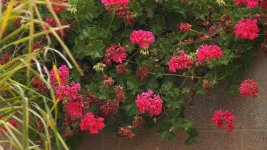
The national park trips will cost more than the HPX-250. Evaluating and prepping cameras prior to the big trips. Picked flowers w/ red color as a good stress test. No room for errors nor any reshoot. For interesting comparison between HPX250 & 3100. The HPX3100 is equipped w/ Fujinon HA22x7.3. Both cameras were set to as similar as possible. The purpose is to see what what are the limitations and certain type of scenes to avoid. I know that most long hikes I'll not be able to bring the 2/3" cam. HPX250 is the only viable cam for 5-10 mile hike on various trails. Last time I hiked to Arches National Park. Bringing a heavy 2/3" and tripod is physically draining and I prefer not to do it again.

1st attempt here is "baked" in the camera - meaning it's not intended for future grading. HPX 250's settings:
ND 1/16
f/5.6
AVC-I 100, 30pN
Detail Level: +2 / Vertical detail level: +3 / Detail Coring +1
Master ped: +24
Gamm: HD NORM
Knee: AUTO
MATRIX Cine-Like
Skin tone detail: OFF
V Dtail Freq: THIN
0 dB gain

HPX 3100:
AVC-I 100, 30pN
Factory color matrix B (R-G +24, R-B +09, G-R +03, G-B +14, B-R +05, B-G +18)
Color correction ON
R-Mg +50, Mg +08, Mg-B +0, B +0, B-Y +0, Cy -10, G +0, G-Y +0, Yl +19, Yl-R +34
Horiz Detail: 10
V. Detail: 15
H. Detail Freq: 18
Master Gamma: .45
Gamma: Film Like 2
-6 dB gain

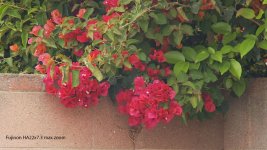
Fujinon HA22x7.3 w/ CAC file activated on HPX3100. f/8, zoomed 90% of 100%. This lens has a longer reach than HPX250's max zoom.

The results so far quite interesting. It appears that the HPX250 can't resolve the fine detail. I have shot interior shots and it was a bit better. Overall image is a bit muddy vs 2/3" camera. Shot between f/5.6 - 8 (HPX250's lens sweet spot). I will try to use Barry's Cine D, which is very flat and intended for future grading. This is similar to Film Rec Gamma on the Varicam. I may have to apply some sharpen filters to get it sharper and more punch to the image. Will know later down this week.

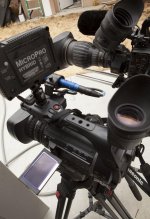
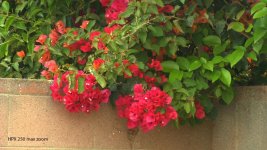
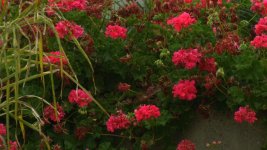
1st pict shown is the HPX-250's screen grab. It's a bit saturated and muddy overall. 2nd is the 2 cams behind scene setup. 3rd is the HPX3100's screen grab. All images are as-is. No color correction or any other post color trading applied. Direct AVC-Intra 100 export to JPEG at high quality.
 

Attachments

  • HPX250-HD-CineGamma-tweaked-f5.6.jpg
    HPX250-HD-CineGamma-tweaked-f5.6.jpg
    91.9 KB · Views: 0
  • HPX250-HPX3100shootOut1.jpg
    HPX250-HPX3100shootOut1.jpg
    66.5 KB · Views: 0
  • HPX3100-FujinonHA22x7.3maxZOOM2.jpg
    HPX3100-FujinonHA22x7.3maxZOOM2.jpg
    117.8 KB · Views: 0
I had to cancel a winter trip to Yellowstone alone because the permit fees to shoot cost more than a HPX250.
I talked to a guy a few weeks ago that was contacted by Yellowstone officials because they found his video on Vimeo and searched their records for a permit. It's gotten beyond stupid. I won't shoot in national parks any more.
 
It's one thing to require permits...keeps the park from getting spoiled by all manner of unprofessional productions. But to try to extort money from someone well after the fact? That's a poor showing.

Also, more than the cost of a HPX-250? That seems ridiculously steep.
 
The first picture's focus seems soft. I have shot alot of wide exteriors with my 250 and it doesn't look soft like that, it looks very sharp.. Is that the way it looks in the moving video as well?
 
Back in 2007 at Oahu, Hawaii, they were very picky about pro shooting at various point of interests. They all want some sort of location fees. At Zion, they didn't bother. I was approached by park rangers couple times in UT, but they led it slide because I was acting like a tourist. I thought film permit is needed only when there's a big crew w/ grip trucks, lights. etc. But w/ a one-man, low profile - come on. But the records search is pretty low. Do these feds have better things to do than bothering tax paying citizens. Things changed in 2012. OK, I understand that if you shoot and resell to major networks - it's reasonable for $500-$1K permit w/ a skeleton crew on federal property for several days. $4-8K for a permit? What are they thinking? But for personal and limited audience like the web, it's getting too much. Well, I'll go regardless of what they do. Probably the HPX250 along w/ a camouflage cover will pretty much be undetectable.
 
The 1st attempt was to see how can the HPX250's max zoom lens can perform. I triple check the focus by focus assist. In addition. making sure all the red are there. They're all there. Max zoom didn't perform well. Zoom lens tend to suffer at the max magnification. On higher quality lenses, it's very minimal and you need resolution test chart to evaluate. But on lower quality lens, HPX250 is no exception. I wish Panasonic publish its best focal and zoom ranges for critical shooters. I also afraid that under extreme contrasty situation, the HPX250 may have similar performance impact.

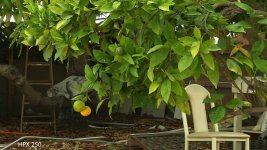
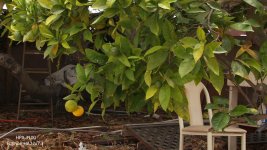
2nd test below zoom range is keep in the mid range.
The detail, v. detail, d. coring are all set to their max. I also increased the master ped to +28 fr +24.
All are set to factory 5.6K preset wb. HPX250 has a bit more greenish look on the default.

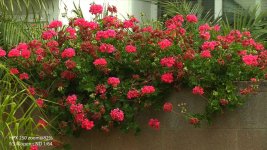
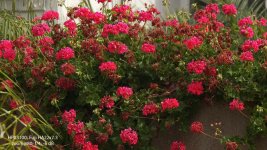
Here it's much better picture quality when the HPX 250 is set in shaded and evenly lit type of scene and it's not zoom all the way in - it's midway zoom of 56% to be exact. Unfortunately the footage shows a lot of annoying noise in the dark area of the scene (behind the wall - left chair area). This is due to detail coring boost all the way up. The HPX3100 is very quiet and has a different color rendition. It seems it can handle much more dynamic range at the bottom of the frame. You can see details in the leaves around the left ladder. There is no DRS on any of the cams. I can't use DRS in 1080p/30pN AVC-I mode w/ the HPX-250 anyway. I can increase the detail at the bottom by expose about 1-2 stops more, but this will over expose the top of the leaves.

In real life shooting, I can't afford to wait for magic hours to accommodate the HPX250's limitation. It's good to know for reference.
 

Attachments

  • HPX250-HD-CineGamma-ShadedTrees-f8.jpg
    HPX250-HD-CineGamma-ShadedTrees-f8.jpg
    108.2 KB · Views: 0
  • HPX3100-FujinonHA22x7.3-ShadedTree.jpg
    HPX3100-FujinonHA22x7.3-ShadedTree.jpg
    104.5 KB · Views: 0
Last edited:
Shot between f/5.6 - 8 (HPX250's lens sweet spot).

I have found f4 to be the best on my shots, but that is maybe something I just like.

I do agree about the Nation Parks, its not the same as being 1 person shooting some footage vrs a group shooting footage. After reading Kevins artical I only brought my still camera when I was out last summer. However now with the small 250 I think I could get away with the toursit look, I just need to find my Hawiian shirt i know its somewhere. . . .
 
I am very interested on your impressions of the HPX250 at the conclusion of your trip. On another note, some of our federal land agencies/managers have gone completely out of their mind. I won't shoot anything even for pleasure on NPS managed property. Each NPS park seems to have become both intensely restrictive and implemented inconsistent regulations. Fortunately in the southeast the Forest Service is acting like they have some sense and that's where I go. I carry a copy of their policy with me in case I am challenged (News, and gathering of news related stories, and other types of documentaries not requiring the use of actors, models, sets, or props do not require a permit). I classify myself as documenting the current state of nature.
 
Last edited:
Here's the final confirmation that focusing is sharp for both cameras by having another part of the scene reshot and w/ verified focus.

I can say that the HPX250's max zoom performance is pretty poor. It almost looks like a digital zoom of some sort.

The HA22x7.3 max zoom is trying its best. But the image is acceptable and not fuzzy. Notice that this lens can pickup atmospheric condition.
I mean it's scary. When it's hot, I can see heat waves in the clip. This is a perfect example of pickup fog just before it hits the red flowers
and the wall. The fog is toward the center of the image. This makes it very challenging to shoot any thing that has fog or moisture in the foreground
w/ the 2/3" lenses. Even a speck of dust on the front element can impact an image when zoom all the way out or in. Very sensitive to dust particles.

I will wait for a sunny, clear day to do more fun experiments.
 

Attachments

  • HPX250-HD-CineGamma-LeftWall-MaxZoom.jpg
    HPX250-HD-CineGamma-LeftWall-MaxZoom.jpg
    98.2 KB · Views: 0
  • HPX3100-FujinonHA22x7.3maxZoom-LeftWallRoses.jpg
    HPX3100-FujinonHA22x7.3maxZoom-LeftWallRoses.jpg
    107.2 KB · Views: 0
Shot between f/5.6 - 8 (HPX250's lens sweet spot).
No no no no no -- that's really bad for the HPX250! You can't stop the lens that far down, or the whole image will go soft due to diffraction. Forget anything you may have ever read or heard about this subject and follow what I'm saying here -- going to f/8 will result in blurry footage, period, end stop, absolute.

Never stop the lens down that far, ever. Keep it at f/2.8 or more open if you can. F/4 if you must. F/5.6 if you absolutely can't avoid it, but I would avoid it whenever possible. F4 or more open, always and forever, for any 1/3" full-raster HD video camera.

Note, this is not an HPX250 "problem", it's the laws of physics. Cram 1920x1080 pixels into a 1/3" chip, and diffraction will limit how far you can stop the lens down. You will start losing color resolution in the red channel as early as f/4.

Open that iris up and keep it open!
 
I took your suggestion and reshoot the same test scene at f/3.4 - open on the HPX250. It's sharper. Due to the lens f/stop limitations, I can't open it wider when zoom in at 82%. It's quite a challenge to keep everything under f/4 for optimal performance. Had to use faster shutter speed as an electronic ND filter in situation where there's no time to setup.

With less than a week of real world HPX-250 usage, it explains why all of the footage shot at night time and low light are sharp: They were mostly zoom out all the way f/open-2.8. It will take more practice and prep sessions to maximize the use of this cam.

In the 2/3" world, do you know what is the recommended f/stop setting for optimal sharpness? f/4 has too much shallow DOF. There are times when I need a large DOF to have everything sharp. f/5.6-8 seems to work fine on 2/3". I was able to get from f/1.9 - f/8 and it still looks very decent. That's subjective. But scientifically through the laws of diffraction, the precise f/stop will be helpful to keep in mind for any shoot.
 

Attachments

  • HPX250-HD-CineGamma-f3.4z82-Afternoon.jpg
    HPX250-HD-CineGamma-f3.4z82-Afternoon.jpg
    137.9 KB · Views: 0
  • HPX3100-FujiHA22x7.3_Afternoon-f4.jpg
    HPX3100-FujiHA22x7.3_Afternoon-f4.jpg
    131.3 KB · Views: 0
Last edited:
Can we talk about the national parks again? I went to the North Rim of the Grand Canyon the week it opened, around May 15th. My lovely wife made the reservations. I took a Canon Vixia HF21 and shot the sunrise. I'll post at some point. We were traveling light. There was a guy there the night before who had a RED set up from before sunset until after. I wish I would have talked to him. Speaking of the HPX250 and nature, Kevin Railsback comes to mind. http://filmmakingnaturally.com/
I emailed this link to Kevin today. I know he will like it. We sold them some of the original Hyperdeck Shuttles, all that we had left in stock. You will see pretty quick what they do with them. http://www.movingmurals.com/
 
I shoot national parks primary scenics with extensive use of ND grads, & color grads filters. Smooth pan left right, tilt up down, full servo zoom with ease in/out are critical. Wildlife is a specialized field. I don't have that kind of patience waiting for days to shoot the animal. It's just too costly. Have to make a living.

Getting close to a bear w/ a 22x lens is nerve wrecking. Probably some sort of full body camouflage is needed. A 42x lens is at a safe distant and easier to shoot plus tighter closeups can be obtained. Thinking of going to the zoo as a good litmus test to see if wildlife is something that I can really handle.

What I'm sensing is that it's getting harder and harder as years goes by. My moto is shoot as much as you can before it gets worse with these absurd rules and regulations from the gov't.
 
Just confirming the f4 stop. I have put a .8 ND filter on my 250, this has made it easier to keep to the ideal stop without constantly changing the camera NDs when shooting exteriors. I can no longer lift a my "real" 2/3" camera with a Fujinon HD lens (PMW-500) so the 250 has become a very good substitute and still exceeds the BBC HD broadcast standard. With careful shooting the 250 certainly does the job. The Red focus feature used in conjunction with the EVF in black and white mode has solved a few inconsistencies of obtaining accurate focus.
 
ND filters... Ah yes. Reminded me of the glory days of dSLR and Canon 5DM2s several years ago. The filters still have uses! Holy cow! ND .02 - 1.8 for their f/1.2 prime lenses on a bright sunny day.
 
Had to use faster shutter speed as an electronic ND filter in situation where there's no time to setup.
Don't forget you can also set it to -6dB of gain, which will make the images cleaner as well.

In the 2/3" world, do you know what is the recommended f/stop setting for optimal sharpness?
A 2/3" chip is 4x the size of a 1/3" chip, and with equal pixel count, that makes each pixel on the 2/3" chip 4x the size of the pixels on the 1/3" chip. Therefore diffraction is nowhere near such a worry. I haven't tested specifically for it, but I would guess that you should be able to go at least 2 f-stops further, so f/8 should be easily sharp, and f/11 is probably still good.
 
I read Part 2 of the HPX250 manual and found no -6 dB gain anywhere. I think you're referring to their 2/3" HPX 3K series cams. -6 dB served me quite well as I always use it for bright sunny day. It's extremely clean. From the 2/3" world, the results are very good even at f/11. f/16 is starting impair.

I'm reviewing HPX250 footage shot in low light conditions and found that they are not sharp naturally. Just earlier today I intentionally cranked up all of the detail, h.details, detail coring and it still has that softness look. But when ambient lighting improves, quality improves. The softness is reduced. It's still there, but not as obvious as when it's dark. Is this because of the diffraction issue and lens limitation? Probably the lens need to be open at f/1.0 to get the max light. But that isn't going to happen w/ this zoom lens.

Don't forget you can also set it to -6dB of gain, which will make the images cleaner as well.


A 2/3" chip is 4x the size of a 1/3" chip, and with equal pixel count, that makes each pixel on the 2/3" chip 4x the size of the pixels on the 1/3" chip. Therefore diffraction is nowhere near such a worry. I haven't tested specifically for it, but I would guess that you should be able to go at least 2 f-stops further, so f/8 should be easily sharp, and f/11 is probably still good.
 
Doh! You're right about the -6dB, I think that was on the HPX370, not the HPX250. They're otherwise extremely similar, so I thought the 370 had it as well... and now, just checking, the 370 goes to -3, not -6, so I missed it twice...

I find HPX250 footage to be very, very sharp. I don't know why you're having issues with it. Did you see Kevin Railsback's footage? It's pin-sharp...
 
Back
Top