HPX250: HPX250 or HPX170

fdooman

Well-known member
Hello Forum,

I have been using the HPX170 for almost two years and I love it. I'm trying to add the second camera, I came across HPX250. I was so close to place my order with B&H, but, I have noticed lots of negativity on 250, just by reading on forums and reviews.
For example:
1- CCD VS. CMOS
2- Audio issue with certain external mics
3- Focus issue, (not the same lens as 170, instead cheaper.)
4- Flashing green pattern.
5- Panning issue
I have noticed that, most of the high end cameras are still using CCD over CMOS. This leads me to believe the CMOS are not mature yet, or I maybe wrong.
Also, I have noticed on Panasonic website recording format on 170 as a 1080, not 1080i. I have check the setting on my 170, I don't see 1080, all I see is 1080i. Is there any new firmware that I'm not aware of?

I love this forum as always been a great place for advices. Any tips on this would be greatly appreciated.

Fred
 
Fred, I have shot with a HPX170 since 2009. My plan is to supplement it with a Panasonic GH2 or GH3 for macro and wide landscape shots in order to achieve a higher detail than the HPX170 can obtain. Since these will be static shots I don't think CMOS will present a problem. I too avoided the HPX250 for the reasons you stated above. I tried one out for a couple of hours and felt the lens quality/ control was not up to par. I was however attracted to the AVC-Intra100 codec and long reach of the lens. IMO Panasonic has not produced an excellent lens/zoom control for low end pro cameras since the DVC-30.

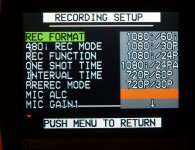
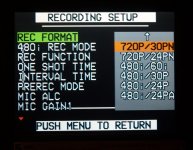
As far as recording setup is concerned, you should be able to shoot every rcording format in these screen shots from my camera. I usually shoot the following formats depending on the project 1080i/60i, 1080i/30p and 720p/60p. What may be a little confusing is 1080i/30p is actually interpreted as a progressive format.

recording setup 1.jpgrecording setup 2.jpg
 
Last edited:
I have been using the HPX170 for almost two years and I love it. I'm trying to add the second camera, I came across HPX250. I was so close to place my order with B&H, but, I have noticed lots of negativity on 250, just by reading on forums and reviews.
Like with anything, you'll hear far more complaints on forums than you ever will praise. People go on forums when they have a problem; it's pretty rare for someone to pop up and say "hey, guess what, I was on my thirtieth shoot with this camera and it still performs perfectly." So read the comprehensive reviews, but don't get too distracted by people raising questions, especially when they're questions that aren't related to actual issues but are more likely related to misunderstandings.

1- CCD VS. CMOS
Well, that is what it is. CMOS is a different technology from CCD. It has its pluses and it has its minuses. As compared to an HPX170, the pluses are a substantially sharper picture and a way, way cleaner image -- a lot "smoother" texture. The disadvantages to CMOS as compared to CCD are primarily in image skew and flash banding. However, the HPX250 has pretty minimal skew, and it has a "flash banding compensation" feature to overcome that issue, so ... as far as CMOS camcorders go, the HPX250 is one of the best.

2- Audio issue with certain external mics
See, I don't know about that. I know I've used the HPX250 with the same mics I've used on my AF100, HVX200, HPX170 and DVX100, and encountered no problems at all. My mics are a little older (Sennheiser 416, Oktava MK102, Tram and Countryman lavs) so maybe people are encountering issues with newer mics, I don't know. But a simple level match and a pad should solve any overdriving issues.

3- Focus issue, (not the same lens as 170, instead cheaper.)
Well, depends on what you mean by "focus issue". The lens on the 250 is a great lens, huge range, sharp, the focus ring is as precise as it was on the prior cams, no problems at all in that aspect, and it has focus-in-red and expanded focus assist. But it doesn't autofocus as fast or lock in as solidly as the HPX170 did. That's just part and parcel of the design, it's 50% longer and has chips that are 4x sharper, so the demands of autofocus are a lot more stringent and there's a lot more glass to shovel around at high speed. It does okay with autofocus, but I wouldn't try using autofocus in a low-light environment at 24p, that would be asking for trouble from any camera.

4- Flashing green pattern.
That, as far as I know, was a hardware issue with one guy's camera. And any camera can have a problem, so that's a non-issue as far as the HPX250 overall.

5- Panning issue
Don't know what that refers to, there is no panning issue with the HPX250.

I have noticed that, most of the high end cameras are still using CCD over CMOS. This leads me to believe the CMOS are not mature yet, or I maybe wrong.
Depends on what you mean by a high-end camera. Most 2/3" broadcast cameras are still CCD, yes. But small-chip cameras have pretty much all migrated to CMOS; I can't think of a current model or recently-introduced model from any manufacturer, 1/2" or smaller, that's using CCD anymore. The HMC150 is a legacy CCD model, and I'm glad it's there for those who need CCD, but Panasonic hasn't introduced a new CCD model smaller than 2/3" in 4 years, and Sony hasn't introduced one in, I think, five or six years, and JVC's recent models are all CMOS, and Canon hasn't introduced a new CCD model since ... well, since the XHA1, that was, I think, 2006?

As for the other "high end", single-chip cameras, they're almost all CMOS now. The Red One/Scarlet/Epic, the Alexa, the new BlackMagic Cinema Camera, they're pretty much all CMOS. A couple of notable exceptions are the new Aaton Digital Penelope and the Ikonoskop, but that's about it.

Also, I have noticed on Panasonic website recording format on 170 as a 1080, not 1080i. I have check the setting on my 170, I don't see 1080, all I see is 1080i. Is there any new firmware that I'm not aware of?
The HPX170 records all 1080 within a 1080i container, but it's capable of imaging 1080/24p or 1080/30p. It just gets recorded in that interlaced container, and can be extracted from that and restored to its full progressive nature by any modern NLE.
 
Thank you Mark and thank you Berry, very well and fair explained. This is what make a DVXuser a special place. As for the negativity I mentioned on this post, there are lots of positive items as well. Therefore, these kind of researches, makes it more easy to to make a best and correct choices based on the type of shoot.

Fred
 
Ever since the 250 showed up at my door the only time I dust of the 170 is when I'm shooting footage of me using the 250.

I think a lot of it comes down to what you're going to use it for. For talking heads, the 170 is fine. But for me shooting a field of tallgrass prairie flowers, the 240 resolves them better where the 170 kind of blurs them together.
If you don't need the extra reach of the lens, the extra resolving power of AVC-Intra then go with the 170. With the addition of Focus in Red and Turbo Focus the 250 has only improved.
 
Fred,

I had the same worries about the 250 as you do. I read up until I had to make a decession, then I made alist of what I needed vrs what I wanted and price. I went with the 250 in the end, and every time I use it I like it more and more. With your list 1-5 I have had no issues, however if you read the threads you would think this camera had all sorts of issues. I am very pleased with my purchase, yes there will always be a newer better model in time. However at some point everyones has to just jump in go with it (water is not as cold as you may think:) just part of the video business.
 
Love the HPX. I've also had no mic issues, no focus issues (I can see where it loses focus on macro zooms, but the focus distance indicator turns white when you're in a macro setting so you know when you can focus parfocally), no rolling shutter problems, and I'm quite happy with the unit. It's a rugged and versatile camera at a really great price with a fantastic lens.
 
I celebrate having a 250. 5 year warranty for peace of mind. Foibles are no worse than other cameras. Using it is a pleasure. Keeping the aperture at around f4 and using a bit of zoom gives nice shallow depth of field so do not use A101 as much now. AVC Intra codec quality gives peace of mind for broadcast use/clip sales. USB download to hard drive backup from camera without a computer is a great feature. In all for the money I don't think it can be beaten at the moment even more so if the yet to come Micro P2 cards are sensibly priced. Finally the quality of the pictures says it all.
 
The HPX250 so far is the closest B-cam match to any of the higher end 2/3" HPX3K series camera that I've used. It is not the same league to 2/3" by any stretch of reality, but the color matrix and overall look is similar enough to fool most people. New sharper LCOS flip out viewfinder, true SMPTE tc are two big features that a must have for serious productions. The current price of $4.5K is quite a bargain (used to be $6.5K in 2011 - odd how Panasonic raised 2/3" cam price but lowered 1/3" cam), considering how much more expensive 2/3" cam is. An example is the VF21G viewfinder on a typical 2/3" alone costs almost the same as the HPX250! In my line of business, there's no such thing as 1 cam fit all. I have a variety of cams to get the shot. The 250 is being used often. But in no way it can replace 2/3" cams in terms of absolute highest picture quality and lens flexibility (super wide angle-super telephoto), but a very good complement to the production.

I will be shooting various car mount POV shots w/ HPX250 soon. So far the jello or fast pan problem is not a big problem w/ this cam. It will be there, but much fewer than any lousy h.264 crippled codec dslr such as the Canon 5D, 7D. The CCD and CMOS is a taste. Kind of like analog tape vs super clean digital recording. I still prefer 2/3" CCDs on non-large sensor class of camera. It has that rich rendition, rich texure look to it. Coupled w/ a high end broadcast EFP lens, it's a formidable combination for those who needs the best possible picture quality.

I have the one and only blue Schoeps CMIT-5U and mounted on the HPX250. No distortion heard so far. All levels set to factory. The much cheaper Rode NTG-2 is pretty good also. Unfortunately I don't use the Rode NTG-2 mic often unless I take it out to harsh environment and leave the CMIT5U at home. Shotgun mic is also a personal taste thing. I simply like the accurate and crispness sound that the Schoeps deliver. It has been a pleasure listening to the recorded sound that I forget about the HPX250's 1/3" CMOS image deficiencies.
 
Last edited:
Like with anything, you'll hear far more complaints on forums than you ever will praise. People go on forums when they have a problem; it's pretty rare for someone to pop up and say "hey, guess what, I was on my thirtieth shoot with this camera and it still performs perfectly." So read the comprehensive reviews, but don't get too distracted by people raising questions, especially when they're questions that aren't related to actual issues but are more likely related to misunderstandings.

have been using the HPX250ej since Feb.

I'll give you guys my positives with the 250 compared to the other two HPX cams I've used:

Long lens compared to 171e
improved picture quality over 171e especially in low light (due to HD imager?)
ability to shoot AVC-intra (full-raster & 10-bit colour depth)
improved LCD screen over 171e AND 2100e
improved viewfinder over the 171e
focus in red
expanded focus
auto audio (for cam mic on ch2 !)
I think it feels easier to turn audio pots - could just be me
selectable audio out on headphone jack (171e had no options)
same 72mm lens diameter as 171e (so i can still use my Tiffens)
same batteries as 171e and portable P2 player/recorder
171e rear zoom controller is compatible with 250
shutter dial allows easier access to shutter speed adjustment and has lock button
5 User buttons
HDMI out
I can change IOS without opening the LCD screen
Displays colour temp when white balancing (171e said "OK")
Flash Band Compensation

There's probably more but just can't remember right now.

ajh
 
The positives are what it is all about. If there are negatives that don't suit then it is simple-buy something else. The price of the 250 with its features and picture quality made it a no brainer for me. I have an AF101 that has been useful on many projects, it is not the sharpest camera on the block but for web work is about to pay for itself in one go - again! All these cameras allow us to make good money and so depreciation is not a major factor in their purchase.
 
I work at Sony so I get a really good discount on cameras. I had an HPX170 for a film I had been making. I loved it but I had to take a year off for family medical reasons. Now that I am back, I am looking forward to buying a 250 soon to finish the film.

The new features only add to this choice. No-brainer.

Brian
 
I concur with all of the above. I bought my 250 when they first came out and I haven't looked back since. A great camera with a beautifully sharp picture and the ability to use gain with no "grain" is also wonderful. Works with all of my microphones Rode NTG2, Sony wireless lavs, Seinheisser handhelds. Just a great all around camera.
 
I'm thinking of replacing my 170 with a 250 as well. I'm just a hobbyist filming mainly wildlife for my own enjoyment, so I'm a bit limited with how much I can justify spending. I really love my 170, but being confined to filming from within a vehicle and only on designated roads, means a good zoom is very important. (I film mainly in South African National Parks, Kruger, Kgalagadi etc). I've been using a 1.4 converter which is fairly adequate, but still have the disadvantage of swapping it on and off for wide or close shots.

I shoot mainly on 720pn for economy of space, and also do a lot on 50fps for birds. The pre-record function is great, particularly when waiting for an animal to react to developing situation, but am I correct in saying that it only works in 25fps, so cant be used in slo mo?

I'm not a technical expert so I could be missing something here. If I am right does the 250 have the same limitation.

A few points that appeal on the 250:

22 x zoom
AVC Intra
Better quality video
Good pricing
P2 cards
Ability to swich OIS without opening the LCD display

It would be fantastic to have higher frame rates. Slo mo is so important with wildlife. This is where the Sony FS700 sounds great, but it's out of my price range and I dont like AVCHD, but maybe that's just because I dont know enough about it.

Any liklyhood that Panasonic might improve the 250 with higher frame rates to counter the FS700?

If anyone has any ideas on what other camera might be suitable I would appreciate it.
 
I'm just a hobbyist filming mainly wildlife for my own enjoyment, so I'm a bit limited with how much I can justify spending.

That's exactly where I'm at. I mainly shoot wildlife in northern Australia. I've been looking for something that I consider good enough for a couple of years, but everything under about $40K has had too many negatives. I've currently settled for a slightly modified consumer camera, but the ergonomics are driving me crazy, especially coming from using pro cameras many years ago. The picture quality is actually not all that horrible under optimum conditions, all things considered.

I've been using a 1.4 converter which is fairly adequate, but still have the disadvantage of swapping it on and off for wide or close shots.

You also lose some sharpness and it exaggerates any chromatic aberration and flaring in the main lens, no matter how good the quality of the convertor is.

also do a lot on 50fps for birds.

I shoot everything in 50p and edit on a 25p timeline. I often slow shots to 50% and still get smooth motion. 1080p50 is a non-negotiable requirement for me, which is the only reason I don't currently own a HPX250.

The pre-record function is great, particularly when waiting for an animal to react to developing situation, but am I correct in saying that it only works in 25fps, so cant be used in slo mo?

That is correct. VFR disables a lot of the special record functions like interval recording and pre-record.

It would be fantastic to have higher frame rates. Slo mo is so important with wildlife.

Absolutely. For me, 1080p50/60 is a requirement. I'll put up with what I have otherwise.

This is where the Sony FS700 sounds great, but it's out of my price range

It is a more than I'm comfortable spending, but for me the main issue is that it wouldn't be quick enough to use and would cause lost shots. We both know how fast things can change when shooting wildlife.

and I dont like AVCHD, but maybe that's just because I dont know enough about it.

I would much rather use a higher bit rate 4:2:2, but in practice I haven't had too many major issues with AVCHD at 28Mbs/1080p50. I feel AVCIntra is better than the source signal from the camera head on the HPX250, especially in less than ideal conditions.

Any liklyhood that Panasonic might improve the 250 with higher frame rates to counter the FS700?

Almost certainly not. The processor in the HPX250 can not handle the data throughput, but it's mainly an issue of sticking to format specifications. AVCIntra does not specify anything above 30fps in 1080p. The new AVCUltra does, but I can not see that being added to the HPX250. Too large a jump in technical requirements.

If anyone has any ideas on what other camera might be suitable I would appreciate it.

The one I have my eye on is the new HM600 from JVC. Unfortunately, it doesn't do 1080p50/60. There are so many people requesting it that I'm sure JVC will add it if the processor is capable, but the early reports from JVC seem to indicate it isn't.
 
Back
Top