How the F35 Camera Dock Communicates - Unlocking the Missing Features

Not five minutes ago I was able to push content generated by my laptop to the Sony F35 LCD and assistant panel LCD. For my initial test, I sent User Bits. I've been able to send some simple commands to the camera or SRW1 deck for about a day, but this is the first visual feedback.

Progress!
 
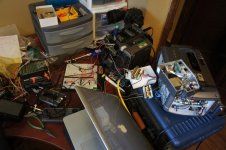
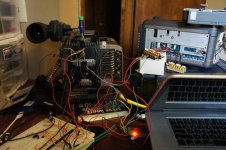
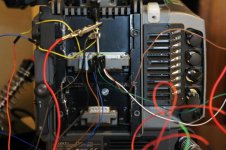
We're having an enlightening conversation about responsible handling of expensive electronics in one of the other F35 threads, so I thought I'd share what my workstation and rig look like right now...
DSC00983.jpg
DSC00984.jpg
DSC00985.jpg
 
I Love it. What is your day profession? You seem to have the best understanding of how the F35 talks inside.
 
I Love it. What is your day profession? You seem to have the best understanding of how the F35 talks inside.

DP/Cinematographer/Videographer/Field Producer...

I just love the F35, and am very annoyed that there are no tapeless recorders that can be docked like VTR units. If I could have paid for the solution, I would have. But since no one else was going to do it...
 
am very annoyed that there are no tapeless recorders that can be docked like VTR units.

The Codex Onboard Digital Recorder
The Panavision SSR-1 (although you can't buy that)
And the S.Two OB-1 (although I don't know if it interfaces properly)

Sony obviously intended to sort this out with the SR-R3, but there will be a reason they didn't do it (not enough of a market).
 
The Codex Onboard Digital Recorder
The Panavision SSR-1 (although you can't buy that)
And the S.Two OB-1 (although I don't know if it interfaces properly)

Sony obviously intended to sort this out with the SR-R3, but there will be a reason they didn't do it (not enough of a market).

You know, I spoke too quickly, and phrased it poorly, as I do know about those recorders.

What I meant to say is that there are not affordable, compact, modern tapeless recorders to use as VTRs. The Codex is hideously expensive unless you find an amazing deal, and the same is true of the OB1. They also both have fairly expensive media and bulky ingest decks/readers.

The SR-R3 was never sold. The SR-R1 is close and may share a number of circuit boards, but lacks the dock interface at a minimum.

I think the research I'm doing will permit me to modify the SR-R1 to behave much like the SR-R3 would have. It should also permit use with things like the Atomos Samurai, hyperdeck, etc under at least some conditions.

It should be easier, cheaper, and lighter to run this camera than it was with the SRW1, Codex or OB1. We should be able to use the compact recorders of today.

That's my thinking.
 
The OB-1 and Codex can both be had relatively cheaply, its their docking stations which are expensive.

The ALEXA XT rendered a lot of Codex recorders redundant overnight.

I was always a bit peeved at Sony with the SR-R1, I remember seeing it shown docked to an F900 and it looked a lot more integrated than it really is.

This lack of camera-recorder communication is one of my motivators to going to the F65. Sadly most people that ever used an F35 back in the day don't realise you don't need the tape deck on there to make it work.

Very interested in your progress for sure!
 
The OB-1 and Codex can both be had relatively cheaply, its their docking stations which are expensive.

The ALEXA XT rendered a lot of Codex recorders redundant overnight.

Relatively cheap is, well, relative.

The Codex also is a somewhat piecemeal system, and there are license fees for the various options, so even if you get the hardware, you still need the license for all the features.

And the media is ridiculously expensive. And the docking stations are from a whole different era and the cost is insane and they're big and bulky hassles.

The recorders themselves are also not exactly small.

In today's age, something as stripped down as the Hyperdeck should be able to work with the F35. Or something else compact... Ki Pro Mini, Atomos Samurai, the like.
 
So, some things I've learned:
- When you do a VTR record, the camera does a CRC check of the returned video feed. If it doesn't match, the tally lights go crazy and the viewfinder warns you of the error. The design is an annoyance for my work now, but really smart engineering - it verifies the recorder received the right image.
- The SRW1 with option boards can't record a 1080 50p/59.94p stream as 50p/59.94p... not an option. It will only record it for slower playback 23.98/25/29.97. So contrary to a prior post of mine, there's no way you'll have trapped RGB 60p footage you can't play out of the deck.
- The SRW1 does full playback to the camera, and it can be sent to the viewfinder and monitor out ports (mind you, the playout will be 422 even if recording was 444). I think this means camera LUTs get applied as well on the playback.
-The SRW1 has two different serial communication protocols over the same wires. The camera only responds to one of them, but the other one has a crazy detailed level of information feedback.
-Timing matters. Frame packets from the recorder to the camera have to arrive at the right interval spacing or the camera won't output video signals, best as I can tell. This is causing me some frustration coding on my laptop, as precise intervals on PC/Mac are difficult. Actually easier on embedded microcontrollers with specific clock rates.
- Any recorder for use as VTR with the F35 will need to have an output SDI signal that can be looped back to the camera, or the CRC check will fail.
-I'm not confident the Atomos Samurai will respond to the F35 monitor out record trigger.
 
Is output delay an issue too for the SDI loop? I gather it is possible a few frames delay could make the camera think there are issues?
 
Is output delay an issue too for the SDI loop? I gather it is possible a few frames delay could make the camera think there are issues?

My best guess is that it's expecting a single frame of delay. Testing this authoritatively may be difficult with the equipment I have on hand.

It's a guess based on certain deductions, but I'm not proof positive yet. What I can say is this - the camera clearly generates a CRC of each video frame output over the recorder link, holds that value in memory, and tests it against returning frames. Since the CRC is going to change every frame (unless you're shooting a test pattern like bars) it's going to have a very precise delay. Mind you, it's possible the recorder has a way of telling the camera what delay to expect, but I haven't been able to demonstrate such a feature yet.
 
It's all this behind the scenes stuff i guess which explains how these things wind up being $100,000+.
 
As of this afternoon I've successfully emulated the VTR frame packets to the camera's satisfaction - enough that dock released the video signals.

I also think I've identified the camera record trigger, and will be seeing about testing record emulation here shortly.


Interestingly enough, I finally ran across a feature that behaved like a pure security feature, as I can't fathom any other reason for it to exist. Essentially, the camera generates two bytes of data, and unless the recorder provides the correct one byte response, the camera won't unlock the video streams. And the question bytes change every few seconds. As soon as a correct answer is given, the camera doesn't ask again until it's shut off and turned back on. It's a bit confounding, really. And I haven't so much figured out what the algorithm is, as that I've just provided a brute force answer, that sometimes take 10seconds to lock, and sometimes 3 minutes. It's a bit weird, and it is possible I'm misunderstanding the purpose.
 
So, I can verify that the Atomos Samurai accepts the F35 monitor port SDI record trigger. It will take it for start and stop. It's probably the same SDI flag as used with the Sony F3. In the Samurai menu just select the "Sony HD-SDI" record trigger. This means it's likely compatible with all recorder products that accept the Sony PMW-F3 HD-SDI record trigger.

The catch is this: The camera refuses to send this trigger unless a VTR is attached. That said, I nearly have my emulation protocol to a sufficient stage to reliably allow for this behavior.
 
Also, in a separate test, the SDI loopthrough on the Samurai is acceptable to the F35 dock as a return feed for the CRC check. Mind you, this was tested at 422 23.98, and obviously the Samurai doesn't support 444, but in terms of timing, the loop back seems to be accepted.
 
Also, in a separate test, the SDI loopthrough on the Samurai is acceptable to the F35 dock as a return feed for the CRC check. Mind you, this was tested at 422 23.98, and obviously the Samurai doesn't support 444, but in terms of timing, the loop back seems to be accepted.


So what would we need to do then to enable this by non computer geniuses like you?
 
So what would we need to do then to enable this by non computer geniuses like you?

Essentially, the protocol I've reverse engineered needs to implemented in code on some sort of micro controller or miniature computing board. I have to do this before even I can use this the field. Potentially, this can be programmed a freely available board like the Mini-32, Rasberry Pi, Arduino, BeagleBoard, or similar. Many of these boards are available for purchase under $100 USD, some under $50 USD. I have to read specs carefully to verify compatibility before proceeding to coding. I happen to own a PIC32 development board, so I'm inclined to explore that route first.

So, the emulation board itself is $100 or less I expect.

That said, you will have to have a dock connector. Given that it seems to be a proprietary Sony design, it does not seem cost effective to try and make a new one. I suggest simply using the same Sony one used in the SRW-1. It's the CN-2429 board, current part #A-1056-864-A, and Sony sells it as a replacement SRW1 part for a little under $300. This board has quad link outputs, and dual link returns - so enabling quad-link output from a single dock port is possible with this approach, if still a bit arduous, considering you must still provide the dual link playback return.

The next component is cables. These will vary a bit depending on your desired implementation. The dock port outputs video signals, power, and data signals. You'll have to route these. This cost is a bit hard to estimate this early, but if you can do basic wire stripping and crimping, likely in the range of $100.

Finally - you'll need a housing. The simplist thing would be to re-use the IF box housing, but then you lose the ability to switch to the IF box in it's original capacity.

If not, you'll need some sort of rigid project box to house your creation. To dock it you should get Sony's dock port piece for the IF Box, which they sell as a replacement part for about $110 USD.

Also, if you're really trying to integrate your recorder, more complicated custom housings are possible.

So this is quite the endeavor, with physical components easily costing $700+ if you don't own any parts yet. For someone with a parts graveyard and an industrious mind, it might be much lower.

And then there is the software and protocol side. While it's not really my intention to become a manufacturer, I have spent a considerable amount of time and money in reseaching and coding this project. I may look for a way to recoup some of my costs before making the code freely available.

I realize for some of you this is unwieldy. And I did have a somewhat separate notion of perhaps renting out the resulting recorder units, once completed. Imagine if you had a big shoot coming and could rent a hyperdeck that was integrated to the camera. Or an SR-R1, with it's 12bit RGB 444 and 50p 422.
 
So, as of today, testing with the laptop I can reliably boot the camera with my emulation VTR software, and convince it that an acceptable VTR is attached.

Current features:
- Camera outputs dock unregulated 12v power - please note due to design, this only works when supplying power from the 8pin Lemo DC in. If the camera is powered on CA power, it will not power the dock. Ever. This was intended as safety feature, due to the high draw of the SRW1-VTR.
- Camera outputs dock video. Authoritatively only tested single-link SDI, but dual and quad link should be possible as well.
- Record button on camera works. Requires a loop-back SDI signal for CRC verification. Works for start and stop.
- Tally light works (optional). This includes: LED indicator next to button on cam and assistant panel, VF internal indicator, VF external tally, rear tally.
- The monitor port SDI trigger works (when enabled in camera menus), Atomos Samurai accepts it, likely same "Sony" trigger as on PMW-F3.
- Camera can display the playback signal from the recorder, when menu is set to "PB" for VF/monitor.
- Camera outputs the current Select FPS setting. Unfortunately, utilizing this information might be complicated. Only sends the rate, not which specific frames are "real". That said, I think there is a seperate frame pulse that indicates which frame is "real". Even so, I don't know of a recorder on the market that allows for frame by frame triggering. Correct me if you know better.
- Camera can send it's video format and select FPS settings to the emulator.
- Emulator can push new video format and select FPS settings to the camera.
EDIT: When recording is enabled, fan automatically goes to minimum. It returns to it's set level when recording ends.
EDIT: To be clear, the vtr emulation can push the recording state to the camera. So ultimately, wherever you push record or stop, it gets fed to the other end.

The camera will accept and display the following if sent by VTR emulator:
- Media minutes remaining
- Can display one of the following at any given time: timecode, userbits, ctl timer
- tally light (not hard tied to recording - can be triggered independently)
- Generic "VTR Warning" (if the emulator knows something is wrong, it could be programmed to push this)


Also, to clarify for everyone - this entire project makes zero modifications to the camera body. The finished product I'm envisioning would dock to *any* F35 with current firmware (2.12, likely backwards compatible, but I can't test or promise EDIT: based on Sony documents, likely compatible with F35 v1.3 firmware or higher.) and make the camera behave as if a proper authorized VTR was attached for the duration it is docked. Once undocked, you're back where you started - no mods, etc.

EDIT: In theory this stuff will work on the F23 as well.
 
Last edited:
Back
Top