FS7: How is FS7 for low light?

What's a "Speed Ramp?
Seems to me your questions has been answered by a number of people including me who have compared the FS7 to other cameras.
 
I'd be interested to test the FS7's native sensitivity. Sony claim 2000 ISO for the F5 (which shares its sensor) but the F5 only hit's its rated middle grey value of 32 IRE when exposed at 1000 ISO. So I imagine the FS7 is probably the same. You can certainly get away with rating the camera at 2000 ISO without an outrageous noise penalty, but it certainly doesn't appear to be the 'native' sensitivity of the sensor.

1000 ISO is still the highest native ISO of any pro camera short of the new Varicam's dual-native 5000 ISO base. But it's only a 3rd of a stop faster than an Alexa, Red Epic or F65.
 
I am not allowed extra lighting for the poor/low light I shoot in.
That is why I currently use an A7s at 6400 ISO

My guess is that the FS7 would have to shoot at ISO 8000 in the same light with it's crop sensor.
Are there any ungraded samples at ISO 8000?
 
Could you explain? This doesn't make any sense. ISO isn't tied to sensor size.

You are correct, except that a larger Sensor can collect more light especially if it has the same megapixels.
Also a crop Sensor typically uses a crop lens with smaller glass, which is why the SpeedBooster was developed.

I did find a Video shot by Andrew Reid at ISO 8000 with the FS7.
It showed the deficiencies at 120 and 150 fps.
I would like to see one shot at 4k, 1080P30 and 60 fps using ISO 8000 in really low light.
 
Last edited:
You are correct, except that a larger Sensor can collect more light especially if it has the same megapixels.
Also a crop Sensor typically uses a crop lens with smaller glass, which is why the SpeedBooster was developed.

It's the same light per pixel whether the camera is in crop mode or full mode.
 
Also a crop Sensor typically uses a crop lens with smaller glass, which is why the SpeedBooster was developed.

Focal reducers (ie SpeedBooster) were originally designed for use with telescopes. Also, the image circle created by a lens is irrelevant to its speed and irrelevant to its size. Have you used a Panavision lens?

I did find a Video shot by Andrew Reid

That will be your first mistake...
 
You are correct, except that a larger Sensor can collect more light especially if it has the same megapixels.
Also a crop Sensor typically uses a crop lens with smaller glass, which is why the SpeedBooster was developed.

I did find a Video shot by Andrew Reid at ISO 8000 with the FS7.
It showed the deficiencies at 120 and 150 fps.
I would like to see one shot at 4k, 1080P30 and 60 fps using ISO 8000 in really low light.

I wouldn't listen to Andrew Reid for much of anything. If your shooting with zero light and overcranked your setting yourself up massive image issues on any camera. Short of new Varicam no camera is capable of clean images under those settings.

Focal reducers concentrate the light to a smaller sensor but light is light and a stop is a stop. F2.8 on FF camera and F2.8 on crop sensor receives the same amount of light to the pixel. What differs is DOF and FOV.
 
It's the same light per pixel whether the camera is in crop mode or full mode.

I believe he's referring to the photons per photo site. A 12mp full frame sensor will collect more photons per site (pixel) than a 12mp crop sensor. That's why full frame sensors have always outperformed crop sensors in low light in the photography world (when comparing similar mp size).
 
I was testing the firmware 3.0 noise suppression on my FS7 last night, and it does help in high ISO situations, but I continue to notice another peculiar anomaly and that is, as I close down the aperture of the lens, the picture goes from clean to noisy. But if there is a small area of high brightness, the dark areas remain clean. It seems as if there is automatic gain control on the sensor that cranks up the gain and with it, the noise, as the overall light level hitting the sensor decreases. This anomaly doesn't appear as long as some portion of the sensor is receiving much more light than the surrounding area.

If shooting a night sky full of stars, noise is apparent, but if shooting the moon, the noise is much less apparent at the same ISO. The lack of something bright seems to trigger a gain boosting effect that increases noise. I don't see how that can be, as I don't see the overall picture brightness increase in the absence of a small area of brighter illumination, but the noise floor alone increases. I haven't come up with a sensible theory for why that happens.
 
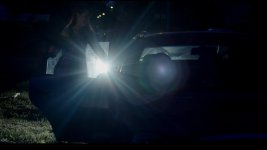
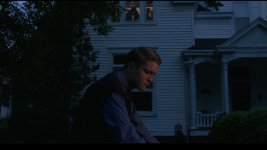
I shoot narrative so use lights 90% of the time, but in the world of micro budget films there is always the scene or two where there is no time or inadequate equipment. Both of these shots are in that category- they were shot well after sunset. In the shot in front of the house , we had one light on the boy on the bike, nothing else. On the backlit shot of the girl getting in the car, we had no light other than that coming at the camera. I saw the footage projected on a 40 foot screen and saw no appreciable noise in the dark areas at all. Had I been shooting with my old HVX, the footage would have been unusable.

These were shot In CineEI Slog3 at 2000 iSO with an F1.8 lens.
lens flare.jpg
bicycle.jpg
 
Those images look pretty clean downscaled like that. And a fairly fast lens helps. I like to use f/.95 for these night scenes as it enables me to shoot at ISO 500 under these conditions. The bright light in the first scene is what I'm talking about--it seems to keep the sensor from upping the gain and bringing in visible noise. I can't tell if there's a lot of noise from these small downsampled images, but the bottom one certainly appears clean at one eighth size.
 
Back
Top