

Patryk_Rebisz
Veteran
A few days ago i wrapped a big one-night shoot for a PSA for Dept of Transportation in New York City. Unlike the previous spot i shot for them that was seen by millions of New Yorkers (and tourists) in cabs and on digital billboards - this one was WAY more complex and technically challenging. So i feel sharing the experience and the approach will help some people here on their own large productions.
Fundamental problems we were facing is that we had to shoot a lot (12 camera set-ups) in a very finite amount of time (9pm to 5am - dictated by available night). On top of that, since we had a child actor we could only film with the child until midnight. Add to the fact that the filming takes place in a moving car and a number of large machinery was involved and you can appreciate the complexity of this endeavor.
We had to be very precise so this is one of the few times in my life where i ended up building a digital model of the space to figure out camera angles and gear position (it also helped in creating animatic for the client to see). The animatic was based on real life measurements of the location with Bing used as main source of the overhead map (their satellite image points STRAIGHT down) while Google was used to dance around in their 3d map space to confirm relative measurements. I'm not a techy guy so everything was hand drawn and scaled to fit the exact measurements in After Effects. The result was a charming virtual set that let me place the camera wherever i wanted to see angles and figure out potential problems. [You see an overhead shot of that set showing lighting and distro position].
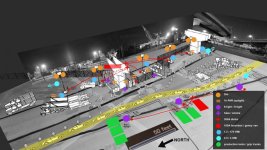
The key to our success was to move as little gear as possible so i placed all big lights and didn't move them for the rest of the night. The only units that were moved was slight panning of smaller HMIs and re-positioning of atmosphere (smoke and haze) - though in reflection i simply should have ordered a few more of those hazers/smokers.
As the set was over 300ft long we ended up using many practicals (the construction light towers) but in our pre-pro test we discovered that even though the towers are bright their bulbs flicker like crazy so we had to mount or own lights to the towers (2x 2k per tower). Significant part of the logistics was to figure out need to distro and cabling. We had 2 genny vans - one to power lights that would be visible in the frame and the other to power up the "fill" lights (3x 9-light). In the end the "in the frame" van was powering around 45,000w of lights/gear while the one providing fill was outputting around 30,000w.
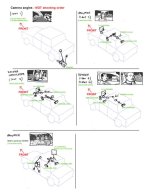
Another part of the approach was to simplify the car camera set-ups so that we could move speedily from one set-up to another. What helped us is removing the passenger front seat so that we could easily frame the child sitting behind the driver and then frame the medium profile of the driver. As for lighting, you might laugh to know that ALL in-car shots were lit with tiny LEDs (LitePanel Minis and 1x1s) powered by 400w car battery inverter. The lights were mounted on suction cups to the roof and sides of the car. Because the set-up was so minimal we didn't have to use car trailer thus we could easily and safely back up the car without a need to go around (as would be the case if we used a car tow).
To be honest, on the set we had so little time that there was ZERO room for creativity. What we had in storyboards - we got in the can and nothing else. The shoot, partly due to its size, was meticulously prepared and this was the only reason that we got what we needed in such a tiny amount of time. If you are in NYC in a month of so, you should see the spot playing everywhere around the city.
Fundamental problems we were facing is that we had to shoot a lot (12 camera set-ups) in a very finite amount of time (9pm to 5am - dictated by available night). On top of that, since we had a child actor we could only film with the child until midnight. Add to the fact that the filming takes place in a moving car and a number of large machinery was involved and you can appreciate the complexity of this endeavor.
We had to be very precise so this is one of the few times in my life where i ended up building a digital model of the space to figure out camera angles and gear position (it also helped in creating animatic for the client to see). The animatic was based on real life measurements of the location with Bing used as main source of the overhead map (their satellite image points STRAIGHT down) while Google was used to dance around in their 3d map space to confirm relative measurements. I'm not a techy guy so everything was hand drawn and scaled to fit the exact measurements in After Effects. The result was a charming virtual set that let me place the camera wherever i wanted to see angles and figure out potential problems. [You see an overhead shot of that set showing lighting and distro position].
The key to our success was to move as little gear as possible so i placed all big lights and didn't move them for the rest of the night. The only units that were moved was slight panning of smaller HMIs and re-positioning of atmosphere (smoke and haze) - though in reflection i simply should have ordered a few more of those hazers/smokers.
As the set was over 300ft long we ended up using many practicals (the construction light towers) but in our pre-pro test we discovered that even though the towers are bright their bulbs flicker like crazy so we had to mount or own lights to the towers (2x 2k per tower). Significant part of the logistics was to figure out need to distro and cabling. We had 2 genny vans - one to power lights that would be visible in the frame and the other to power up the "fill" lights (3x 9-light). In the end the "in the frame" van was powering around 45,000w of lights/gear while the one providing fill was outputting around 30,000w.
Another part of the approach was to simplify the car camera set-ups so that we could move speedily from one set-up to another. What helped us is removing the passenger front seat so that we could easily frame the child sitting behind the driver and then frame the medium profile of the driver. As for lighting, you might laugh to know that ALL in-car shots were lit with tiny LEDs (LitePanel Minis and 1x1s) powered by 400w car battery inverter. The lights were mounted on suction cups to the roof and sides of the car. Because the set-up was so minimal we didn't have to use car trailer thus we could easily and safely back up the car without a need to go around (as would be the case if we used a car tow).
To be honest, on the set we had so little time that there was ZERO room for creativity. What we had in storyboards - we got in the can and nothing else. The shoot, partly due to its size, was meticulously prepared and this was the only reason that we got what we needed in such a tiny amount of time. If you are in NYC in a month of so, you should see the spot playing everywhere around the city.


