How does DVX200 compare to Panasonic AG-UX180 4K Premium?

jeff9329

Well-known member
I know there is little info out on the AG-UX180 and 90 so far, but does anyone know the general differences?

I know the AG-UX180 has a 20X lens and the 90 has a 15X lens vs. the 14X on the DVX200. But what about the wide end?

Are the AG-UX cameras smaller?

If the DVX was smaller, and had PH mode 1080P30 I would have already bought it. Im still trying to replace a HMC-40 with something 4K instead of buying a 90.

Anyone have any info yet?
[h=1][/h]
 
Check out the NAB videos on YouTube. There's scant info, but it's clear that the 180 has more features than the 90 which is cheaper. The 180 has a 20x lens, no specs as of yet, and can shoot 60p, whereas the 90 has a 15x lens and shoots 30p. And the 1" sensors, obviously.
 
How much difference is there in the sensors (are they basically functionally equivalent)?

Which is bigger?

Which is the latest generation sensor?
 
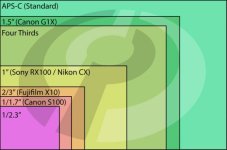
m4/3 will be much larger...

Sensor-Comparison-520x345.jpg

As far as generation... the 180 will be a newer sensor, but the DVX200 hasn't even been out a full year, so it's not by much.
 
If you plan to shoot UHD/60p the AG-DVX200 will only use roughly ~1" of the sensor and give you 37mm wide angle, so if you plan to use that particular mode I suspect the UX180 will have a much more practical lens. Other than that it's hard to say, better zoom range obviously but maybe also faster/better zooming for broadcast/run&gun? Since they're pushing 10 bit along with UHD it'd be really great if it offers any 10 bit recording modes, nobody said it will but nobody said it won't. Also for the AG-DVX200 they said less than $5000 and it ended up as $4200, so it could well be the UX180 will sell for closer to $3000 when all is said and done. I mean you have cameras like the HC-X1000 using a 1/2.3" chip so it's not like 1" is particularly small it's more the AG-DX200 being particularly large. I'm sure they've left some features to get PR during the actual launch too, not just at NAB.
 
I believe that at NAB, I heard Panasonic say that the DVX200 does not use the same sensor as the GH4. It's a different design.
Another difference between the UX180 and the DVX200 would include that I believe the UX180 cannot shoot DCI 4k.
 
Last edited:
I guess
The DVX200 uses the GH4's sensor which is a couple years old?
Absolutely not correct. The DVX200 does not use the GH4's sensor, it uses the next generation beyond the GH4's.

Very likey the newer camera will use the GH5's?
Again, most definitely not. The newer cameras use a 1" sensor, which is half the size of a four thirds sensor. At this point we have no idea if this is a brand new sensor or something else, but we do know that it's 1", not 4/3's.

The big benefit to using a smaller sensor is that the optics become easier to manufacture, and you can get longer zoom ranges from a comparable size hunk of glass (hence why, even though they're about the same size, the UX180 will have a 20x zoom and the DVX200 has a 13x). But at the same f-stop, the DVX200 will have notably shallower DOF. Which, again, is either a bonus or a detriment, depending on your intended use for the camera. For cinema work, the DVX200 would obviously be the better choice of the three. For deep-DOF handheld newsgathering or sports, maybe the 1" sensor and longer zoom range of the UX180 makes it the better choice. For budget-conscious, maybe the lower price of the UX90 makes it the better choice. The three models have a lot of similarities, but they are also different and they have different price points.
 
Last edited:
I believe that at NAB, I heard Panasonic say that the DVX200 does not use the same sensor as the GH4. It's a different design.
Another difference between the UX180 and the DVX200 would include that I believe the UX180 cannot shoot DCI 4k.
I don't remember what they said publicly about the UX180, but I did grill them on what the differences were and they told me a few things that let me understand the ordering of the cameras. As I recall it, I would say that these three (UX90, UX180, DVX200) are all members of the same family, and the DVX200 is the top dog in that group. They all share an extremely similar design, all will operate pretty much the same etc., the DVX200 costs the most and has the most features and has the biggest sensor; the others have most of the same feature set but there are differences in capabilities and price. Think of them like an updated trio like the AC130, AC160, and HPX250 -- except that instead of the HPX250/DVX200's differentiating factor being the recording media, this time it's the sensor size.
 
For deep-DOF handheld newsgathering or sports, maybe the 1" sensor and longer zoom range of the UX180 makes it the bette

Thanks for the info, Barry. I'm definitely looking forward to this for sports and stage work. It's a shame I can't do a dry-run at Diving Zones next week as it means I'll have to wait until next season, but in my mind (for my usecases at least), the DOF of the UX180 makes it superior to the DVX200. Particularly true if the UHD/60 winds up being usable for full-width stage views. Not sure I need a 20x zoom, as I won't likely be delivering UHD. If we get a usable 120fps HD, that's definitely of interest too. Hitting the water at 30mph means I can use all the time resolution a camera will deliver.....

sewolla -- the lit on the UX180 that I've read said it does support 4k/24, but I agree with Barry that if you're shooting cinema, you might be better off with a DVX200.
 
Found this:
http://panasonic.biz/sav/broch_bdf/ag-ux180_ux90.pdf

Some things I can make out: UX90 doesn't have Cinema 4K, but UX180 does. UX180 = 20x zoom lens, UX90 = 15x. UX180 is a "world cam" (NTSC/PAL), UX90 is NTSC-only, so UX90 does UHD at 24/30p, UX180 adds 25p, 50p and 60p. In HD, the UX90 is 24/30/60, the UX180 is 24/25/30/50/60. UX180 has vfr up to 120 fps, UX90 goes to 60fps. UX180 has the infrared recording mode, the UX90 doesn't. UX180 supports dual-codec recording and background recording, the UX90 doesn't. UX180 has SDI, UX90 doesn't. They also appear to have different viewfinders.
 
Back
Top