How do you no budget guys light your stuff?

deadby23

Active member
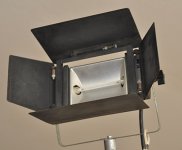
I fall into that category and i try and do what i can with a few work lights and a 500w par with barn doors. I try and use practicals as much as possible.

Post what cheap equiptment you use to light with, how you use them, and maybe some pics/videos of setups you have done in the past or are currently doing.

Also, post any videos/articles on ways to light scenes with no budget or using inexpensive lights.


In the lighting section they have a bunch of DIY and Low to No budget lighting solutions. Theres actually a sticky with all of the best articles in it. Heres the link

http://www.dvxuser.com/V6/showthread.php?48278-Lighting-for-beginners!-Tutorials-links-collection.
 
I went on ebay and bought a bunch of old, cheap, stage fresnels and put them on stands. Voila!
 
i don't know in what context you are asking the question but film making IS about $ (besides art, experience, etc). Thus true no-budget doesn't really apply to filmmaking. If you want to create images with light and tell stories (on no $) maybe you should pick-up painting, illustration or comics drawing?
 
One of my favorite no budget lights is the paper chinese lantern with a big, like 60watt or bigger high CRI CFL lamp in it. Makes a great softlight/fill light.
 
i don't know in what context you are asking the question but film making IS about $ (besides art, experience, etc). Thus true no-budget doesn't really apply to filmmaking. If you want to create images with light and tell stories (on no $) maybe you should pick-up painting, illustration or comics drawing?

I wouldn't say it's about money so much as time. Having money means you can get things done faster but the whole idea of DIY or "No Budget" is the hours you put in to make up for that. On a certain level, a light is a light. What makes a professional light worth its cost is the build quality (time saved not having to repair / replace it ) and ease of use ( you can quickly set up, break down, modify it etc. ). Give me a work light and some black wrap and I can get the same effect as an arri fresnel, it will just take me an hour and when the PA bumps it bringing the coffee it will take me another half an hour to fix it.

In answer to what I think the OP meant, you'd be surprised how close you can get just re-bulbing the practicals in an existing location. You can also make your own softboxes pretty cheaply with cfls and stuff from the hardware store. I do recommend you always have at least a small kit or pro lights on hand though because sometimes you need to be able to set something up quick and you'll appreciate the money you spent on those lights then.
 
That's just what djkarn said, $ can be substituted with time, but most no-budgeters don't think about the fact that time cost money. So vicious circle is repeated. If your no-budget short film takes 6 days to shoot rather that 2 if decent gear was used that means you spent 3x $. Now you are thinking, but this is no budget i don't spend any money which again is very common as most no-budgeters don't see the big picture (thus spending) and rather see the few $ that stayed today in their pocket.
 
I get where deadby is coming from - my son and his friend are constantly "borrowing" gear, and they've been very thankful for having useable stuff.

Here's my top cheapo suggestions:

Resign yourself to shooting a lot of tungsten. There's just not many affordable daylight solutions that deliver a lot of watts. 80 watt flo's in a china are nice & pretty, but in the grand scheme of things - it ain't much light. 500 - 1000 watts of tungsten per fixture is pretty useable. Having some decent kick gives you more choices, more ways to get what you imagine light-wise.

You really really need decent quality stands - that's the one thing you just can't DIY. Stands & knuckles. If you're in a decent sized town, you can get plenty of 1/2 or 5/6 stainless tubing for booming flags & scrims. Don't stick a fresnel on a lightweight boom though. You'll find that REALLY LEARNING to diffuse and flag lights is what will separate you from the pack.

Setup a saved search on ebay's continuous lighting category. Click the used button, set it for "ending soonest" and save the link. Check it daily. Also check "newest" and look for buy-it-now deals that have just posted that day. Learn a bit about wiring and grounding and you can rehab simple repairs. My most-used tungsten lights are theatrical fresnels and rectangular open-faced lights that I paid anywhere from $10 - $50 for. The light coming from them is light - they don't look like swanky Altman video lights, but they look like "real" gear and work like real gear.

If you buy a theatrical light with a pipe clamp, you can throw a stand adapter (a TVMP or "spud") on for $10 - $15; buy the Avenger model, it has a useable handgrip vs. the terrible bolt-thing on a matthews.

You can do tremendous things with open faced lights; relamp 'em for cheap, from 100 - 1000 watts; just don't buy anything that can't take a barndoor.

You can do beautiful work with a pile of fabrics - ripstop nylon or a similar sheer-ish white fabric; black felt; and unbleached muslin for bounce. It's cheap. get it in lengths of 3 yards and you can run it floor-to ceiling. With open faced units, you can make a 5' x 10' softbox for "real" soft light. Hang some black felt on either side to block spill if needed. You can make a 12 inch x 8 foot vertical striplight in minutes, one of the most useful things for moody looks. Takes a couple stands & knuckles and some metal tubing. 80% of shots where people have asked me "how did you get that soft, glowing, gorgeous light" use this technique. Check thrift stores for deals on large sheers and dark drapes - it generally doesn't have to be black if it blocks light.

Black foamcore with open faced units or fresnels can give you immense control over hardness of light edges - learn the effects that come from changing the light-to-flag distance, the flag-to-subject distance and the relationship of those three items. Just experiment with hardness of edges and shapes of washes on walls. Experiment with diffused light that's also flagged for things like mid shots and faces.

Get a couple 6" fresnels if you find them - great mix of utility and value.

Keep an eye out for affordable lamps for the fixtures you own, and keep lamping in mind. If you get a deal on a 7" open face that takes a certain size of lamp (in varying wattage levels), and you find another fixture that takes the same size lamp but is more costly - having to stock fewer bulbs is a time and money and hassle saver down the line. When shooting tungsten, being able to relamp at 100, 300, 750, or 1000 watts is an unbeatable creative tool.

The #1 tip I can give you is learn to make beautiful scenes with what you have. Everything you learn by experimenting with a couple lights will remain useful knowledge for your entire career. Learning to do killer light with a small kit will serve you well, even when there's a grip truck at your disposal. Study paintings, movie stills, photos and think of how you would replicate a look with what you have on hand.
 
i don't know in what context you are asking the question but film making IS about $ (besides art, experience, etc). Thus true no-budget doesn't really apply to filmmaking. If you want to create images with light and tell stories (on no $) maybe you should pick-up painting, illustration or comics drawing?


Plenty of no budget films launched very successful filmmakers. Like Christopher Nolan. For lighting, he used whatever was available -- lamps at home and sunlight -- for Following, which was brilliant. I didn't even care about the technicals anymore, because story and characters outweighs everything.
 
watch ebay and pick up some pro lights when deals are to be had. I recommend Lowell lights, they aren't the best in the world, but they do their job and you can find single omnis/totas on ebay for cheap cheap. Pick up a few and like the last post, learn how to manipulate them.
 
deadby, always consider finding someone local who is producing high quality shots on a budget, go along to his shoot and see how he's doing it. Learning from others is a good place to start.
 
watch ebay and pick up some pro lights when deals are to be had. I recommend Lowell lights, they aren't the best in the world, but they do their job and you can find single omnis/totas on ebay for cheap cheap. Pick up a few and like the last post, learn how to manipulate them.

I'm not a big fan of the Totas - they're usually overpriced (they're overpriced new) and the barn doors are just **barely** barn doors; there are a lot of them used though. On the other hand, my rectangular open faced lights get a lot of use - they take the same bulb range as totas but you can get much more control. They show up from time to time, I got this one for $15:
DSC_0018.jpg
 
JetBlack, you are not Christopher Nolan, so lets stop the delusion. 99.9% of filmmakers need $$ to make anything half-decent.

Your words are always encouraging.


Noel Evens said:
deadby, always consider finding someone local who is producing high quality shots on a budget, go along to his shoot and see how he's doing it. Learning from others is a good place to start.

A very good tip. This is how I learned most of what I know - try to work on the sets of those who know more than you and absorb as much as you can. If you can't work there, at least volunteer or try to bear witness to the goings on.

I had my first television shoot yesterday as camera operator. I learned more in twelve hours than I did in three weeks of school. And I wasn't paid for the job; it was more or less a volunteer position. Cue segue into knowing the right people thread...
 
JetBlack, you are not Christopher Nolan, so lets stop the delusion. 99.9% of filmmakers need $$ to make anything half-decent.

I don't think that's the point of OP's question. Also, no budget is an expression that usually means very small budget. I think it's valid to ask about cheap ways to light, because they exist: foam core, shower curtain diffusion, etc. Should you give up filmmaking because you can't afford it?
 
JetBlack, you are not Christopher Nolan, so lets stop the delusion.

It's arrogant rudeness like this -- totally uncalled for -- that has turned me off this place. I really get tired of having to slog through this kind of demeaning, insulting stuff while trying to go through a thread that might have some useful information in it.
 
Back
Top