How do other filmmakers develop so much confidence in themselves?

Mate direct all you want. Its a fun hobby and a good job for a few. If you are shooting a feature using lots of your own or anothers money it will be more likely to profit if you employ an experienced director.

Im hired by a developing director. He has done 10 years in TV and is begining to square up for narrative fiction - he not ace but I can assure he has some chops.

Well I could just produce a first feature, but I was also advised not to do this, because they said that it's not wise to put it all in the hands of another director entirely, if that's true also.
 
Im sure there are a million routes but to a feature I would say there are two basics..

have a concept, get it funded and hire professionals in all roles

build yourself, through shorts, commercials, practice, intenet youtube watching, until you can do it all yourself
 
Well I could just produce a first feature, but I was also advised not to do this, because they said that it's not wise to put it all in the hands of another director entirely, if that's true also.

as producer you hire fire the director.


---

while im delineating roles.. many/most producers directors are pretty clued up and have lugged stuff on set, most have a good concept of every role from 'what is too much BG noise' to that will cross the line' and most important a grasp of the sublty or not of performance. Not to mention knowing the price of sandwhiches, coffee, Cstands, ALea and locations.
 
Im sure there are a million routes but to a feature I would say there are two basics..

have a concept, get it funded and hire professionals in all roles

build yourself, through shorts, commercials, practice, intenet youtube watching, until you can do it all yourself

Sam, there are a number of big filmmakers who self-financed microbudget features that they shot themselves. (Kubrick, Tarantino, Nolan) and they didn't always work up to it with smaller projects. It varies
 
Im sure there are a million routes but to a feature I would say there are two basics..

have a concept, get it funded and hire professionals in all roles

build yourself, through shorts, commercials, practice, intenet youtube watching, until you can do it all yourself

Oh okay, well I thought that men trying to do it all myself in previous projects was the problem and I was trying to bite off more than I can chew. So wouldn't the solution logically be to hire other help in other departments, so I don't have to do everything myself, and thus not biting off more than I can chew?
 
One of these days I'll make a bogus account and troll the members of DVXuser into a 10 page topic. That is, if that's not what I already just did.


Oh okay, well I thought that men trying to do it all myself in previous projects was the problem and I was trying to bite off more than I can chew. So wouldn't the solution logically be to hire other help in other departments, so I don't have to do everything myself, and thus not biting off more than I can chew?

You can't make a perfect film with a microbudget. But you can't get a budget to hire crew without making a microbudget film. The goal is not to make a perfect film, it's to show your storytelling skills and the ability to manage such a large project.

You will have to bite off more than you can chew. Try to manage it by prepping extensively and working harder and smarter. Being a good manager is part of the challenge.

If you can get friends or colleagues to assist you as a favor, that would be a tremendous help.

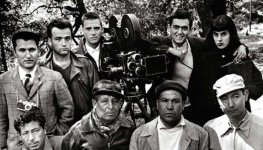
On Kubrick's first movie, he was the director/DP. Besides the actors, he hired a few Mexican migrant farm workers to haul his equipment. His girlfriend helped with continuity. His other friend took Production stills. That was it. It was a bad movie, but a step along his journey.

Here's his crew. Notice that he's the only one smiling (he was an a--hole):
skfear.jpg
 
Sam, there are a number of big filmmakers who self-financed microbudget features that they shot themselves. (Kubrick, Tarantino, Nolan) and they didn't always work up to it with smaller projects. It varies

Of course there are, some pure genius some from families with very deep pockets some just irresponsible gamblers that won. Do you hear of the irresponsible gamblers that lost?

--


As for selling screenplays.. (wiki)

'He began his career as an independent filmmaker with the release of Reservoir Dogs in 1992, which was funded by money from the sale of his screenplay True Romance "
 
Oh okay, well I thought that meant trying to do it all myself in previous projects was the problem and I was trying to bite off more than I can chew. So wouldn't the solution logically be to hire other help in other departments, so I don't have to do everything myself, and thus not biting off more than I can chew?

By doing it all yourself I mean be handy with a boom, know how many GB/mins will fill a card, how long that card will take to DIT, what t1.4 means to a focus puller, how to hire and release a location. Learn to do these things.. but dont do them all on your feature, just check up that you are not being overcharged by the people you are paying to do them. Learn realistic expectations.

Remember you can do small projects yourself, and do them well, my suggestion is to start with a film - "how to make a coffee". Do make stuff where you bite off more than you can chew.

You would work up from self shooting to getting a chum with a mic or a camaera and then some acting talent.
 
'He began his career as an independent filmmaker with the release of Reservoir Dogs in 1992, which was funded by money from the sale of his screenplay True Romance "

Wrong

"Tarantino co-wrote and directed his first movie, My Best Friend's Birthday, in 1987. The film was left uncompleted, but its screenplay later formed the basis for True Romance.[20]"

Same wikipedia's page. If memory serves me, he shot it on weekends while he worked at a movie rental store. He said it was bad but he learned a lot.

Re: gamblers who lost. Yes, Ryan will probably not succeed. Those are the odds. I'm just telling him how others have done it. Nobody is a "genius" until they make their move and others recognize them. Kubrick started with loans from his pharmacist uncle or something. Not tons of money. Shane Carruth made Primer for $7k as mentioned
 
FWIW, I don't think the OP is trolling. It's the same situation as with Ironpony (it might even be the same guy!). Ironpony used to do the exact same thing, it's very similar to the child's game "why", and it's open ended never closed - "why can't we land on the sun?" "because it's hot!" "why is it hot?" "because of nuclear reactions" "why are there nuclear reactions?" and so on. There never is a "final" answer, it's a prelude to the next question - in that sense it's like those early machines that were trying to pass the Turing Test. The idea is that the machine reaches full AI status if a human can't tell that they're talking to a machine rather than a human - the way they used to do it is by the machine taking the last answer the human gave and turning it into a question, that way imitating "real intelligence", even if it's just a trick - "I'm sad" "Why are you sad, Jim?" "Because I lost my job" "Why did you lose your job?" and so on, and Jim is fooled into thinking it's a real human at the other end.

Regardless, Ironpony was not trolling, even if it seemed that way - I remember Barry finally getting super irritated because he thought that IP was trolling, and so he ultimately banned him. But the truth is, IP was just along the spectrum, and that's how a lot of them talk. This particular condition unfortunately does not predispose folks to success in professions where people skills are central. Directing relies a great deal on people skills - hence odds of success super low for those without such skills. Completely incidentally, there's a decent (not a masterpiece) film about a person on the spectrum The Night Clerk (2020). The main actor is brilliant in that role (and really, it's the best reason to watch it). Folks like that can still be successful in technical capacities on the set - being the DIT person, sound etc. - but directing, sadly is not one of them. Of course, that's just my take of what's going on, and I'm sure opinions differ, but again, FWIW, I don't think the OP is trolling. But neither should you expect the converation to go anywhere in this "Turing Test" simulation :) - the OP will learn nothing, but that doesn't mean the discussion might not be interesting for other reasons - because the question of "confidence" is interesting in the world of artists. So enjoy it for what it is!
 
Last edited:
I think Kubrick was along the spectrum. (Part of the reason his character development/directing of actors/general empathy was weaker than the rest of his skills). It's a spectrum, after all. Many famous directors may have been on it. There are advantages and disadvantages. But I agree with your point that the people skill part can be a disadvantage.
 
Wrong

"Tarantino co-wrote and directed his first movie, My Best Friend's Birthday, in 1987. The film was left uncompleted, but its screenplay later formed the basis for True Romance.[20]"

Same wikipedia's page. If memory serves me, he shot it on weekends while he worked at a movie rental store. He said it was bad but he learned a lot.

Re: gamblers who lost. Yes, Ryan will probably not succeed. Those are the odds. I'm just telling him how others have done it. Nobody is a "genius" until they make their move and others recognize them. Kubrick started with loans from his pharmacist uncle or something. Not tons of money. Shane Carruth made Primer for $7k as mentioned

Im sure im wrong.. I just know that there is a system and I think it starts with 'optioning' a story.

The only good film Ive (not) been involved in got optioned. Im sure it will be shot not by me but by a proper crew up from London with their 3 alexa minis and a truck or three + 20 non camera people. (its a sweet british tale - not an SFX monster)

Ive done little bit of day playing grip on these 'proper' films.

That is 80% or more of the home page of Amazon or 95% of whats on the cinema when its open.

That 20% (or less) is of course there for the taking by privateer using guile or money they made working in the city.
 
Well said Oldcorpse! I think you are right. And that makes these threads not less interesting. I enjoyed some of the answers.
 
By doing it all yourself I mean be handy with a boom, know how many GB/mins will fill a card, how long that card will take to DIT, what t1.4 means to a focus puller, how to hire and release a location. Learn to do these things.. but dont do them all on your feature, just check up that you are not being overcharged by the people you are paying to do them. Learn realistic expectations.

Remember you can do small projects yourself, and do them well, my suggestion is to start with a film - "how to make a coffee". Do make stuff where you bite off more than you can chew.

You would work up from self shooting to getting a chum with a mic or a camaera and then some acting talent.

Oh okay well I've made short films where I bit off more than I could chew but I thought from learning from that now, that what to do instead, was to hire people to help with bigger projects. I just don't feel I could do every task in every department. I thought hiring a DP for example would be an enormous benefit to learning the whole cinematography craft, compared to someone who is specialized in it. Plus a lot of directors hire separate DPs, so I thought it was reasonable practice of course. And I thought co-directing might help as well for a first one, but some others say don't do it.
 
I think Kubrick was along the spectrum. (Part of the reason his character development/directing of actors/general empathy was weaker than the rest of his skills). It's a spectrum, after all. Many famous directors may have been on it. There are advantages and disadvantages. But I agree with your point that the people skill part can be a disadvantage.

I've heard Kubrick speak and he doesn't strike me as being on the spectrum. Wes Anderson is possibly. Spielberg is thought to have some Aspergers / Savant-like traits. Some have diagnosed David Lynch as being on the spectrum, which I can see.
 
Last edited:
I've heard Kubrick speak and he doesn't strike me as being on the spectrum. Wes Anderson is possibly. Spielberg is thought to have some Aspergers / Savant-like traits. Some have diagnosed David Lynch as being on the spectrum, which I can see.

Well it's a spectrum, and probably 2-dimensional not 1-dimensional. Some book suggesting he was on the spectrum:

"He is described as having poor social skills, obsessive interests, literal thinking, and a lot of inflexibility, all of which are telltale signs of autism."

And his indifference to fashion and usually wearing the same thing every day:

"Kubrick dressed simply, wearing the same style clothes every day: beat chinos, a basic blue work shirt, a ripstop cotton fatigue jacket with many pockets, and a pair of well-worn running shoes. "Many producers and actors thought he dressed like a beatnik", notes Herr,[13]:14–15 and his wife thought his baggy trousers made him look like a "balloon vendor." His meals were also simple, "he has no time to waste," writes Ciment.[7]:41"

I think he was autistic like I think Zuckerberg is autistic, if that makes sense
 
Back
Top