How big a difference does a polarizer make?

DavidBeier

Veteran
I was doing some test footage at a small horse farm. It was near the end of the day everything had that gorgeous rim lighting I'm so fond of. I did some telephoto shots of the horses and the grass as well as some long shots. The telaphoto stuff was some of the best stuff I've shot with the HVX200 thus far but I was surprised how soft my long shots were. I realize that the HVX isn't as sharp in wide angle it is in zoomed in but the difference in clarity and detail was quite pronounced (with such angular lighting I was expecting a lot more detail on the tall grass). I don't know if, having the detail coring turned on to +6 might have done it (perhas it thought the grass) was noise but I'm definatly not happy with the results.

Anyway, Barry recently said that a polarizer can make a big difference in landscape stuff so I'm wondering if anyone with a polarizer would mind doing some comparison shots so I know if it's work the extra $300. Anything else anyone could recommmend for getting more detail in wide landscape shots would be appreciated.
 
Ok, here's the thing with polarizers. The greatest zone of polarization is like 90 degrees from the sun. So, if you point your finger and thumb like a gun, your index finger points towards the sun and where your thumb points is where the greatest band of polarization is.

So, in order to get the most out of a polarizer, the sun needs to be pretty much overhead. Well, for landscape shooting that's about the worst place for it to be.
You need shadows to give things depth. With no depth, everything looks flat.

I try to shoot all my landscape stuff in the first and last hour of sunlight. There's a reason why it's called magic hour. There's no need for a polarizer.

However, if you have to be out in midday shooting, a polarizer does make the best of a bad situation. It'll saturate your colors and remove some of the glare and reflections.

I do carry a 4X4 polarizer in my bag. I use it quite a bit on streams and things like that to remove the reflections to show the river rock below etc.

I've yet to really use it on a landscape shot as I never shoot past magic hour for anything serious.

Course, now if bigfoot or something came trotting by, I suppose I'd make an exception. :)
 
Kevin,

You have given a world of excellent advice in this post. That kind of understanding goes leaps and bounds beyond getting more of an improvement out of your shots than most of the technical capabilities of the cameras themselves could ever do. I too have been a follower of scoping out landscapes and shooting at magic hour. Another thing to add is that stormy weather can also be a huge benifit in the lighting and ambiance of landscapes as well as going out in the magic hour.
 
It's true that polarizers work best when the light is 90 degrees away from where you're pointing the camera. But this doesn't necessarily mean it works best at noon time. It can work well any time you have lighting from the side.

Using the gun example, point your index finger at your subject and your thumb straight up. Your thumb is pointing at a light source 90 degrees away from your subject. Now keep your index finger pointing at your subject and rotate your wrist left and right. Your thumb just pointed at all the places that the light source can be 90 degrees from your subject.
 
A polarizer cuts down on glare. Glare kills your image. Polarizers do wonders for shooting leaves and grass, but only if you're being hit by glare.

Kevin is the master of beautiful landscapes, but I wouldn't say that a polarizer is only useful at noon... remember that it's an entire band of effectiveness. A polarizer will start "working" as soon as the sun comes up, and continue as long as there's sunlight. You just have to be at 90 degrees to it. So if the sun's due west, you can get the polarizer's effect by shooting due north or due south. If the sun's directly overhead then you get the effect in any direction. So you have more freedom with a polarizer at noon, but you can still use it at any time, you just would be more restricted in your shots.

The main problem with using a polarizer is that it only works in certain directions and you need to be aware of that or you'll get inconsistent photography. If the sun is low on the horizon and you execute a circular pan, you'll go through zones where the polarizer is most effective and then you'll continue panning through zones where the polarizer has no effect at all, and then on to areas where it has most effectiveness. That will make your skies inconsistent. So you have to know how it works, and when it works, and where it works, to get the most effectiveness out of it. And if you do that it can be a tremendous help, especially on anything that's reflective (such as shiny grass and shiny leaves).
 
Ok, if polarization wasn't my problem then what do you guys think it might be? I WAS shooting in magic hour and was really shocked at the lack of detail I got in the grass in my wide open shots. Compared to the close ups I got of the horse, I'd swear they came from two different cameras (or at least two different output resolutions). What can I do to get some more detail when shooting landscapes? Do you think the detail coring might have hurt the image since the blades of grass might have been taken for noise?
 
Well, I never said that the polarizer was only useful at noon. :)

Another thing I hate about polarizers on wide shots is if you get part of the greatest band of polarization and part that is less. You end up with a sky in one corner almost black and the other a pale blue. It drives me nuts. :)

Can you post some pics of the shots you're talking about?

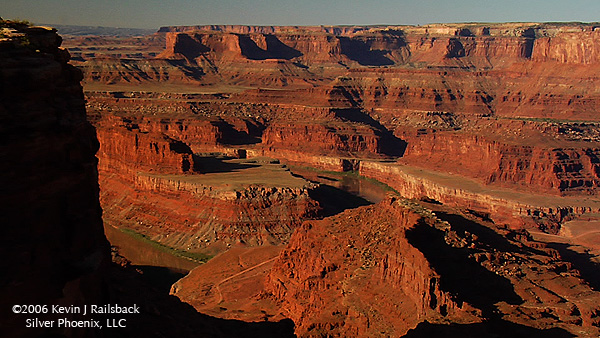
Here's a shot taken at Dead Horse Point in Utah with the HVX

point.jpeg


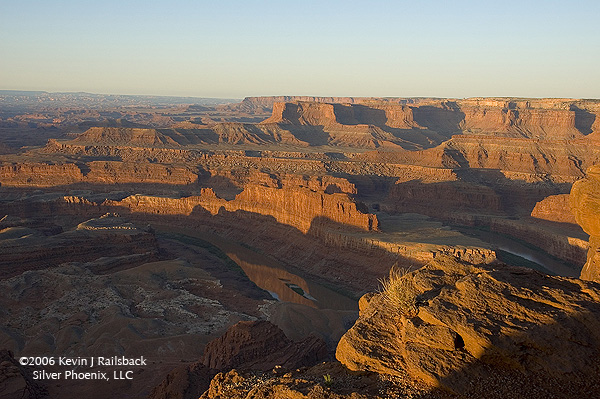
Here's a shot from a little different vantage point taken just a little earlier with a Nikon 6.1 digital camera.
point2.jpeg


Yeah, the Nikon is sharper but gee, it oughta be.
On a HDTV the footage of Dead Horse Point looks killer.

All I know is after I got back and showed my folks, they went out and bought a42" plasma HDTV. Every time I come to visit, they ask if I can bring some footage with me to play on the TV. :)

Some people think the HVX is a little to soft for their tastes when it comes to small objects objects in the frame which in allot of cases landscapes are just that.

Sure, the HVX has limitations, everything does. But without seeing the images you're talking about, it's hard to tell if you've reached those limitations or if it's something else.
 
For landscapes, I use detail +4, vert 0, color +2, coring 0, master ped -3. I wouldnt do detail coring higher than +2 ever. It softens the image too much for me.
 
Out of curiosity, why exactly do most people set the detail up but not the v detail? Also, how exactly does the detail coring reduce the noise? I mean, it must be different than upping the detail or the two would just cancel each other out. I realize I'm asking a lot of questions that are probably somewhat rudimentary but I'm still waiting for Jan to put up the website so I can get Barry's book (I know it'll be soon but I'm in the process of shooting something now and would appreciate any advice you guys can give).

Anyway, here are some of the shots I'm talking about. JPEG of course hurts the image a bit:

Sunset.jpg


landscape1.jpg


landscape2.jpg
 
Like I said, I realize the image will be softer in wide but, compared to the close ups the difference just seems real extreme:

goldengrass.jpg


horse.jpg


The detail I see on the horse, individual hairs and all, just seems in a different league than the rest.

What can I do to make things look better when I'm in wide? Thanks.
 
In the two ones right at sunset, it was at infinity. The othe one was on the grass between the post and the fence.
 
Don't recall exactly. I believe I had both in camera ND filters on and it set to open. Zoom was one stop up from wide open.
 
Interesting... this looks like a shot that was taken with the Fstop at F11 or higher. Once you get in that area stuff gets soft on ANY 1/3" CCD camera. I use detail coring to cover noise when I am in CineD and/or in low light. I set it at zero if there is enough light, I surely wouldnt have it at +6 if you had to use ND filters and such.

The HVX, like many other cams, does not have a setting that is good for everything. It must be situationally adjusted. Next time you are shooting with plenty of light, no gain, etc. turn that coring down to zero and see if that helps... I bet it will...


ash =o)
 
Appreciate the advice Ash. I'm confused though. I was always under the impression that the more closed the iris was, the sharper your focus is. Whenever trying to get deeper focus in telaphoto (yes, I like deep focus and will never use a 35mm adapter), I was told to try to use F11 or higher if possible. Does this make it softer when you are wide instead of telaphoto?
 
This is where the 1/3" CCD comes in. Your understanding is in general correct but the small CCD size is an exception to this rule. The wider you are, the more it is masked but closing down the iris on smaller chipped cameras can definitely create softness. The XL2 will go to 20X and on the long end of that lens you start getting softness at F8...


ash =o)
 
Back
Top