FS7: Horrible chromatic aberration. What is causing it?

Vikash

New member
We have been filming on the set up below since the FS7 Mark I was released:

FS7 Mark I
Tamron 24-70 VC IS 2.8
Metabones Speedbooster Ultra T

We have recently been noticing really bad chromatic aberration. We are really confused what is causing it. In this exact same set-up we hardly noticed it before but now it's just so noticeable in many shots that are backlit.

We did many tests. We put the lens on a 5D which caused no real issues. We used a normal metabones adapter and we saw it a little bit. Then we put on the speedbooster and it showed up bad and green. We are just really confused. Could this be the lens (it was dropped and repaired at some point). Or could this be the speed booster? Why would it only start happening recently?

I have attached screen shots. The shot with the woman and the car is using the speed booster. You can see really bad CA around the car and in the tree.


Picture 1.jpgPicture 2.jpgCA.jpg
 
I guess you need to do some simple science.. test the options..

The lens on another camera - 5d shooting raw stills - perfect

The camera with another lens - a good sharp lens like the middle of a 50mm at 5.6 or 8

The with/out the booster.

Also try the camera in Log as your non log (I guess) profile might be doing bad things.

---

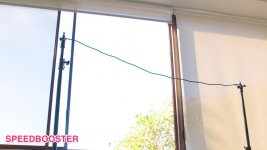
Looking at the wire in front of the blind we cannot see the lens doing anything funky.

S
 
Welcome to the world of cheap optics Vikash. Any cheap lens thrown into such extreme contrast situations is going to break down. Hell some $14,000 Ultraprimes will exhibit a bit of CA like that if you push them that far.
 
First questions I would ask since the shot compositions and exposure look similar on the first shot of wire :
What was your f stop on each shot and what was the lens focal length on the zoom since both of those elements would affect CA.
Next question would be:
What are you focused on ? Normally I would expect to see some CA in this contrasty situation with virtually any still photo lens and I would expect it to change from green to magenta on either side of the exact focus point ( I forget whether green is in front or behind the focus point.) as you change that focus point the CA will get better, worse or may disappear entirely.

Lastly - Just looking at these comparisons I don't see that much difference between the speed booster shot and the non speed booster shots. The CA is worse on the speedbooster but there are other variables present (f stop, mm, focus point, etc) which may also affect the amount of CA.

The bottom line is axial or longitudinal CA is present in virtually ever still photo lens . Its worse at wide open f stops and high contrast edges.. Lowering the contrast even with your setup might help it. However you may be correct that Speedbooster can exacerbate it. I have seen red and blue CA with a Canon 24-105 coupled with speedbooster that was so bad I sold the lens. I also own that tamron and this makes me want to do some tests with and without speedbooster. Frankly you're scaring me.

Lenny Levy
 
I haven't tested extremely careful though I guess I ought to, but i've never seen any CA except once sand that was with speed booster and a 24-105. In that case I think speed booster probably exacerbated CA that is already in the lens, so that doesn't mean its causing it. However that was a different type of CA (blue Red) that tends to happen on the edges of the lens . With speed booster you're seeing more of the weakest parts of any lens. I'm no expert about lenses though so take anything i said with a grain of salt. I use speed booster often though along with many other friends and no one I know has noticed any problems.
 
I haven't tested extremely careful though I guess I ought to, but i've never seen any CA except once sand that was with speed booster and a 24-105. In that case I think speed booster probably exacerbated CA that is already in the lens, so that doesn't mean its causing it. However that was a different type of CA (blue Red) that tends to happen on the edges of the lens . With speed booster you're seeing more of the weakest parts of any lens. I'm no expert about lenses though so take anything i said with a grain of salt. I use speed booster often though along with many other friends and no one I know has noticed any problems.

What can you expect when you add a lens element which is not specifically corrected for specific lens but instead meant to work with all lenses? If you understand optics then of course chromatic aberration is the answer. That's why with some lenses it is mild, with some severe. Technically speaking, the truth is that even a simple UV filter introduces some CA, yes it is so minor that in most cases it does not matter, but in scientific photography it is always considered.
 
The lenses may or not be bad but I'm so suprised how posters are not proponents of basic testing.

The fs7 is loaded with edge errors in the wrong situations and or profiles.

Some form of rational test is the only way forward.
 
I have seen this problem with canon l series zoom as well, the 24-105 especially. Blaming this on tamron is too quick a judgement. Lets start by using another lens?
 
Tamron lenses are soooooooooo bad with CA. Just get rid of them and get either native E-Mount glass or get Canon's L series zooms.

There's good and bad advice here. Tamron lenses in my experience are varied, and the 24-70 VC (my copy at least) exhibited little/no CA under almost all conditions. The Canon 24-105 is one of the worst offenders I've ever encountered however.

That said, having just upgraded the Tamron to the new Fuji 18-55 MK, I can safely say that this lens (minus SB obviously), is a WORLD apart from all the still lenses I've used thus far.

If you can, then I'd say pick one up. You won't regret it!

J
 
One of the big differences in general between still and genuine cine lenses is CA. In my admittedly limited experience virtually all still lenses display axial ( green magenta) CA and from what I've seen many cine lenses don't. I remember seeing this just comparing my modern ZF Zeiss primes with quite old Zeiss standard primes. At NAB I asked a Zeiss rep about it and he confirmed its just really expensive to correct for CA and since still photographers can do it in post its not a priority. I haven't looked at that many cine lenses to test them though. Zeiss rep also commented that it tends to be worse in very sharp fast lenses e.g. Zeiss 35mm ZF 1.4 is much worse than a Zeiss ZF f2 lens.
 
There are three elements in this equation, camera, booster, lens.

DXO gives 6UM of CA to this tamron and also to the zeiss 55mm prime

https://www.dxomark.com/Lenses/Comp...on-on-Nikon-D800E__884_483_1086_1009_1242_814


The lens is simple to test on a different sensor (the OP owns a canon stills camera) - I just dont see why no rational testing is occuring rather than just assuming that a cheap brand is bad.

(as it happens the cheap brand is bad.. it only resolves 15mp which is way less than something like a zeiss.. but still way more than the FS7!)
 
The notion that a lens has to be bad to begin with to exhibit CA when used with speed booster, and claim that relation between its performance when not speedboosted and speedboosted is somehow predictable is just wrong. It is a simple matter of coincidental match or lack of it when a lens is paired with a speed booster. An otherwise excellent lens can perform horribly with speed booster while a mediocre / poor lens may appear to remain relatively unaffected by the addition of speed booster, it's a complete hit or miss. Matching of individual lens elements and/or lens groups is a big part of lens manufacturing and quality control. Even within one batch of lenses the particular lens groups are carefully individually matched, they are not freely interchangeable within the entire batch. That's why for example trying to swap elements in a broken lens with the ones coming from a "donor" lens usually gives bad results.
 
Last edited:
Those images are way overexposed for a start so it's not possible to determine whether what you're seeing is a real CA or an in camera effect due to ringing or aliasing in the image processing under extreme contrast i.e. it's a mathematical issue caused by rounding errors or simplification as an 'end effect'.

The FS7 is significantly better at handling extremes of contrast in CineEi than in Custom mode but nowhere does the OP say which mode was used. We also don't know what codec was used so we don't know what colour sampling or bit depth or even what gamma curve was used, rec709, HG or SLog2/3??

Without more than the paucity of information made available no one can determine what exactly is being seen in those images so the thread will go round and round blaming Tamron and not blaming Tamron. If anyone is really interested in getting to the bottom of the issue you need to ask for more information and use a bit of scientific method to separate real lens aberrations from image processing aberrations.

The FS7 Mk1 is a £7k and expecting it to be flawless when the operator presents it with horrendously over exposed images or invented situations that would rarely be encountered in practice is a pointless exercise. In the 18 months I had the FS7 I encountered a pink fringe around a high contrast edge once, this was in Custom Mode SLog3 but in CineEI this was gone. The FS7 can be helped along with a decent bit of diffusion to to clean up a bit of moire in 4k but if you insist on pointing the camera at an open window with the aperture wide open all bets are off.

I really don't think it's worth blaming the Tamron or Speedbooster until you can replicate the so called CA with properly exposed images.
 
Back
Top