
Navigation
Install the app
How to install the app on iOS
Follow along with the video below to see how to install our site as a web app on your home screen.
Note: This feature may not be available in some browsers.
More options
You are using an out of date browser. It may not display this or other websites correctly.
You should upgrade or use an alternative browser.
You should upgrade or use an alternative browser.
Hollywood ... as in, the end of ....
- Thread starter DLD
- Start date
It can, if it wants to, because its market cap is around one trillion. With a "t". The question, however, is Amazon's long term plans. So far, it hasn't been quite as aggressive as Netflix.
PS. OK, so I failed to mention Amazon as a 'big player" in the streaming world. I still hold a grudge against it for the stove top oven that failed to work out of the box back in 2005.
PS. OK, so I failed to mention Amazon as a 'big player" in the streaming world. I still hold a grudge against it for the stove top oven that failed to work out of the box back in 2005.
I saw Dunkirk in 70mm in San Diego while on a trip recently. First time I have been in a theater in about a year so it wouldn't be appealing to me. Hollywood is putting out very few stories that interest me.
You made it through Dunkirk? I walked out after 50 minutes. It was loud and boring. But the new at-home-type full recliner seats were excellent.

Batutta
Major Contributor
You made it through Dunkirk? I walked out after 50 minutes. It was loud and boring.
So goddman LOUD. The bass in the TCL Chinese theater was so intense it gave me a headache.

puredrifting
Major Contributor
So goddman LOUD. The bass in the TCL Chinese theater was so intense it gave me a headache.
it was loud where I saw it in San Diego but at least it was clean and not distorted loud. Supposedly Nolan has screening instructions that it should be played at xx dB floor but I don't know if that's true, I read it in one of the articles. As far as boring, I didn't find it too boring but I am a history fanatic and I love that the entire film hardly had any dialog and almost no exposition. I didn't think it was great, but I thought it was good and I felt that technically, knowing how much of it was done in camera and with optical effects, not digital moving Photoshop, gave me a good appreciation of it.
http://www.latimes.com/business/hollywood/
As Hollywood wraps up the all-important summer box-office season this Labor Day weekend, a sobering reality has gripped the industry. The number of tickets sold in the United States and Canada this summer is projected to fall to the lowest level in a quarter-century.
More good news for Hollywood - http://variety.com/2017/film/news/b...lose-encounters-labor-day-weekend-1202546346/
Slowest Labor day weekend in about two decades.
Slowest Labor day weekend in about two decades.
Oh, it's far worse than that. Look at the "tickets sold" numbers.
http://www.the-numbers.com/market/
http://www.the-numbers.com/market/
In the 1930's the attendance numbers/tix sold were huge. Then WWII, then TV began to squeeze down the movie business.That chart is too zoomed in. I'd like to see one that goes back to 1930 or 1940. Then we can see the decline that Hollywood has successfully thrived in for decades.
http://www.businessinsider.com/movie-attendance-over-the-years-2015-1
Yes, I've seen that one, but I was hoping to see one going to at least 2015. The online internet did get significant traffic until the last few years. That chart looks like a flat line for 47 years (because it doesn't have enough vertical resolution) and the other one, which zooms into 95 to present makes it look like a dramatic decline. Neither give the full picture and their combined information isn't clear. There were likely several ups/downs in the last 50 years, but the big chart doesn't have enough resolution to show it.
Ok, the data going back to 1980 shows that ticket sales have actually risen by 8% since 1980 but declined since 2002. That's what I like about data. It can be very deceiving, depending on how you view it. If you look at 1980 ticket sales and compare to 2016, you get a rosy picture. If you compare 2002 and 2016, it looks bad.
Last edited:
For statistical purposes, one has to take out the standard deviation anyway. The box office, including the attendance, will have ups and downs and that can depend on a number of factors, from the economy to the quality of the films shown, etc. Trying to detect trends ain't easy.
PS. For me, online video took off around 2007 when I found the "Irony of Fate" on YouTube in glorious 240p.
In 1980, the US had a population of ~ 226 million. Now, it's around 320. The demos should give a ~ 45% increase in tix sold over this time frame.
PS. For me, online video took off around 2007 when I found the "Irony of Fate" on YouTube in glorious 240p.
Ok, the data going back to 1980 shows that ticket sales have actually risen by 8% since 1980. That's what I like about data. It can be very deceiving, depending on how you view it.
In 1980, the US had a population of ~ 226 million. Now, it's around 320. The demos should give a ~ 45% increase in tix sold over this time frame.
...In 1980, the US had a population of ~ 226 million. Now, it's around 320. The demos should give a ~ 45% increase in tix sold over this time frame.
Yes, excellent. We could look at per-capita ticket sales instead of total sales to get the per person interest in going to the movies. That would look more depressed.

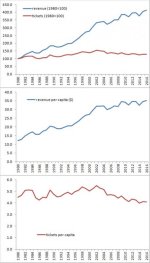
While the US car and light truck sales are far more dependent on the general economic conditions, here's that chart -
http://www.macrotrends.net/1372/auto-and-light-truck-sales-historical-chart
An average car price in 1980 was ~ $7,000 and is ~ $35,000 now or five times greater. An average movie ticket was $2.69 compared to $8.84 now or 3.3 times greater.
http://www.macrotrends.net/1372/auto-and-light-truck-sales-historical-chart
An average car price in 1980 was ~ $7,000 and is ~ $35,000 now or five times greater. An average movie ticket was $2.69 compared to $8.84 now or 3.3 times greater.
A Hollywood exec would reply that Netflix and Amazon - to say nothing of HBO, Showtime, BBC, Canal+, etc. - are acting as de facto film studios and their totals should be taken into account.
And he would have a point.
Of course, that plays into the end of old Hollywood too.
And he would have a point.
Of course, that plays into the end of old Hollywood too.