High power LED light for video?

As I'm sure you're aware that lumens from an LED spec and foot candles from a lighting fixture have no relation at all. The math may be correct in converting between the two but it does not have anything to do with the observed brightness of the light in a real world situation. Lumens when used to describe the power of an LED refer to the light power directly on the LED die without the influence of lenses, reflectors and the fixture it's placed in. Foot candle or lux values on the other hand measure the actual brightness of the light generated from the fixture. Lumens have no place in evaluating the output of a video production lighting system aka- a fixture. LED lenses probably have the greatest impact on LED brightness specs. In a test I ran at NAB 2011 A Creamsource LED Doppio Mini 1x1 panel with a power draw of 240watts put out over 4700 foot candles at 1 meter...serious brightness able to compete with a 1k tungsten open face fixture. More LED tests at www.thecolouroflight.com.

I agree that a single 100watt LED die is no match for an 800watt tungsten fixture, and large LED dies pretty much have horrible colour specs and really are intended for streetlights not film sets. The Cree LEd is sweet and the new Luxeon Rebel LEDs have exceeded 135l/w but again at the cost of colour quality only managing a 60CRI (but CRI is bunk lies for LEDs anyways).
 
Chris, can you point me where I can do some reading on the points you are making just above, about LED output intensity and CRI? If it's on your excellent website I missed it, thanks.

And, I confess I haven't been following along. How, exactly, did you measure the output at NAB? How good is the AMPAS article on LEDs?
 
Last edited:
"Lumens have no place in evaluating the output of a video production lighting system aka- a fixture"

Yes, I am fully aware of that fact, but most videographers/shooters/cameramen in general do not seem quite to understand the brightness levels given as lumens or luxes. To complicate the matter, manufacturers do not even have a standard yardstick of measurement. Some rate the lux at 5 feet and others rate it at 2 feet and 8 feet distances. Standard should be at the 3 feet ( 1 meter mark) and even with a standard lux@3ft. implemented, how does that relate to perceived brightness ? We are all used to the brightness of a 100 watt haligen, a 750 watt halogen and a 40 watt halogen on-camera light. But in reality those watt figures relate to the power consumed by the light and NOT realted at all to any brightness level. As a rule of thumb we assume that a 200 W halogen is twice as bright as a 100 halogen, but not necessarily so as different materials used for bulb diffusion and filament characteristics vary with make. So now the only way to see the real world brightness of a led light is either to borrow, purchase or test one in the flesh. Specs alone do not convey the full picture, as as many manufacturers are overly exaggerating the specs. by a wide margin. A real good way to universally measure the light ( and this is my idea ) is to take an incident light reading in the EV (equivalent light) scale. That way any EV value can be easily converted to FC (footcandles) Lumens or Lux values. If the EV value is not on the meter scale, then a simple ASA 100 at 3 feet incident at say 1/30 sec. and read off the aperture value, which can easily be converted to EV. Better yet, a LUX meter. Saying a 1000led unit is equivalent to a 500W halogen yet consumes 40 watts is real horse s**t.

"(but CRI is bunk lies for LEDs anyways)."

Leds do come in High CRI's ( Nichia, Cree offerings) as well as many others. As a matter of fact I do have a video light with a CRI of 90 @ 2800K consuming 18 watts and as bright as a 75 W halogen.
 
We've been asking for (and are beginning to see) spot / flood type Fresnel-like fixtures. The Light Source's fixture is very exciting because of the shape of the beam, but it is, for the moment, a flood only.

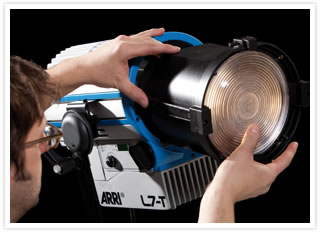
Erik, you need look no further than the new LED Fresnel Arri was showing at NAB this April. In my opinion Arri has finally engineered in their new 200W L7 LED Fresnel a fixture that combines the cool-burning, energy-efficient advantages of LED illumination with the controllable versatility of traditional Fresnel fixtures.

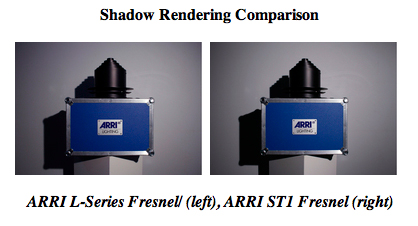
Arri_LED_Shadow_Comp.jpg

As you can see in the pictures above, that compare the output of an L7 Fresnel to an Arri ST-1 Quartz Fresnel, the L7 Fresnel has clear and defined shadow rendering capability like that of the ST-1 Quartz Fresnel. And, as the pictures below demonstrate, the L7 Fresnel has a spot to flood range similar to that of the ST-1 Quartz Fresnel and excellent field homogeneity in both flood and spot.


Arri_LED_L-Series.jpg

​

And, just like the ST-1 Quartz Fresnel (pictured below), the beam of the L7 Fresnel (pictured above) is easily controlled with barndoors - enabling the light to be precisely cut to set pieces and talent (see far right photos above & below.) And, given the discernable amount of light the L-Series Fresnel prototypes threw in a show demonstration video from IBEC last fall, on what appears to be a 6x6 Ultrabounce rigged 20’ overhead, and under the high ambient light levels of the show hall, it seems the production model L7 Fresnel has more than enough output to waste some to diffusion and color gel if one so desires (a shortcoming to most LED panels is that they have barely enough.)


Arri_LED_ST-1.jpg

​

The L7 line of LED Fresnels introduced at NAB consists of three models: the L7-D, L7-T and L7-C. All share the same basic housing and the same 7" Fresnel lens, and all have output comparable in intensity to a conventional 1K Fresnel. They differ in terms of color temperature, with the D model outputting a daylight-equivalent 5600 K, the T model a tungsten-equivalent 3200 K, and the top-of-the-range C model offering total color control. In my opinion, the Arri L7s finally deliver the true-to-life color rendition, previously achievable only with full-spectrum tungsten sources. By color blending with a multi-emitter LED engine, the L7 is able to overcome the generally poor color rendering capabilities of other LED fixtures. Both the 3200 K and 5600 K color temperature models offer a CRI and CQS greater than 90 so skin tones, costumes and scenery will finally appear life-like under LED light.

The L7-C’s fully tuneable white light can be adjusted for different skin tones, camera sensors and mixed-light environments, while specific color shades can be matched through full gamut color mixing. Unlike other LED fixtures, this level of color control does not involve compromising the quality of the light field: the L-Series is unique in combining uniform light and single shadow rendition with absolute control of color attributes.


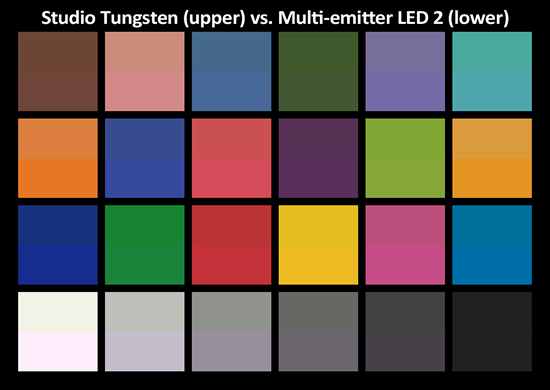
Arri_L7_Macbeth_Chart.jpg


Split Macbeth chart: each color patch shows the visible effects of studio tungsten light in the top half of the patch, and a representative multi-emitter LED lighting instrument in the bottom half. Note: this is not the L7 but results typical of the multi-emitter LED approach ​

An added benefit to using a color blending multi-emitter LED engine is that the L7’s firmware can calibrate the blend of different color emitters to compensate for the inevitable color shift of the LEDs with age. This approach assures consistent realistic color rendition throughout the fixture’s life.

There are two alternative cooling systems: one passive and the other active. The passive cooling system was designed for broadcast studios. It incorporates no moving parts or fans and is therefore completely silent. The active cooling system was designed to provide a more compact and lightweight option for location work. It uses an extremely quiet (<20 dB) fan and weighs 10lbs less than the studio version.


ArriL7_Active_Cooling.jpg

​

The location fixture carries an IP54 rating for weather resistance which means that it is protected from falling rain and splashing water, and that the internal electronics, optics and LEDs are protected from dust, dirt and humidity – making it a very robust fixture that will stand up to the rigors of location production.


ArriL7_watertest.jpg

​

All the L7s feature Power Factor Correction with a near unity Power Factor of .91. Which means that the 200W fixtures will draw no more than 1.98A at 120V (220W) and cause virtually no Harmonic Distortion. Since it creates virtually no line noise, you will be able to power nine 200W L7s on the 20A circuit of a portable generator without a problem. And since the L7-T has an output comparable to a 1k Quartz Fresnel, and the L7-D has an output comparable to a 575W HMI Fresnel, the L7 series takes what you can do with a portable generator to a new level. For example, with the enhanced 7500W output of our modified Honda EU6500is, you will be able to operate a lighting package consisting of a 30 L7s. I think you would have to agree that is an incredible step-up in production capability.


ArriL7_upgrade.jpg

​

At a price around $2’800, the L7s are one of the more expensive LED fixtures at NAB. But, to assure that they are not quickly rendered obsolete by the rapid advances being made in LED chip efficiency, Arri has designed them to be an expansible platform that can incorporate future developments in LED technology. Not only, do the heads allow for the incorporation of more efficient LED chips when they become available, but the light engine is also fully upgradeable, ensuring that the fixtures can take advantage of technology advances as they happen. To accommodate future control protocols (such as ANC), their firmware is also upgradeable through the USB port on the rear of each unit. They will also be compatible with planned future optic accessories that will expand the L-Series versatility. Able to incorporate future developments in LED technology, the expansible platform of the L7s ensures that they will have a long useable life and so will assure a return on investment in them. Given the rapid pace of LED chip development, I can’t think of another LED fixture that won’t be obsolete in a year or two.

With the same clear and defined shadow rendering, excellent field homogeneity, and smooth continuous flood to spot focus as a 1kw Quarts Fresnel, these first production models of the L-Series LED Fresnels may well be the first true LED Fresnel lights (use this link for more details.) For more detailed information on the Power Quality generated by LED power supplies and to see a demonstration video of the new Arri L-Series LED Fresnels, use this link to an article I wrote for our company newsletter on the use of portable generators in motion picture lighting. In it I cover some of the basic electrical engineering principles behind LED drivers, the harmonic distortion they can generate, and how it can adversely affect generators. The article and the demonstration video are available online at http://www.screenlightandgrip.com/html/emailnewsletter_generators.html.

Guy Holt, Gaffer, ScreenLight & Grip, Lightng & Grip Rental in Boston
 
We like these fixtures very much. I suspected the Fresnel fixtures would be good based upon the LoCaster product Arri brought to market.
 
How good is the AMPAS article on LEDs?

The AMPAS series is great, some serious players and techniques are involved. I met briefly with the chair of the AMPAS LED project at NAB and got some great information about their activities and its significance to the LED film lighting business. I will be posting some followup later in the month as I hope to have a conference call with thier tech people regarding their research.
 
"Lumens have no place in evaluating the output of a video production lighting system aka- a fixture"

Yes, I am fully aware of that fact, but most videographers/shooters/cameramen in general do not seem quite to understand the brightness levels given as lumens or luxes. To complicate the matter, manufacturers do not even have a standard yardstick of measurement. Some rate the lux at 5 feet and others rate it at 2 feet and 8 feet distances. Standard should be at the 3 feet ( 1 meter mark) and even with a standard lux@3ft. implemented, how does that relate to perceived brightness ? We are all used to the brightness of a 100 watt haligen, a 750 watt halogen and a 40 watt halogen on-camera light. But in reality those watt figures relate to the power consumed by the light and NOT realted at all to any brightness level. As a rule of thumb we assume that a 200 W halogen is twice as bright as a 100 halogen, but not necessarily so as different materials used for bulb diffusion and filament characteristics vary with make. So now the only way to see the real world brightness of a led light is either to borrow, purchase or test one in the flesh. Specs alone do not convey the full picture, as as many manufacturers are overly exaggerating the specs. by a wide margin. A real good way to universally measure the light ( and this is my idea ) is to take an incident light reading in the EV (equivalent light) scale. That way any EV value can be easily converted to FC (footcandles) Lumens or Lux values. If the EV value is not on the meter scale, then a simple ASA 100 at 3 feet incident at say 1/30 sec. and read off the aperture value, which can easily be converted to EV. Better yet, a LUX meter. Saying a 1000led unit is equivalent to a 500W halogen yet consumes 40 watts is real horse s**t.

"(but CRI is bunk lies for LEDs anyways)."

Leds do come in High CRI's ( Nichia, Cree offerings) as well as many others. As a matter of fact I do have a video light with a CRI of 90 @ 2800K consuming 18 watts and as bright as a 75 W halogen.

I couldn't agree with you more! The lack of testing standards is a big issue. I really like your suggestion, I never considered using the EV scale but as soon as I can find an hour I'm gonna see if I can get my head around a testing routine.

As for CRI my comments are more aimed at the fact that it is impossible to measure CRI for a discontinuous spectrum device like an LED. I'm deep into an article about this that will see the light of day soon to fully explian my position. Currently manufacturers rely on the CRI ratings as it was all that was available until recently but it is so rought with problems it is all but useless for LED produts.
 
I wrote an article on the subject of lumens vs. lux in LEDs over 2 years ago at the introduction of our LED line, you can see them here:

Lux and Foot Candles vs. Lumens

http://www.coollights.biz/wordpress/archives/72

Basically anything with a beam (like an LED or collection of LEDs) should be considered a fixture and should be measured only with a light meter in lux or footcandles to truly understand its output against other fixtures. Anything that's just a raw bulb with nothing but 360 degree radiation of light around it and no fixture should and can be measure in lumens (with an integrating sphere). A simple LED by itself (like the common 5mm LED used in many video/film fixtures today) is not a bulb but is a fixture and produces a beam not true 360 degree radiation around it. Comparing an LED to a bulb with lumen specs is apples and oranges and doesn't give a hint of the true efficiency of LEDs.

An article on CRI in LEDs as well:

http://www.coollights.biz/wordpress/archives/199

We talked about the color meter issue recently in these places as well:

http://www.dvinfo.net/forum/photon-management/493324-color-meter-weirdness.html

http://reduser.net/forum/showthread.php?56556-Color-Meter-Weirdness

Color meters may not be able to read sources with correlated color temperature (discontinuous) but an integrating sphere and its peripheral gear can calculate CRI and color temperature fine (among other parameters) for LEDs. Its what any competent LED manufacturer or lighting manufacturer would use for bulbs as well as LEDs.
 
Last edited:
Color meters may not be able to read sources with correlated color temperature (discontinuous) but an integrating sphere and its peripheral gear can calculate CRI and color temperature fine (among other parameters) for LEDs. Its what any competent LED manufacturer or lighting manufacturer would use for bulbs as well as LEDs.
Hi Richard, this is fun stuff, thanks for sharing. I understand why a pocket color meter struggles with discontinuous sources but I don't follow your other two comments. I haven't seen the output from sensing and electronics used in an integrating sphere but I don't see how the output of a spectroradiometer can give you either CCT or CRI from spiky sources since both are subjectively determined by humans by visual comparison to reference colors. I can see that the output, the spectral power distribution curves, could be processed in a computer program that could approximate what humans would come up with but that's about it. What am I missing?
 
Maybe that's the method that a committee decided upon at some point and some end users use with a color chart to determine those things because they don't have anything else that's practical to use and carry around; but there has been test equipment to determine it for many years now. This equipment takes the better part of a fair sized room and uses the methods specified by said committees to make its determinations. I'm sure this equipment will shrink in size over time, but you'll still need a good chamber to test in to make it accurate and repeatable. So even when we have the pocket meter that can do it, you aren't going to be walking around NAB, with the metal halide lights on the ceiling, making accurate determinations of any kind.

So, we use this equipment because it simply wouldn't be repeatable or accurate to have a human reading a chart for trying to calculate CCT and CRI in a factory environment. We need automation, consistency and repeatability in those environments. As far as I know, the spectroradiograph part of the machine is used in making the CCT determination as I understand it. Other parts of the machine are used to compare some number of color samples (10 colors I believe) under an ideal and calibrated continuous (real black body type measured in CT) source (like a tungsten lamp) with the source under test after we've determined the CCT. For more details about this process you'd need to contact the test equipment manufacturer as that's their main business and charter and will know more details about the inner workings than any of us will.

I don't see anything in my experience that tells me the CRI we get from the sphere peripheral read out is wrong and we get spectral analysis, lumen output, CCT and CIE coordinates as a bonus. High CRI sources (like good quality flo bulbs) that have been measured and verified as such by this type of equipment give fine results in color rendering in real live, non-laboratory settings or even with charts if that's your thing. As LEDs and the phosphors people use in them evolve they will follow the same path flos have to better CRI. I have a sample 5mm panel using such phosphors but it does make the LEDs very expensive until the price of these rare earth phosphors for LEDs come down like the ones for flo bulbs did over time. Thus I'm not sure about the ultimate marketability for now. CRI with that panel is great, test results with chart are great and results in real world photography as well. For now though its just for the lab until the price is affordable.
 
Last edited:
Leds are getting better in huge leaps and bounds this year, as demonstrated by leading led mfrs.
It was only a few years ago that a led with 30 lumens per watt was a big thing and came only in the blue tint variety. Since then, leds have been proven ( in lab tests) to surpass the assumed theoretical limit of 200 lumens per watt and just a few days ago this week Cree has claimed a 231 lumens per watt figure ( not yet commercially available) led. I am sure that in the following months there will be a breakthrough to realize a single die led with a high CRI that will have the equivalent 100W household bulb drawing 12W or less at an attractive price. Leds for photography/video applications with high efficiency and CRI will surely soon follow at lowered prices as things usually go.. In mass producing leds for domestic use, the end consumer cost must be attractive in order for the masses to seriously consider the changeover especially in this economy.
Pro led units for studio/film production on the other hand are special application lights that must have quality/output consistency/controls/light quality and reliability hence the current high prices.
Leds will surely replace all existing filaments in the not too distant future. Just as the large TV flat panel LCD that is in everyone's house nowadays was unaffordable less than 6 years ago, no one
thought at that time a 47 inch one can be had today for under $500 , and prices are still dropping because of mass production and consumer acceptance due to the lower prices. Make them affordable (not cheaply made) and they will come.
 
Your right Richard, without a doubt the integrating sphere is the king of light characterization. I spent a pile of time with a manufacturer of test equipment learning how their gear works to characterize LEDs and flos and they openly admit that CRI calculations (which are now a software calculation) do not properly represent the real world situation of LEDs and colour rendering. My comments belittling CRI is about my belief that CRI is a flawed metric, a belief that is gaining wide spread acceptance these days, but until a new system-whatever it may be-is adopted as an industry standard then we will all continue to talk about CRI values.

I think for video or digital aquisition the issues are significantly different than they are for celluloid film and until a convergence of these two mediums occurs in respect to lighting colour quality the industry will continue its search for the perfect light.
 
There would be an effective difference in CRI for film and digital. Since spikes are exaggerated in film and it is not a WYSIWIG or immediate medium at all like digital then spikes are a much bigger issue for film. White balance capabilties in digital make up for these spikes for the most part. In addition digital is more modeled after human perception as much as possible and that is part of why it is more WYSIWIG.

I don't spend much time thinking about real film and its needs as my main market is people using digital mediums and this board and others like it are primarily designed around digital mediums without which we wouldn't even have boards like this. The needs of real film market are already being catered to as far as I can tell and it is a very small market with entrenched vendors for all parts of it from lighting to the cameras used. They already know what they need to use to get the results they want including with lighting (both lighting meant for film use and practical lighting as well).

Everyday people would hardly be talking about renting a Panavision camera and lenses for the weekend, then taking the 35mm magazine in to develop and color time, then digitize, edit and put on youtube. As I said, there would be no dvxuser, dvinfo.net, reduser, youtube, vimeo, etc. without digital mediums and the ease of use they engender and the community they have allowed to happen as a result that can share their work and art in a very immediate fashion. Real film and its needs are therefore not an issue for us at Cool Lights (because that market is too small and too entrenched as I said) and I personally don't think it has a wide and far reaching future but others are free to disagree.
 
Whom would you consider an entrenched LED vendor for the film industy? Just curious or were you refering to traditional tungsten/hmi fixtures?
 
Chris and Richard, maybe I can google this but who are the manufacturers of the systems for characterizing CCT and CRI that you are talking about. I like chewing on the techie stuff and want to look into those products some. TNX.
 
Given that these same companies would also serve the larger market using digital mediums, I don't think its in my charter to enumerate who my competitors are, that's for them to do for themselves and they are already well known. I will say that many people involved in real film production love tungsten and won't give that up any more than they would want to give up real film--that's fine and they have the freedom hopefully to continue doing it the way they want. When the discontinuous type sources do penetrate that market, there are the usual suspect suppliers that are present. Given that the end users of this equipment are really not much more than corporate employees of these big film projects, its highly unlikely they will choose brands other than what they already know about--many of the same companies that take them out to lunch, etc. That's not going to change much over time and the phrase "no one ever got fired for buying IBM", applies in a similar way to this environment just with different vendor names. That always referred to the fact that corporate employees don't go out on a limb, but take the safe route in specification of equipment. What's the incentive to do it differently?

I also do find it amusing that people post that link over and over to the "Academy" study and all its references to how this lighting behaves on Kodak stock. Most of the people posting that link may never have even used real film or understand the differences. In this report, they don't even really talk about the fact that the behavior with digital mediums is quite different in many cases. Therefore the real issue is that CRI as it is today is meant for digital mediums and human perception and has nothing to do with film which is not even close to human perception and has to be specifically engineered both in production and post production to give us an experience close to what we expect. What they need therefore is their own index for their specialized world and all vendors that want to participate in being known for "film lighting" could use said index; but there is absolutely no need to tear down the current index used in commercial lighting as well as any lighting used for digital mediums.

Back to your question, it would also be fun to see who was helping with this study behind the scenes, perhaps some of the same companies of the entrenched market I spoke of. But that kind of thing would never happen would it.
 
Last edited:
Back
Top