Help with boxy/muddy sounding voice

aram

Well-known member
Hello there. Mostly a lurker here but from just lurking I have learned quite a bit and was hoping I could get some help (my skin is not tough enough for jwsound even though I lurk there too).

I recorded this with a Tascam DR10 CS and a Rode Lav.

https://drive.google.com/file/d/1iOova4ELA2QpKAqACcmaDft-ZSBLTC_A/view?usp=sharing


I have been processing it up and down and around and I cannot get rid of a certain boxiness that the sound has. The best I managed was cutting a bit at about 240, 360 and 520 Hz and then a serious cut at around 1KHz where there's a constant noise, then adding a a gentle rise at about 120Hz and 2KHz, but it still has that annoying boxy sound.

Any advice on how to process it so that it sound clearer?
 
Hi Aram,

Here's a quick sample on how I process audio: Dingo version of Boxiness

Here are the basic steps I took using the MAGIX Sound Forge audio editor...

1- Increased the volume by +6 dB ( your audio was too quiet )

2- Used paragraphic EQ to boost and cut specific frequencies over a 2.5 octave scale. Here's a screen grab of the SF PEQ control panel...

Dingo_Boxiness.jpg

So I'm cutting off frequencies lower than 80 Hz ( with many recordings it's all noise below 80 Hz ), next I'm boosting frequencies at 150 Hz by 4.4 dB ( I do this by ear, as every person's voice is different ), next I'm boosting frequencies at 300 Hz by 1.2 dB, next I'm cutting frequencies at 800 Hz by 9.1 dB ( this is where most voices can sound very flat ), lastly I'm boosting frequencies at 8,000 Hz by 8.5 dB. ( this is because your mic doesn't seem to be very sensitive in the higher range, so boosting this will add some clarity to your voice )

3- Used a compressor to keep all waveform peaks after the EQ to -6 dB or lower. ( -6 dB is good for general audio playback )

4- I used spectral noise reduction to lower the hiss in the background. ( properly matched mics and recorders won't have much hiss when recording in a quiet room )

Is this closer to the audio sound you were after ?
 
Last edited:
I recorded this with a Tascam DR10 CS and a Rode Lav.

Where did you place the lav relative to the speaker's mouth? The sound is severely rolled off on the top end, which could be placement, particularly if the lav is hidden under clothing. The rolled off higher frequencies effects the consonants, and above that the "air", which may be why you think it sounds boxy.
 
Thanks for the help, guys. The lav was clipped to the neck of my t-shirt. Maybe it should have been placed further down?

Dingo, I checked your version. Thank you so much for having a go. It definitely sounds clearer which I like, but I also think there is a harshness to the higher frequencies that I don't personally like.

dingo.jpg

original.jpg

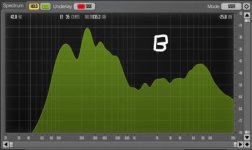
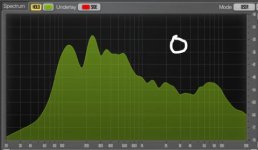
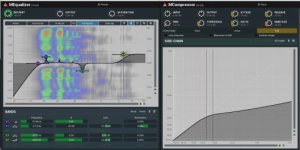
I can see the difference in the spectrum both in SPAN (see pictures O for original and B for Dingo's version) and in the sonogram in MEqualizer and there's clearly a lot more energy in the higher frequencies in yours. Gonna try what you did, but not boost as much at 8KHz and see how that goes.
 
Dingo, I checked your version. Thank you so much for having a go. It definitely sounds clearer which I like, but I also think there is a harshness to the higher frequencies that I don't personally like.

That's because I am applying ( somewhat crudely ) a huge amount of gain at 8,000 Hz. Properly recorded you shouldn't have to add gain like this.

I've gone through seven different LAV mics over the past 10+ years, and for the past few years I've standardized on the Oscar Sound Tech OST-801 and OST-802 mics. They are a clone of the TRAM TR50 mic ( I also own a TRAM TR50 too ) but to me they sound better, especially in the upper range. The OST mics are also less than half the cost of the TRAM mics. ( about $90-100 depending on the configuration )

My favorite LAV mic that I own is the Sanken COS-11D, which sounds a lot like a condenser mic, but it picks up everything in the room, so I can only use it in very quiet environments. ( the OST mics have a neat trick where you place them facing their vampire-clip, so that only audio is picked up from above the mic, and this is a big help when recording in noisy environments )
 
Thanks for the advice on microphones, Dingo. Maybe when I move house I'll order one of the OSTs I've been curious about them for years.

I reproduced most of your recommended settings (slightly modified to what sounded better to me) but made the high shelf only +5.5db and I think it is not too terrible now!

Only I am hearing some slight reverberations from the room that I did not hear before and they irritate me! Better stop now, while I am still sane.

If anyone wants to check (and more advice is always welcome), I made the modified files available below and you can see the settings I ended up using in the EQ and compressor.

https://drive.google.com/drive/folders/14-0_hByvnVh1VCO7VFe0ho7unZJ7hJL6?usp=sharing

Almost final Boxiness Post.jpg
 
Thanks for the help, guys. The lav was clipped to the neck of my t-shirt. Maybe it should have been placed further down?

.
Rode Lavs are a pretty dull sounding mic in my experience. I think they are a pretty neutral sounding mic, but they do nothing to add clarity to voices in normal lav hiding situations. Be prepared to add some higher end. Also, a mic at the neck rarely sounds natural. This is especially true if the mic is under the chin and pressed against the larynx. It sounds a bit like this is a placement issue.
 
My favorite LAV mic that I own is the Sanken COS-11D, which sounds a lot like a condenser mic

Not altogether surprising since, like any lav, it is a condenser! So not quite sure what you mean. It is, like most (surely all?) lav mics, a pre-polarized/electret condenser, but electrets need not sound any different/or worse than an externally polarized (aka 'true') condenser: for high-quality non-lav electrets we have, for example, all DPA's range of SDC mics (the 4006, 4011 etc.)

Sorry for the slighty off-topic aside!

Cheers,

Roland
 
Unless I'm being thick - in the good old days, we'd have fixed this simply by turning up the treble - not faffing around with parametric or graphics - it's a bit dull, so turn the treble up - that would be fine for me!
 
Not altogether surprising since, like any lav, it is a condenser!

I think of pencil mics and shotgun mics as condenser mics. Most LAV mics don't sound like either of these type of mics, but the Sanken COS-11D does. I haven't used a DPA lav but I would expect similar sound to the Sanken.
 
Unless I'm being thick - in the good old days, we'd have fixed this simply by turning up the treble - not faffing around with parametric or graphics - it's a bit dull, so turn the treble up - that would be fine for me!

Most TVs, computers, and boardroom sound systems don't have easy accessible treble controls during playback. Users pretty much never adjust these controls, they will just think your audio sounds bad.
 
Also, a mic at the neck rarely sounds natural. This is especially true if the mic is under the chin and pressed against the larynx. It sounds a bit like this is a placement issue.

This is a honest surprise to me. One of the things I have heard about really often is placing the mic in the knot of a tie, which is pretty much the same place where it was.

Honest question: would the middle of the chest be better?

I can imagine the chin won't be blocking as much sound, but also, I have heard about that causing "boominess" issues because of chest "reverberations" (in case it is not obvious, I am not a native speaker, so beware of my double quotes, god knows if I am getting what I mean right)
 
The OST 801's presence boost is good for hiding under clothing and such. Out in the open it can be a bit harsh, and I've experienced annoying artifacts with sibilant voices through a Sennheiser 100 series (companders). Otherwise both are good mics for the low price. The OST TL 40 is another good affordable mic (end fire, round, 4x7 mm) and has a flatter response than the 801/2.
 
The OST TL 40 is another good affordable mic (end fire, round, 4x7 mm) and has a flatter response than the 801/2.

I bought two of these lavs, but they sounded very noisy with my Sennheiser G3 UHF packs. OST 801 / 802 lavs did not have this problem.
 
This is a honest surprise to me. One of the things I have heard about really often is placing the mic in the knot of a tie, which is pretty much the same place where it was.

Honest question: would the middle of the chest be better?

For interviews, if I don't want the lav seen I clip it in-between the buttons of the interviewee's shirt, with the top layer of the shirt fabric covering the lav. As long as the shirt material is not too transparent, you won't see the mic hiding underneath. ( I aim for sternum height on their chest ) If they are wearing a jacket I hide it just under the front of their jacket, which sometimes puts it off to the side, which still sounds pretty good. If the person is a squirmer I put small rolls of tape on either side of the lav to stop fabric from rubbing on the lav.
 
I'll second the OST 801, best lav value on the market. Sankens and a few others (DPA) actually sound better. For around $500.00. The OSTs are under $100.00 and sound 90% as good to my ears.

Based on your sample, you possibly recorded way too low level, which kills your S/N ratio because when you have to add so much gain to normalize, you are radically amplifying the noise floor too. Don't do that or you'll continue to have bad audio, levels mean a lot with audio. The Boxiness seems to be an artifact that probably wouldn't have been as prominent if you'd recorded yourself at higher levels.

Optimal placement for lavs, when possible, is on or near the breastbone or thereabouts (Clavicle?), center chest. Hair mics, shirt collars, tie knots, etc. are sub-optimal locations although a lot of hair mics are used for theater and they can sound okay but live sound is different than recording for picture. As far as how to mount a lav, after decades of messing around with everything you guys are talking about, I think the solution is to use the Rycote Overcovers with the OST801's lav element placed outward through the Overcover's fuzzy with the back to the sticky panel. It's rare I find a product that is so clearly superior to ALL of it's competition but the Overcovers simply are. Apply to inside of shirt or blouse and you are golden. No hiding in ties, shirt collars, vampire clips, wig tape, gaffer tape triangles, cable strain relief (at least with the OST 801s, very littel cable noise unlike my Countryman B6). The presence boost on the 801 compensates nicely for being placed under clothing, you never see any vampire clips, tie clips and most importantly, no noise, no rubbing, no accidently sticking talent or them sticking themselves with the vampire teeth. Bottom line, for me, these have made recording sound for picture about 60% easier than it ever was, because they are usper easy to pre-prep, rig and mount onto talent.

You know how when you have talent hard wire lav'd (if you're smart and don't use wireless for interviews!) and at the end of an interview, talent leaps up and runs off before you have a chance to un-mic them? Then they get caught when the XLR cable gets taught to the lavs power supply, which may be clipped to them or just sitting on the floor. When that happens, best case scenario is a vampire clip with bent pins (if you're using one) and worst cast, the mic stays attached to the vampire clip and the actual mic element gets ripped off the cable (both have happened to me, lost a relatively expensive Tram TR50 when the head was ripped off, got it repaired, then it happened again. Learned that a Tram, once the head has been ripped off the cable can only be repaired once. Ouch.). With the Overcovers, the mic simply detaches from their short or blouse, no tweaked, expensive vampire clip, no lav with the head ripped off of it, it will just slide out from underneath their shirt or blouse (if that's where you exited their clothing when rigging them?)

Been using nothing but the Overcovers for two years now and haven't lost a single moment due to rubbing or handling noise with lavs. Killer wind protection on your lavs too, it's like putting a softie on your lav but it's hidden under clothing. The ONLY place I will still revert to a vampire clip is if talent is going to be wet, in the rain, sweating a lot like athletes, the moisture mitigates the stickiness and the overcover can fall off the talent's shirt or blouse. So if you're a masochist and like getting frustrated with mounting lavs, like getting wildly inconsistent sound, like messing with Vampire clips, tie clips, wig tape, etc. go sick. As for me, Rycote Overcovers are revolutionary and simply are the superior way to mount lav mics for most "normal" situations. You do have to keep buying them as they are semi disposable (the stickies are
a one shot deal, but I can generally extend the life of the fuzzies for around half a dozen interviews or scenes). I like that the fuzzies come in white, black and gray, let's them NOT show through semi-opaque white shirts, etc.

So it's simple. You can do things the traditional, difficult way. Or you can make your life better and easier and use the Overcovers.
 
Last edited:
This is a honest surprise to me. One of the things I have heard about really often is placing the mic in the knot of a tie, which is pretty much the same place where it was.

Honest question: would the middle of the chest be better?

The optimum placement for a lav tends to be around the middle of the sternum for both men and women. Higher placement tends to get the chin shadow you're experiencing. Some voices/bodies can get away with this, most won't.

[When I say "lav" I mean an omni lav, just to be clear. I don't own or have any use for a direction lav mic. Just sayin'.] You are using an omni, yes?

That's not to say that non-optimal placements aren't done -- they are done all the time. Sigh... I'd just rather go for a better capture and less work in post when I can. And that said, the middle of the sternum might not be the optimum place for you personally. For what I'm hearing from your sample, I suggest that you do some tests starting at the middle of the sternum and pushing off-center toward one arm or the other. This might get your mic some more exposure to your nose, depending on how you are sitting/standing and turning your head. Which could be helpful or not -- which is why you need to test to find out.

And I'll throw in my vote too for the Oscar Soundtech 802s. I've got a pair that I use for interview work (visible, not hidden). Perhaps the best bargain in audio.
 
Last edited:
OK, notes taken.

-Buy an OST and see how that goes.
-No more on the collar, if possible always sternum with the overcovers (I actually bought 12 after seeing you recommend them in some other thread. They should give you commission)
-Increase level.

I have just checked and the track peaks at about -9dbs and is generally at about -12dbs when I am talking. I remember reading somewhere that for dialogue peaks at -6dbs were a pretty good level, so I did not feel like the recording was that quiet. I also recorded using 24 bits of resolution, which my understanding is that it allows pulling up quite a bit without too much trouble. Here is the loudness analysis from SWS in Reaper for those who want to see those units.
Capture.jpg

Bearing those two facts in mind, I have two questions:

-What is a good level if peaks at -9dbs is too quiet?


-Should I risk increasing the gain to reach those -6dbs peaks while recording? (with the crappy limiters in the DR10, it seems very risky)
 
Back
Top